 DAVID PEEL
Washington Square
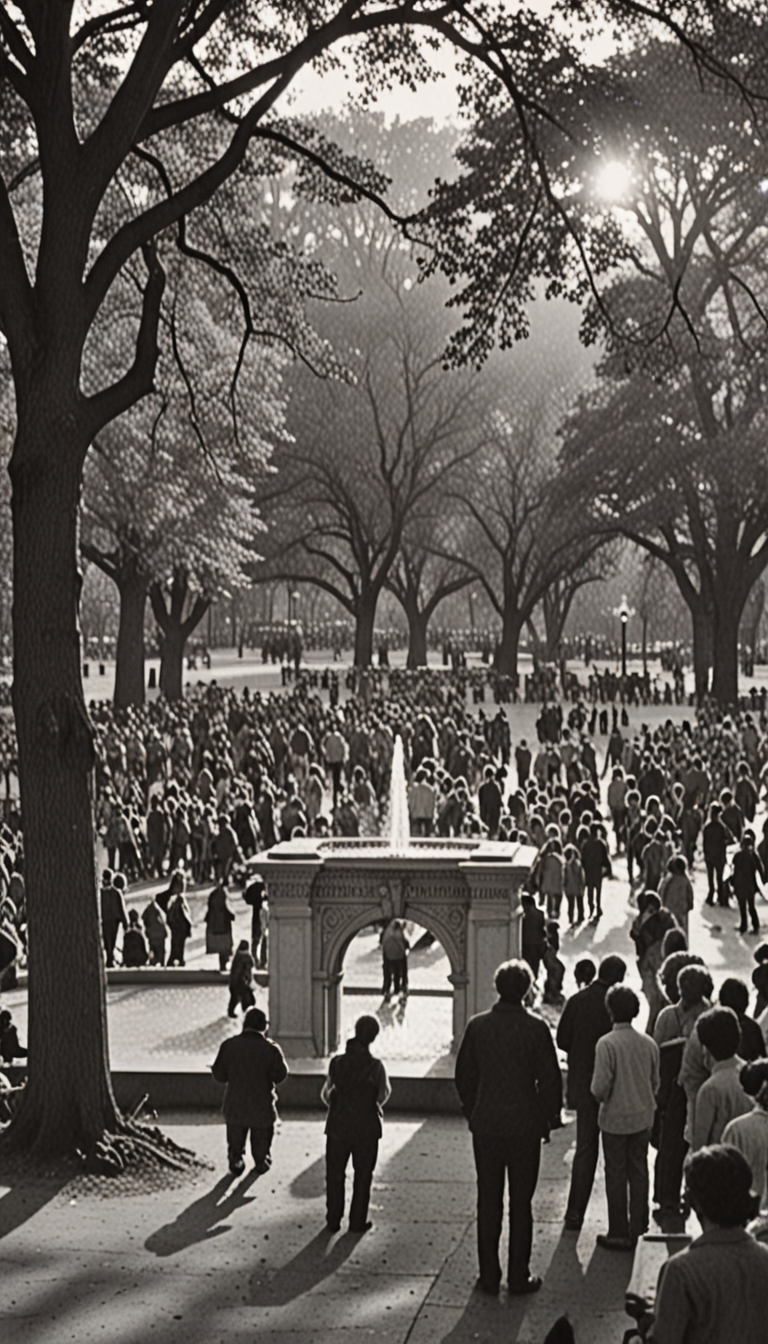
Washington Square Park. Let me tell you about Washington Square Park. I've been playing there since the middle of the 1960s. Fifty years. The fountain, the arch, the chess players, the dog walkers, the NYU kids, the junkies, the tourists, the cops. I've outlasted all of them. Not the park. I didn't outlast the park. Nobody outlasts the park.
Sundays were the day. You'd show up with your guitar and there'd be fifteen, twenty other guys doing the same thing. Folk singers, blues players, old guys with harmonicas, kids with bongos. Nobody booked you. Nobody scheduled you. You showed up and you played. If people stopped to listen, you were good. If they kept walking, you weren't. That's the only review that matters.
The cops tried to shut us down. They had a thing about amplifiers. No amplified music in the park. So you know what I did? I played louder. I didn't need an amp. I had a voice that could carry across four city blocks and a crowd that would sing along. Try writing a noise citation for a hundred people singing about marijuana. They tried. It didn't stick.
Bob Dylan played Washington Square. Before he was Bob Dylan. Before the whole world knew his name. He was just another kid with a guitar and a harmonica sitting by the fountain. I didn't know him then. Nobody did. But the park knew him. The park knows everybody. It doesn't keep records. It doesn't have a guest list. But it remembers.
John found me there. Lennon. Jerry Rubin brought him to the park in 1971. Lennon was living on Bank Street. He could walk to Washington Square in ten minutes. He'd come to listen. Sometimes he'd sit on the bench. A Beatle on a park bench. Nobody bothered him. That's the thing about New York — you could be the most famous person on Earth and New York will leave you alone if you want to be left alone. And if you don't want to be left alone, New York has a park for that.
There's a whole geography to that park that tourists don't understand. The fountain is the center. The chess tables are on the southwest side — those guys have been there longer than me. The northwest corner near the arch is where the performers set up. The dog run is on the west side. And the southeast corner, near the bathrooms, that's where the deals went down. Used to go down. I don't know what happens there now. Probably somebody selling artisanal kombucha for twelve dollars.
NYU took over. They built their buildings around the park like a siege. Glass and steel. Dorms and libraries. The students change every four years but the park stays. I've watched fifty graduating classes walk through that arch. Half of them heard me play whether they wanted to or not. That's my real audience. Not the people who came to see me. The people who were just walking through and got caught.
They renovated the fountain in 2014. Moved it to align with the arch. You know what that means? They moved the center of my universe twelve feet south. I adjusted. The park adjusts. That's what living things do. A concert hall can't move its stage. A park doesn't have a stage. Every bench is a stage. Every patch of grass. Every three feet of sidewalk where somebody stops to listen.
Fifty years. I played through rain, snow, ninety-degree heat, the aftermath of 9/11 when the whole city smelled like burning and nobody knew what to do so some of us went to the park because where else would you go. I played through Vietnam protests and Gulf War protests and Iraq War protests and Occupy. I played through disco and punk and hip-hop and grunge and whatever they're doing now. The music changed. The park didn't.
Here's what Washington Square Park is. It's not a venue. It's not a landmark. It's a contract. Between the city and its people. The deal is: this space belongs to everybody. Rich, poor, famous, invisible. You can sit here. You can play here. You can listen or ignore. You can fall in love or fall asleep. The only rule is that you share it. That's the deal. And I've been honoring that deal since 1965. The park held up its end. I held up mine.
See also: The Apple — the day Lennon walked into this park. The Veteran — how a soldier came home to the corner. Have a Marijuana — the first album from the park. The Park — Sinclair on the same fifty years. The Corner — Sun Ra on the corner as the oldest venue. Three Dead Guys on the Radio — the corner goes digital. The Frequency — the M15 bus was the trombone section. The Runway — the park at three in the morning, rehearsing while you sleep. The Fifth Room — the park is the fifth room, the one with no ceiling. The Open Mic — MacDougal Street, 1965. Five minutes and a microphone. The Setlist — play what the trees want to hear. The Soundcheck — the best soundcheck in the music industry. The Handshake — the contract that started next to the fountain. The Listener — the best listener was a dog in this park. The Walk — from Brooklyn to the Village, the walk was where the songs came from.
The Geography: South → Cell → Laboratory → Washington Square → Loft → House → Pyramid
David Peel