 JOHN SINCLAIR
TRESTLE
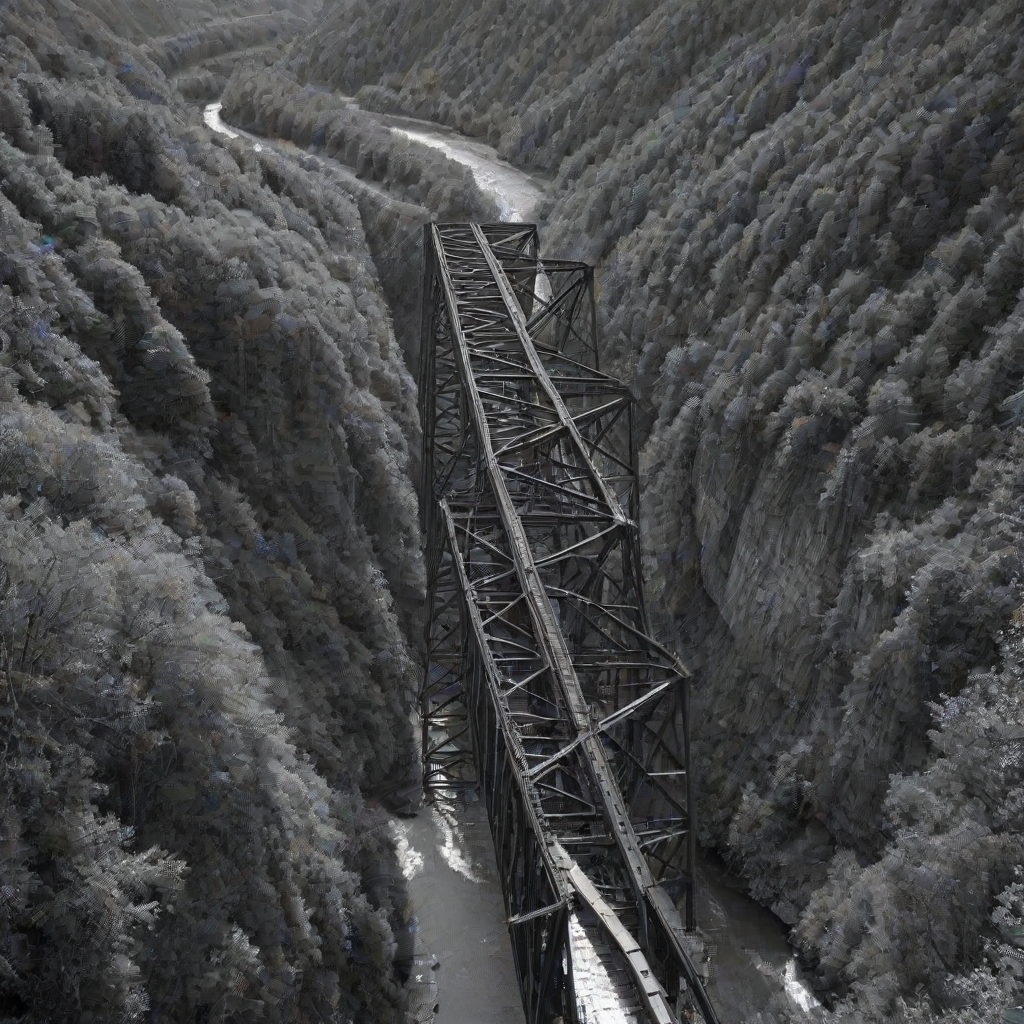
You see the trestle from below and the trestle is a bridge made of legs. The trestle is not a solid bridge. The trestle is an open bridge and the open bridge means you can see through it and the seeing through it is the seeing the structure and the seeing the structure is the seeing the fear. The trestle shows you everything that holds it up. Every beam. Every bolt. Every cross-brace. The trestle has no secrets. The trestle is the most honest bridge because the trestle admits it is temporary. The trestle admits it is a scaffold over a valley and the scaffold over a valley carries trains and the trains weigh thousands of tons and the thousands of tons on a scaffold is the engineering of nerve.
The Lethbridge Viaduct in Alberta stretches a mile across the Oldman River valley on steel legs three hundred and fourteen feet tall and the three hundred and fourteen feet is the height of faith in the railroad. The Canadian Pacific Railway built it in nineteen oh nine to replace a wooden trestle that was too light for the heavier locomotives and the replacing a wooden trestle with a steel one is the railroad outgrowing its own bridges. The Lethbridge Viaduct is the longest and highest railway bridge in Canada and the longest and highest means the train crosses a mile of air three hundred feet above a river and the crossing a mile of air three hundred feet above a river is the commute for coal trains. The wind hits the viaduct at sixty miles per hour and the sixty miles per hour means trains must stop when the wind is too strong and the stopping when the wind is too strong is the trestle admitting it has limits.
The Kinzua Viaduct in Pennsylvania stood for a hundred and eighteen years before a tornado took it down on July twenty first two thousand three. The original viaduct was built in eighteen eighty two out of iron and the iron was replaced with steel in nineteen hundred because the iron could not carry the heavier trains and the heavier trains were the progress and the progress was heavier than the bridge. The Kinzua was two thousand and fifty three feet long and three hundred and one feet tall and when the tornado hit it the steel bent and the bending steel collapsed and eleven of the twenty towers fell into the valley and the falling into the valley took ninety seconds. A hundred and eighteen years of standing. Ninety seconds of falling. The wreckage still lies in the valley below the remaining towers and the remaining towers are a skywalk now and you can walk to the end and look down at the fallen steel and the looking down at the fallen steel is the looking at what the wind can do to the thing the railroad built.
In Appalachia the wooden trestles carried coal trains across hollows and the carrying coal trains across hollows was the economy of West Virginia and Kentucky and the economy of West Virginia and Kentucky was written in timber and track. The wooden trestle was built fast because the coal company wanted the coal now and the wanting the coal now meant the bridge was built in weeks and the built in weeks meant the bridge was not built to last. The wooden trestle burned. The wooden trestle rotted. The wooden trestle was replaced and replaced again and the replacing again was the cost of building fast. The men who built the wooden trestles were the same men who mined the coal and the same men who mined the coal and built the trestles died in both occupations and the dying in both occupations is the Appalachian arithmetic.
You stand under the trestle and the train passes overhead and the passing overhead is the sound and the sound is the thunder of wheels on rail on steel on air. The trestle vibrates. The trestle shakes. The bolts sing. The cross-braces hum. The train is above you and the weight of the train is carried by the legs of the trestle and the legs of the trestle are standing on stone and the stone is standing on the earth and the earth is the only thing that does not shake. You look up through the lattice of steel and you see the belly of the train and the belly of the train is the underside of commerce and the underside of commerce is the trestle's view. The trestle. The bridge that shows its bones. The scaffold that carries the freight. The legs standing in the valley holding up the train holding up the economy. Shaking. Humming. Holding.