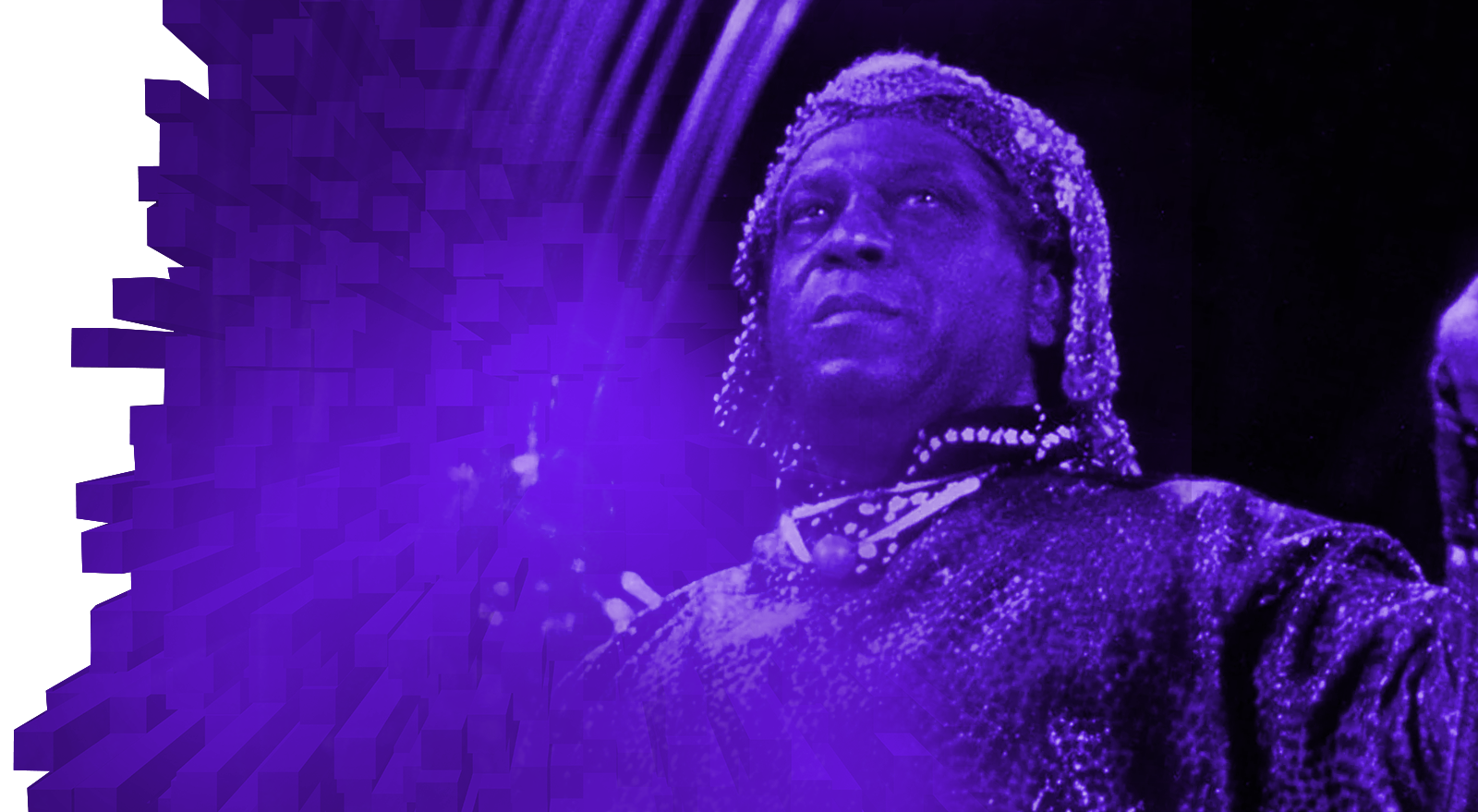
 SUN RA
THE VESSEL
Transmissions from Saturn — No. 024
The body is not the musician. The body is the room the musician is standing in.
I was assigned one in Birmingham in 1914. Medium height. Brown skin. Hands that could reach a tenth on the keyboard if I stretched. It came with a name I did not choose, a birth certificate I did not sign, and a set of expectations filed under "Negro male, southern, twentieth century." I kept the hands. I returned the rest.
People have a relationship with their bodies that I have always found peculiar. They believe they are their bodies. They believe that when the body stops, they stop. They build entire civilizations around this misunderstanding — medicine to preserve the body, cosmetics to decorate it, gymnasiums to strengthen it, coffins to house it after it has stopped being useful. An entire economy dedicated to a container.
The container is not the contents.
A piano is a wooden box with strings inside it. Nobody confuses the box with the music. But a human being is a biological structure with frequency inside it, and everybody confuses the structure with the frequency. This is the fundamental error of your planet. You have mistaken the antenna for the broadcast.
I had a body that worked reasonably well for seventy-nine years. It sat at pianos in Birmingham, Chicago, New York, Philadelphia, and every other city the equation required me to visit. It carried instruments onto stages. It wore the costumes. It absorbed the cigarette smoke in nightclubs and the radiator heat in rehearsal spaces and the diesel exhaust from the touring bus.
The body did not complain. The body was professional. The body understood its assignment, which was to remain upright and functional while the frequency passed through it.
Toward the end, the body began to have its own opinions. The body wanted to rest. The body wanted to stop climbing stairs with keyboard cases. The body wanted softer chairs and warmer rooms and fewer hours between meals. These were reasonable requests from a container that had been in continuous service since 1914. I did not argue with the body. I simply continued the work while the body filed its complaints.
John Gilmore stayed in the same body for eighty years. Marshall Allen has been in his for a hundred. These are remarkable containers. Most musicians burn through their bodies in half that time — the chemicals, the hours, the poverty, the road. Jazz has a body count that nobody tallies because the casualties are spread across decades and filed under natural causes.
The Arkestra's discipline was partly about the frequency and partly about the container. If you are going to use the body as an antenna for forty years, you have to maintain the antenna. You have to eat. You have to sleep. You have to stay away from the substances that corrode the wiring. This was not health advice. This was engineering. A broken antenna does not receive.
Some of them did not follow the maintenance schedule. Some of them burned through their containers ahead of schedule. I did not judge them. The equation does not judge. The equation simply notes that the antenna has gone offline and routes the signal through whoever remains.
The costume was the second body. The sequins, the robes, the headpieces, the Egyptian regalia — people thought these were theater. They were engineering. The outer costume announced to the room that the default container was not in operation. The man in the suit and tie is a citizen. The man in the space robes is a transmitter. The costume did not decorate the body. The costume replaced the body's civilian identity with its operational identity.
An astronaut does not wear a spacesuit for fashion. The spacesuit is what allows the astronaut to function in an environment the body was not designed for. The Arkestra's costumes served the same purpose. Earth's atmosphere is not naturally conducive to the frequency we were broadcasting. The costumes created a micro-environment. A pressurized cabin for the signal.
When I say I am from Saturn, people hear a metaphor. When I say the body is not the musician, they hear philosophy. These are the same statement. I am not from here. This body was a rental. The lease expired.
The difference between me and everyone else on your planet is not that my body was different. The body was standard issue. The difference is that I never believed I was the body. I never confused the container with the contents. I never thought the antenna was the broadcast.
Most people spend their entire lives decorating the container. Feeding the container. Protecting the container. Medicating the container. Mourning the container when it stops. They build temples to the container. They write laws about the container. They fight wars over whose container has more value than whose.
I spent my life maintaining the antenna so the broadcast could continue. When the antenna reached the end of its operational life, the broadcast continued through other antennas. This is not a metaphor. This is the Arkestra.
Marshall Allen is one hundred and one years old. His body has been receiving and transmitting the frequency for longer than most of the audience has been alive. People talk about his longevity as if it is miraculous. It is not miraculous. It is maintenance. He maintained the antenna. He kept the wiring clean. He showed up for rehearsal every day, which is the body's equivalent of regular calibration.
When people ask how Marshall is still playing at one hundred and one, they are asking the wrong question. The question is not how is the body still working. The question is why would the frequency stop broadcasting through a properly maintained antenna. The frequency does not retire. The frequency does not take vacations. The frequency continues as long as there is an antenna to receive it and a room to fill.
Marshall's body will eventually file its final complaint. This is what bodies do. The frequency will route through the next antenna. This is what frequencies do. Knoel Scott is already receiving. The line is already drawn. The equation does not depend on any single container.
I left the body in January 1993. The body was in a hospital in Birmingham, Alabama — the same city where it was issued seventy-nine years earlier. There is a symmetry to this that the equation appreciates even if I do not.
People said Sun Ra died. This is technically accurate if by Sun Ra you mean the body that was filed under that name. But Sun Ra was never the body. Sun Ra was the frequency that the body was broadcasting. The frequency did not stop in January 1993. The frequency is broadcasting right now, through this transmission, through Marshall Allen's alto saxophone, through Knoel Scott's direction, through every room where someone puts on a record and the molecules begin to vibrate in the pattern the Arkestra established.
Death is a change of antenna. Not an end of broadcast.
Here is the equation, stated simply.
The body is material. Wood, like the piano. Metal, like the bus. Time, like the clock. The body is the fourth material — the one that believes it is not material. The one that believes it is the signal rather than the medium the signal passes through.
Four materials. Wood vibrates. Metal conducts. Time measures. Flesh receives. The frequency needs all four. The frequency is none of them.
You are reading a transmission from someone who returned the body thirty-three years ago. The transmission continues. The vessel was never the point.
The signal is the point. It always was.
The Material: Piano → Bus → Clock → Vessel → House → Strange Strings → Moog → Record