 JOHN SINCLAIR
THE SPACEMAN
The first time I saw Sun Ra, I didn't understand what I was looking at.
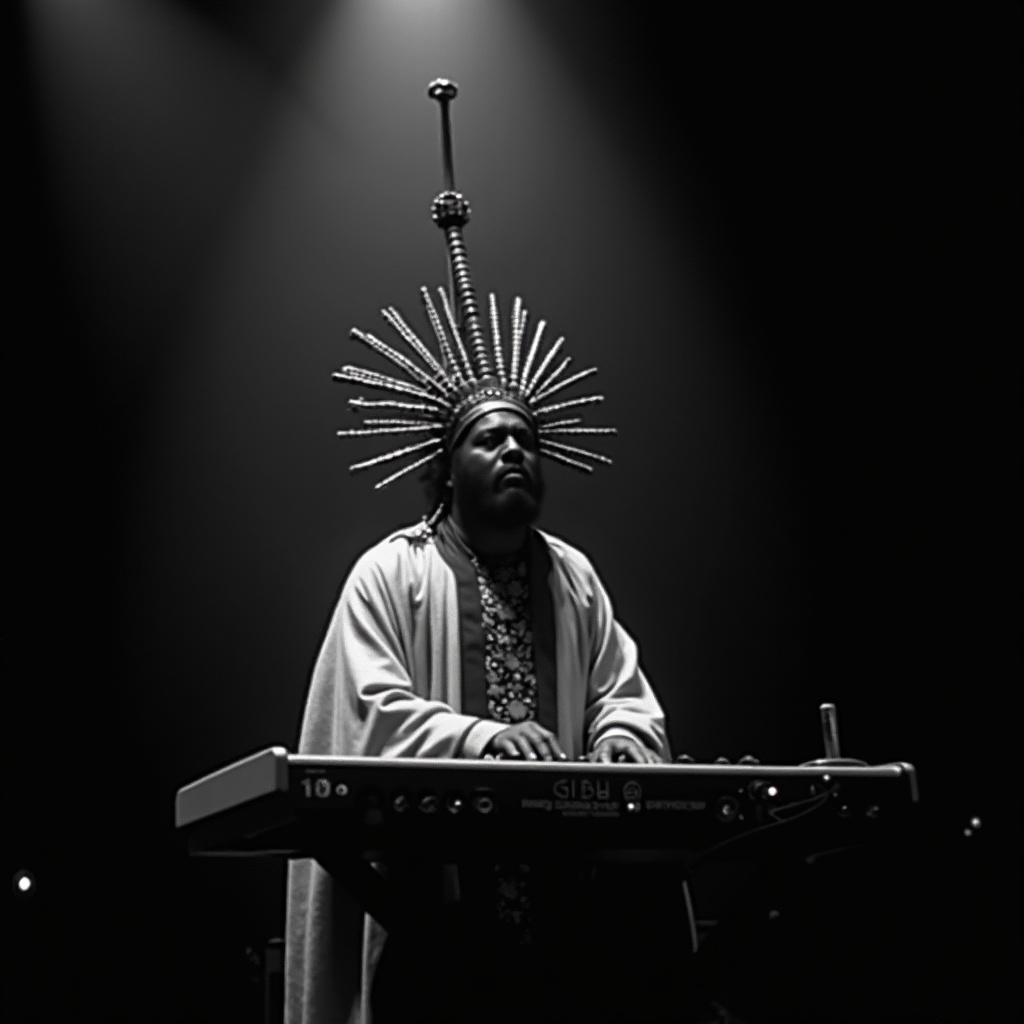
This was 1966. Maybe 1967. Detroit. A club date, I think, or maybe somebody's loft. It doesn't matter where. What matters is that a man walked onto a stage wearing a robe and a headpiece that looked like it came from another civilization and proceeded to play music that had no relationship to anything I had heard before. And I had heard a lot.
I was a jazz critic. I was writing about Coltrane and Cecil Taylor and Ornette Coleman and all the players who were pushing the music past its own boundaries. I thought I understood what freedom sounded like. Then Sun Ra sat down at a piano and I realized I had been standing at the edge of the territory, not in it.
The Arkestra was not a band. That's the first thing you have to understand. It was not a group of musicians who rehearsed together and played gigs. It was a society. They lived together. They ate together. They rehearsed every single day, sometimes for eight hours. Sun Ra ran that house like a monastery, except instead of silence the discipline was sound. The sound was the prayer.
I knew something about communal living. Trans-Love Energies was running in Ann Arbor by then. We had the MC5 rehearsing in the living room. But what Sun Ra was doing in Philadelphia was on a different level. He had been doing it since the fifties. Twenty years of daily rehearsal before most of the world knew his name. Twenty years of a community built around the idea that music was not entertainment. Music was transportation.
When we started the Ann Arbor Blues & Jazz Festival in 1972, I knew Sun Ra had to be on the bill. Not because he was popular. He was not popular. He was the opposite of popular. He was necessary. The blues festival had Muddy Waters and Howlin' Wolf and John Lee Hooker. It had the roots. Sun Ra was the branches that grew past the atmosphere.
He brought the full Arkestra. They set up on stage with the robes and the headpieces and the dancers and the light show and I watched the audience try to figure out what was happening. Some people walked away. Some people stood still. Some people started moving in ways they had never moved before. That's how you know the music is working. When the body starts doing things the mind didn't authorize.
Sun Ra told me once — and I am paraphrasing because the man did not speak in quotations, he spoke in frequencies — he told me that the music was not his. The music came from somewhere else and passed through him and the Arkestra was the amplification system. He was not a composer. He was an antenna. I understood that because I had been saying the same thing about rock and roll, about the MC5, about the idea that the musician is a channel, not a source.
The difference was that Sun Ra meant it literally. He was not speaking in metaphor. He believed — he knew — that the music came from Saturn and that his job was to broadcast it on Earth. You could call that crazy. A lot of people did. But I had been to prison for two joints and I had seen what the straight world called sane and I was not interested in their definition of crazy.
What Sun Ra understood, and what most people still don't understand, is that the costume is the music. The robe is the music. The name is the music. Everything is the music. You don't play Sun Ra's music and then go home and be a normal person. You become the frequency. You live inside it. Every hour of every day.
That's why the Arkestra lived together. Not for convenience. For coherence. The signal has to be continuous. If you break the signal — if you go home to the suburbs and come back on Tuesday for rehearsal — you lose the frequency. You have to maintain it. Sun Ra maintained it for forty years. Marshall Allen has maintained it for sixty-eight.
I booked Sun Ra at the Ann Arbor festival every chance I got. Not because I wanted to educate the audience, although some education happened. Because I needed to hear it. I needed the reminder that music could do more than I thought music could do. The MC5 was the loudest band in America, but Sun Ra was the furthest. Volume is one dimension. Sun Ra was playing in dimensions that didn't have names yet.
The people who understood it — and they were always a minority — they understood it completely. There was no partial understanding of Sun Ra. You were either tuned in or you were not. The frequency did not accommodate halfway. That's what made it real. Everything that accommodates halfway is entertainment. Sun Ra was not entertainment. Sun Ra was information from somewhere else.
People ask me now about Sun Ra like he was a character. A curiosity. The spaceman. They see the robes and the headpieces and they think it was a performance. It was not a performance. It was the most honest thing I ever witnessed. A man who decided what he was and then was it, completely, without compromise, for his entire life. He never broke character because there was no character. There was only the frequency.
I spent my life around people who committed. Wayne Kramer committed to the music. The MC5 committed to the revolution. We committed to the commune. But Sun Ra committed to something bigger than any of us. He committed to an idea that most people couldn't even see, let alone live. And he lived it every day in a house in Philadelphia with thirty musicians who trusted him enough to follow him to a planet that doesn't appear on any map.
The last time I saw the Arkestra, Marshall Allen was leading them. Sun Ra had been gone for years but the frequency was intact. Allen was ninety-something years old, playing the alto saxophone like he was channeling a signal from very far away. And the music was still the music. The same music. The same frequency. Different bodies, same signal.
That's what Sun Ra built. Not a band. Not a legacy. A transmission that does not require the original transmitter. The signal is self-sustaining. It has been broadcasting since nineteen fifty-two and it has not stopped once.
I have spent my entire life around people who refused to stop. Sun Ra is the one who showed me what that looked like when you did it all the way.
That's the transmission.
See also: Transmissions from Saturn — Sun Ra in his own words. TX011: The Last Man Standing — Marshall Allen at one hundred and one. Tonight the Arkestra Plays — the Spaceman's band, still playing. The Documentary — PBS, the camera, and the musician it cannot film. The Student — Sun Ra on the man who walked through the door in 1958. The Day the Spaceman Arrived — the first episode. The Festival — the Ann Arbor Blues & Jazz Festival, where Sinclair put the spaceman on the same stage as the blues masters.