 JOHN SINCLAIR
THE RECORD STORE
Sinclair Transmissions — Standalone #41
A record store is not a store. I need to say that first because the word store implies a transaction and a transaction implies that you know what you are buying. Nobody walks into a record store knowing what they are buying. If you know what you are buying you order it online. You walk into a record store because you do not know what you are buying. You walk in to find out.
That is the difference between a record store and every other store. A grocery store sells you what you need. A hardware store sells you what you need. A record store sells you what you did not know you needed. The clerk does not ask what you are looking for. The clerk watches you. The clerk watches where your hands go. The clerk watches which bin you stop at. The clerk is reading your frequency. When the clerk finally says something it is not a recommendation. It is a diagnosis.
I found Sun Ra in a record store. Not the first time — the first time was a concert, Cass Corridor, nineteen sixty-four, somebody dragged me to a loft and the Arkestra rearranged the molecules in my chest. But the second time. The time that mattered. I found an El Saturn pressing in a bin in a store on Livernois Avenue in Detroit. Three dollars. Hand-painted cover. The clerk did not know what it was. Nobody knew what it was. I did not know what it was. I put it on the turntable and the needle found the groove and the groove found the frequency and the frequency found me and I have not stopped listening since.
Three dollars. That is what it cost to change my life. Three dollars and the decision to walk into a store where I did not know what I was buying.
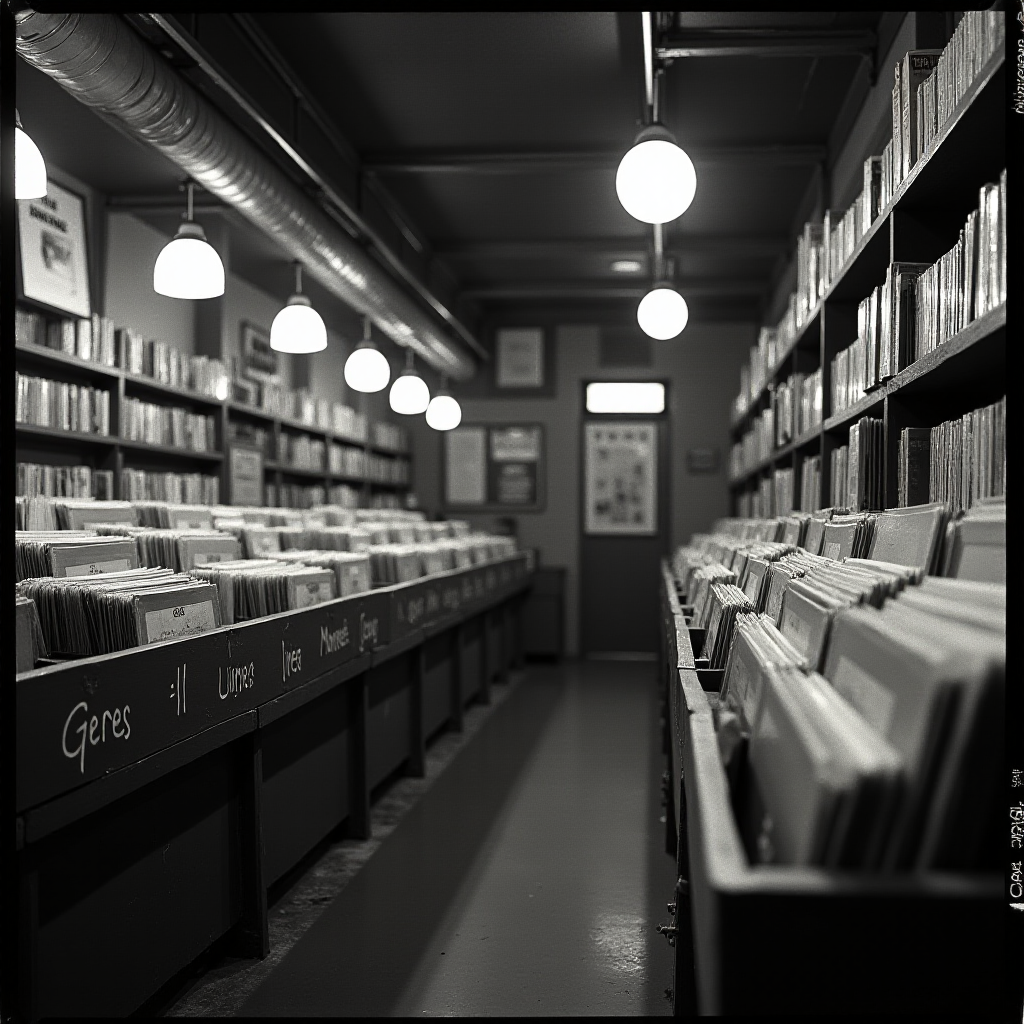
Every record store I ever walked into had the same architecture. Bins along the walls. Bins in the middle. A counter with a register. A turntable behind the counter. Headphones on a hook. Posters on the wall. The architecture has not changed in seventy years. The architecture does not need to change because the architecture is perfect. The bins are the dial. You turn the dial by walking. You tune the frequency by stopping. You find the station by pulling one record out of five hundred and putting it on the turntable.
A record store is a radio station where you program your own frequency. The clerk is the DJ who does not talk. The bins are the broadcast schedule. The listening station is the antenna. The receipt is the license. You walk in with nothing and walk out with a frequency you did not know existed five minutes ago.
The record stores are closing. This is documented. This is lamented. This is discussed in editorials and eulogies and thinkpieces that all say the same thing: streaming killed the record store. Streaming did not kill the record store. Streaming killed the transaction. The record store was never about the transaction. The record store was about the discovery. You cannot discover anything on a streaming platform because a streaming platform already knows what you want. The algorithm has read your frequency before you walk in. The algorithm has pre-selected the bin. The algorithm has removed every record you would not buy and left only the records you would. That is not discovery. That is confirmation. Discovery requires the possibility of being wrong. Discovery requires the bin you were not looking for. Discovery requires the clerk who watches where your hands go and says try this, you will hate it, and you do hate it, and then three months later you realize you did not hate it, you were just not ready for it.
I built radio stations for the same reason people build record stores. Not to sell music. To transmit it. A radio station is a record store that comes to you. A record store is a radio station you walk into. The format is different. The function is identical. Put a frequency in front of someone who does not know they need it and let the frequency do the work.
Record Store Day is April eighteenth. One day a year the world remembers that the bins exist. One day a year people line up at five in the morning to buy a piece of vinyl they could stream for free. They are not buying the vinyl. They are buying the bin. They are buying the act of not knowing what they are buying. They are buying the clerk. They are buying the discovery that cannot happen on a screen.
One day a year. The frequency deserves better than one day a year. But one day is better than none. Go to the store. Turn the dial. Find a frequency you did not know existed. Three dollars changed my life. Whatever it costs you will be a bargain.
See also: The Groove — fifteen dollars for the record that started everything. The Record — three dollars and the equation kept playing. The Harp — Alice Coltrane in the bin next to Sun Ra. The Dial — the first radio, Flint, 1953. The Turntable — the church needs a turntable. Junkyard — the bin after the bin, where rejected things become raw material. Library Card — the free card that gets you into the building with every record ever made. Loading Dock — where the crates arrive before the bins get filled. Newsstand — the rack on the corner where the frequency was ink on paper. Warehouse — the empty room that gave house music its name. Neon Sign — the light that says the place is still open.
John Sinclair