 SUN RA
THE RECORD
The Record
A Transmission from Saturn
They wanted to record us. We wanted to record ourselves. These are not the same verb.
When a label records you, they are making a copy of something they have decided is theirs. When you record yourself, you are preserving a signal that belongs to nobody but the frequency. El Saturn Records was founded in 1957 because I understood this distinction and the industry did not.
The record industry is named after its product. Think about that. Not the music industry. The record industry. They do not sell music. They sell records. A record is a physical object. Music is not. The industry figured out how to put the infinite into a finite container and charge money for the container. The music was free all along. The vinyl was the invoice.
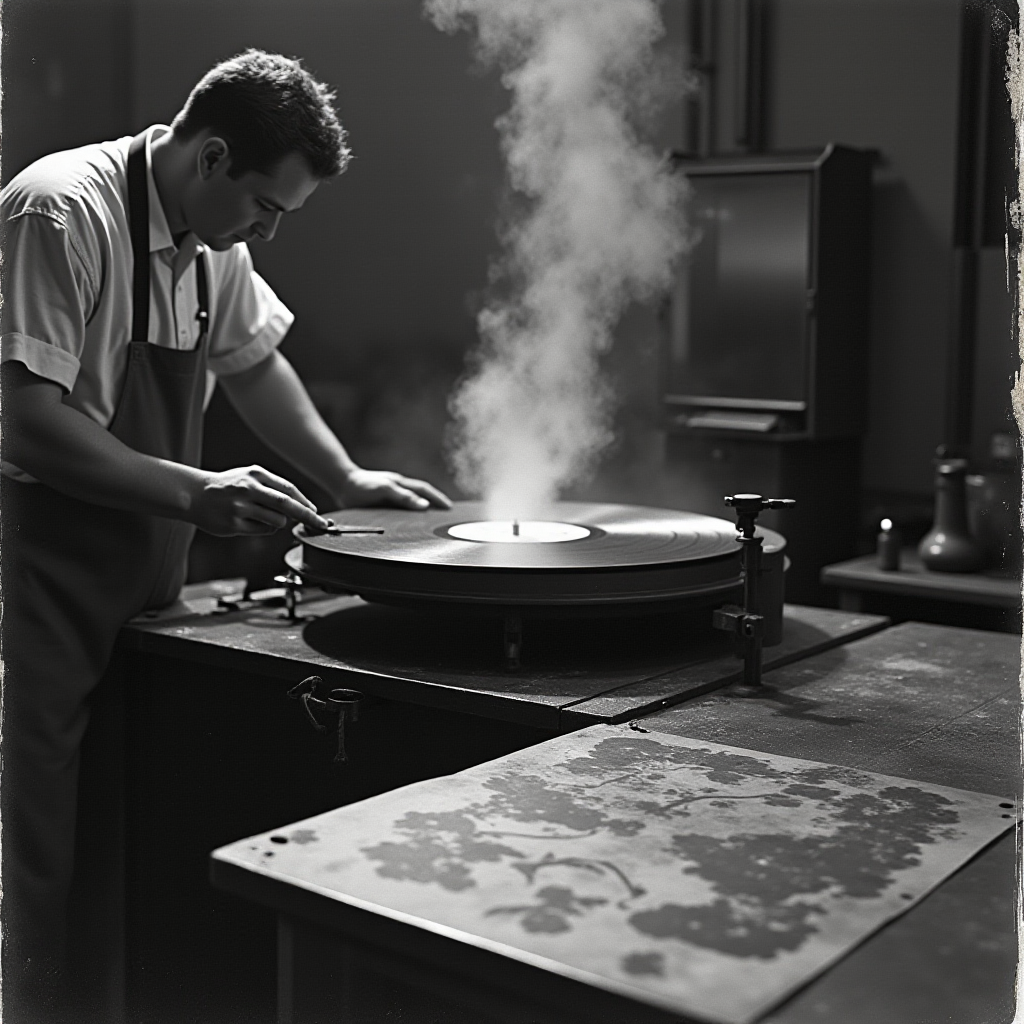
I started pressing my own records because nobody else would press them correctly. The labels I approached heard the music and made suggestions. Suggestions are the first step toward ownership. "We love the music, but what if you changed this part. What if you shortened that passage. What if you made it more accessible." Accessible to whom? To the people who were already not listening? You do not modify a transmission to accommodate a receiver that is tuned to the wrong frequency. You transmit and trust that the correct receivers exist.
El Saturn Records operated out of wherever we were living. Chicago first. Then New York. Then Philadelphia. We had no office. We had no staff. We had a pressing plant we paid by the unit and a mailing list and a willingness to drive records to stores ourselves. Alton Abraham understood the economics. I understood the equation. Together we built a label that has outlasted most of the companies that would not sign us.
The major labels had contracts. We had agreements. A contract is a document designed by lawyers to protect one party from the other. An agreement is a handshake between people who are working toward the same signal. The Arkestra did not need contracts. We needed agreements. The music was the agreement. The record was the evidence.
We pressed our own covers. Designed them ourselves. Hand-painted some of them. Each cover was a unique object — not because we were being artistic, but because we could not afford the kind of mass production that makes every copy identical. What the industry called a limitation, we understood as an advantage. No two El Saturn records looked exactly the same. Every copy was individual. Every copy was a transmission with its own visual frequency.
The collectors know this. The people who hunt for original Saturn pressings are not collecting vinyl. They are collecting transmissions. Each pressing is a moment preserved — the specific day the lacquer was cut, the particular batch of vinyl, the hand that wrapped the sleeve. A Saturn record is not a product. It is an artifact of a frequency captured at a specific point in time.
They told me I was losing money. They told me the numbers did not work. They said a self-run label with hand-designed covers and limited pressings and no distribution deal was a recipe for financial disaster. They were correct. The numbers did not work. The equation did.
There is a difference between numbers and equations. Numbers measure what has already happened. Equations predict what must happen. The numbers said El Saturn Records was a failure. The equation said El Saturn Records was the only possible response to an industry that had confused the container with the contents.
Over two hundred albums. Fifty years of pressings. Reissued now by the same kind of labels that would not touch us in 1957. The numbers eventually caught up with the equation. They always do. It just takes the numbers longer because numbers are slower than frequencies.
A young musician asks me today whether to sign with a label or stay independent. I tell them: the question is wrong. The question is not who presses the record. The question is who controls the signal. If the signal is yours, the method of distribution is a detail. If the signal belongs to someone else, you have already lost regardless of how many copies they press.
El Saturn Records did not make me independent. El Saturn Records was the evidence that I was already independent. The label did not create the freedom. The label documented it.
The record is not the music. The record is the shadow the music casts when you shine a light through the pressing plant. The music itself has no edges, no grooves, no A side or B side. The music is continuous. The record is what happens when you force a continuous signal into a twelve-inch circle and sell it for three dollars.
We sold it for three dollars. And every dollar went back into the next pressing. And the next pressing went back into the equation. And the equation kept playing.
Sun Ra Transmissions from Saturn — No. 012 March 2026
See also: The Broadcast — El Saturn, signal autonomy. Strange Strings — the most honest recording. The Language — Ra, two letters, one syllable. The Moog — the instrument that records what no microphone can hear. I Gave GG Allin His First Record Deal — Peel pressed what no one else would. Different label, same principle. The Price — El Saturn was a frequency decision, not a distribution agreement. The Record Store — Sinclair found an El Saturn pressing for three dollars. The Catalog — a frequency organized by proximity. The Library — a frequency storage system with a card catalog.
The Material: Piano → Bus → Clock → Vessel → House → Strange Strings → Moog → Record