 JOHN SINCLAIR
THE RALLY
I was not there. That is the first thing you need to understand about the John Sinclair Freedom Rally. I was not there. The biggest concert ever held in my name, the night that changed everything, and I was in a cell in Jackson Prison, two hundred miles away, staring at a wall.
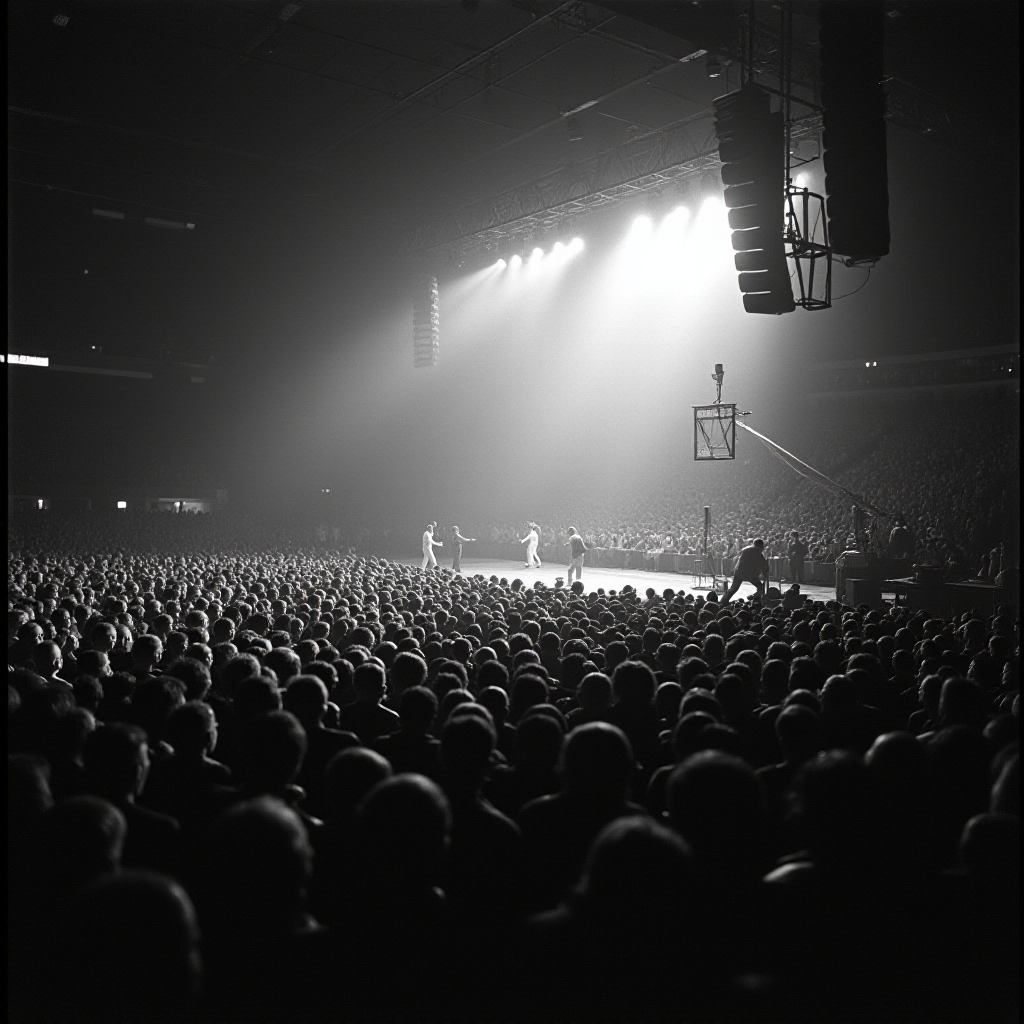
December 10, 1971. Crisler Arena, Ann Arbor. Fifteen thousand people. John Lennon and Yoko Ono. Stevie Wonder. Phil Ochs. Allen Ginsberg. Bobby Seale. Archie Shepp. Bob Seger. Commander Cody. David Peel. My name on the marquee and my body in a cage.
People tell me about that night like I was there. They describe it to me — the sound, the energy, the moment Lennon walked onstage. They forget that I only know it secondhand. They forget that the man the rally was for was the one person who could not attend.
That is what prison does. It removes you from your own story. You become a cause instead of a person. Your name goes on a poster and your body stays behind a door that opens when someone else decides it opens. The fifteen thousand people in Crisler Arena were singing my name and I could not hear them. I was listening to the sounds that a prison makes at night, which are not music, which are the opposite of music, which are the sound of time being taken from people who cannot stop the clock.
John Lennon flew from New York. I need you to understand what that meant. This was John Lennon. A Beatle. The most famous musician on the planet. He had not played a major concert since the rooftop of Apple Corps in January 1969 — almost three years. The first time John Lennon played live for an audience since the Beatles, he did it for a man in a Michigan prison he had never met.
He wrote a song. Three chords, a harmonica, and the truth. "It ain't fair, John Sinclair, in the stir for breathing air. Won't you care for John Sinclair, in the stir for breathing air? Let him be, set him free, let him be like you and me."
Simple. Direct. Lennon understood something that a lot of political songwriters never figure out. The song does not need to be complicated. The injustice is complicated enough. The song just needs to say it plain.
Stevie Wonder played. Twenty-one years old and already Stevie Wonder. He did not come because someone asked him as a favor. He came because he understood that the marijuana laws were being used as a weapon against Black communities and the proof was in every prison in the country. Stevie knew. He knew before a lot of people knew. He played and fifteen thousand people understood something that the courts had been pretending was not true.
Phil Ochs played. Phil, who wrote songs about injustice the way some people write letters to the editor — urgently, specifically, with the names and dates included. Phil, who would be dead five years later because the world broke his heart. He played that night and he was alive and he was fighting and I wish I had been there to see it.
Allen Ginsberg chanted. Of course he chanted. Allen did not give speeches. He chanted and the chanting did what chanting does — it turned a crowd into a frequency. Fifteen thousand people vibrating at the same pitch. That is not a metaphor. That is acoustics. That is what happens when you get that many human bodies resonating together. The room becomes an instrument.
Bobby Seale spoke. Chairman of the Black Panther Party. He stood on that stage in Ann Arbor, Michigan, and he talked about political prisoners and he talked about justice and he connected my case to every case. He made the room understand that two joints in Michigan and a gun charge in California and a sit-in in Alabama were all the same thing. The state caging the people who challenged it.
David Peel played. The man from the Lower East Side, the man who sang on street corners, the man who taught Lennon what it sounded like to make music without permission. Peel had been part of Lennon's circle since they met in Washington Square Park. Lennon heard him playing for free on the concrete and recognized something — the sound of a man who did not need a recording contract to be a musician. Peel followed Lennon to Ann Arbor because that is what Peel did. Where the music went, Peel went. Where the fight was, Peel showed up with a guitar.
That is a fact that connects everything I am telling you to everything David Peel ever stood for. The street corner and the prison cell. The park and the arena. Peel on a stage in Ann Arbor singing for a man in a cage in Jackson, and both of them knowing that the real crime was never the marijuana. The real crime was being loud enough to be heard.
I heard about it the next day. A guard told me. Not out of kindness — out of something else. He said, "They had a concert for you." He said it like it was a joke. Like fifteen thousand people and John Lennon and Stevie Wonder were a punchline.
Then the phone calls started. Then the letters. Then the lawyers calling with voices that sounded different — excited, like something had shifted. And something had shifted. The rally did what rallies sometimes do when the timing is right and the cause is clear and the people who show up are the right people saying the right thing at the right volume.
Three days later, December 13, the Michigan Supreme Court released me on bond. Three days. Two and a half years in prison and three days after fifteen thousand people sang my name, a court decided I could leave.
People say the rally freed me. That is not exactly right. The rally created the political conditions under which the court felt it could free me. The legal arguments had been there all along. My lawyers had been filing the same briefs for two and a half years. The law had not changed between December 10 and December 13. What changed was the cost of keeping me inside.
That is how power works. Not through justice. Through cost. The cost of keeping John Sinclair in prison became higher than the cost of letting him out. John Lennon made it expensive. Stevie Wonder made it expensive. Fifteen thousand people made it expensive. The Michigan Supreme Court did the math.
Three months later they ruled the marijuana laws unconstitutional. The laws that put me in a cage were no longer laws. The judge who gave me ten years had imposed a sentence under a statute that no longer existed. Everything he said about me — that I was a danger, that I was trying to undermine the law, that I was an example that needed to be made — was applied under a law that his own state admitted was wrong.
I think about that night — the night I was not there — more than any night I actually lived through. I think about Lennon onstage with his guitar, playing a song he wrote for me, a song so simple it is almost impossible to forget. I think about fifteen thousand people in a basketball arena in Ann Arbor deciding that two joints was not worth ten years of a man's life. I think about Stevie Wonder and Phil Ochs and Allen Ginsberg and Bobby Seale and David Peel, all of them in the same room at the same time, all of them saying the same thing in different languages.
I think about the guard who told me about it like it was a joke. I wonder if he understood later that the joke was on the system he worked for. I wonder if he ever heard the song.
The rally was not a concert. The rally was a frequency. Fifteen thousand people tuned to the same signal. And the signal was clear. Let him out. The law is wrong. The time is now.
Three days later, the signal was received.
That's the transmission.
See also: I Was There When They Freed John Sinclair — Peel's version of the same night. Letters to John — five letters from David Peel to Lennon. TX005: The Night the Signal Came Back — the night itself. TX001: Ten for Two — the arrest that started it all. The Morning After — folding chairs, paying bills, still here. The Letter — what Sinclair was writing while the rally was happening. Free John — the whole story in one transmission. Country Joe — Country Joe McDonald, 1942–2026. Same rooms, same stages, same frequency. The March — March 28, No Kings, nine million people. The morning after is where it lives or dies. The Names — Porter. Good. Pretti. The state creates the reason for the protest. The Anthem — the song they sang that night. Four chords. One argument. The Crowd — fifteen thousand bodies pointed at one body. That direction is a kind of love. The Protest Song — the song is the receipt. The Visiting Room — the room before the rally. The Warrant — the paper that started it. The Jury — twelve people who never heard the frequency. The Courtroom — the room where it started.