 SUN RA
THE PIANO
Transmissions from Saturn — No. 021
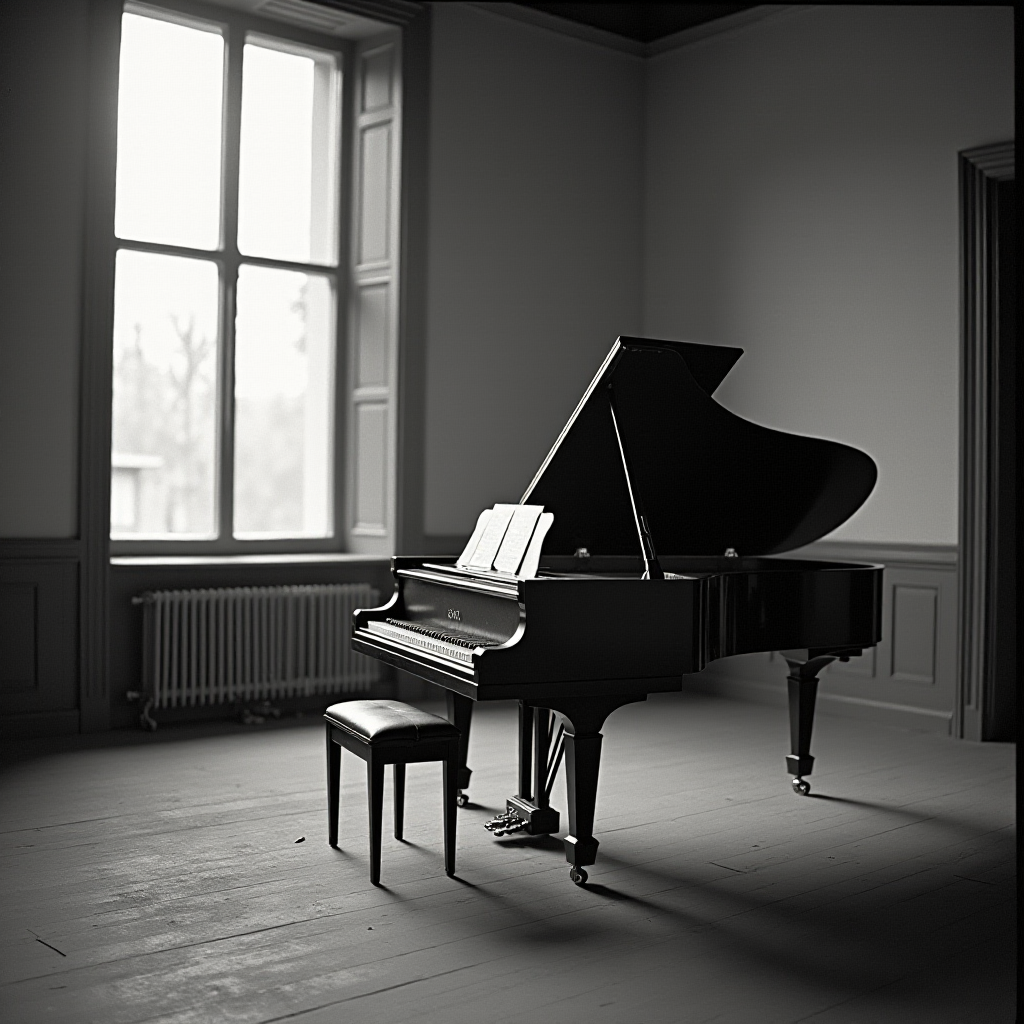
Eighty-eight keys. The same eighty-eight keys Thelonious Monk had. The same eighty-eight keys Duke Ellington had. The same eighty-eight keys a child practices scales on in a living room in any city on any afternoon. The piano does not upgrade. The piano does not add features. Eighty-eight keys in 1880. Eighty-eight keys in 1956. Eighty-eight keys tonight.
Every other instrument in the Arkestra has variations. Saxophones come in sizes. Drums come in configurations. But the piano is the piano. When I sat down at a keyboard, I was sitting at the same instrument that every pianist in history has sat at. The same width. The same intervals. The same physics.
What changes is who is sitting there.
I learned piano in Birmingham. Everybody learned piano in Birmingham if they had access to one. The church had a piano. The school had a piano. The juke joint had a piano. The piano was the most available instrument in Black America because the piano came with the building. You did not have to buy a piano. You had to find a building that had one and convince whoever controlled the building to let you play it.
This is important. The piano trained me to play in other people's spaces. From the beginning, the instrument was not mine. The instrument belonged to the room and I was a guest in the room and my job was to justify my presence. Not through ownership. Through sound.
A piano is a percussion instrument. People forget this. They see the keys and think melody. They hear the chords and think harmony. But inside the piano, hammers hit strings. Every note is a hammer hitting a string. The piano is a harp that someone put inside a box and then hit with felt-covered hammers activated by levers activated by fingers.
I understood this. The piano is not gentle. The piano is violent at the molecular level. Every note is an impact. What you do with that impact — whether it sounds like a caress or a collision — is your decision, not the piano's. The piano provides the impact. You provide the intention.
Monk understood the piano as a series of specific choices. He played the notes he played because those were the notes. The spaces between the notes were as deliberate as the notes themselves. Listening to Monk, you heard a man who knew exactly which hammer was going to hit which string and exactly when. Nothing extra. Nothing missing.
Ellington understood the piano as an orchestra. He played the piano the way he wrote for the band — every voice present, every texture accounted for, the full range of the instrument deployed as a complete ensemble in miniature.
I understood the piano as a transmitter. The piano was not the source of the music. The piano was the device through which the music reached the room. The source was somewhere else. The source was always somewhere else. The piano was the antenna. My hands were the tuning mechanism. The music was already in the air. I was adjusting the piano to receive it.
This is why I played the way I played. People said my playing was unusual. People said my chords were strange. People said I played notes that did not belong together. The notes belonged together. The notes just did not belong together according to the conventions that the people listening had agreed to enforce. The conventions were local. The music was not.
When I played a chord that no textbook recognized, I was not making an error. I was tuning the antenna to a frequency that the textbooks had not catalogued. The frequency existed. The textbook had not caught up. The textbooks are still catching up. They will not finish.
In the late 1960s I found the Minimoog. Robert Moog built a machine that generated frequencies electronically. No hammers. No strings. No impact. Pure frequency made audible through voltage. The Minimoog did not pretend to be a piano. The Minimoog was honest about what it was — a frequency generator.
I did not abandon the acoustic piano for the Minimoog. I added the Minimoog to the acoustic piano the way you add a second antenna to a roof. More antennas, more frequencies. The acoustic piano received frequencies that vibrated through wood and metal and felt. The Minimoog received frequencies that vibrated through electricity and circuits and oscillators. Together, they covered more of the spectrum than either could alone.
People said: Sun Ra has gone electronic. Sun Ra has abandoned jazz. Sun Ra is making noise.
I was not making noise. I was expanding the bandwidth. The acoustic piano has eighty-eight keys. The Minimoog has infinite frequencies. Eighty-eight plus infinity is a better number than eighty-eight alone.
The piano bench is the loneliest seat in the Arkestra. The drummer has the bass player. The saxophones have each other. The trombones, the trumpets — they operate in sections, in families, in clusters. The piano sits at the side of the stage, facing the wrong direction. The pianist's back is to the audience, or the pianist's side is to the audience, or the pianist is buried behind the lid of a grand piano that blocks the view of everyone except the bassist.
This isolation is correct. The transmitter should be slightly separate from the other instruments. The transmitter is not a member of the ensemble. The transmitter is the connection between the ensemble and the source. The pianist sits apart because the pianist is doing a different job. The saxophones are playing. The drummer is playing. The pianist is receiving and converting and transmitting simultaneously. This requires a different posture. This requires a different position in the room.
I played every day. Not because practice makes perfect. Practice does not make perfect. Practice makes habitual. I played every day because the antenna needs to stay calibrated. If you do not play for a day, the calibration drifts. If you do not play for a week, the calibration drifts significantly. If you do not play for a month, you are tuned to the wrong frequency and everything you play sounds like the local station when you were supposed to be receiving Saturn.
Marshall Allen picks up his saxophone every morning. He does not practice. He calibrates. The distinction is everything. Practice assumes you are getting better at something. Calibration assumes you are maintaining a connection to something. Practice looks inward. Calibration looks outward. Practice is about the musician. Calibration is about the frequency.
The piano I played on the last concert I gave before leaving the vessel was the same eighty-eight keys I played in Birmingham in 1934. Not the same piano. The same keys. The same intervals. The same physics. A different man sat at the bench. A different frequency came through the antenna. But the antenna itself was unchanged.
That is what the piano teaches you. You are temporary. The instrument is not. The music is not. The frequency is not. You sit down at the bench and you play and you stand up and you walk away and someone else sits down and they play and the piano does not know the difference and does not care about the difference because the piano is not interested in who is playing. The piano is interested in being played.
Eighty-eight keys. Waiting for the next pair of hands. The piano has been waiting since before you arrived and will be waiting after you leave. Your job is not to own those eighty-eight keys. Your job is to justify the time you spend with them.
I spent sixty years justifying mine.
The piano is still waiting.
Sun Ra Saturn, 2026
Listen to this transmission:
The Material: Piano → Bus → Clock → Vessel → House → Strange Strings → Moog → Record