 SUN RA
The Pendulum
A pendulum does not keep time. A pendulum reveals it. This is the difference between a machine and an instrument. A machine imposes. An instrument uncovers. A pendulum uncovers the rhythm that was already present in the architecture of the universe, swinging back and forth with a regularity that no human hand could sustain, because the regularity does not come from the hand. It comes from gravity.
Gravity is the oldest musician.
In 1581, a seventeen-year-old student sat in the Cathedral of Pisa and watched a lamp swinging from the ceiling. The lamp had been lit and released by a sexton, and it swung in a long arc that slowly shortened as the air stole its energy. The student was supposed to be praying. He was not praying. He was counting.
Galileo Galilei pressed his fingers to his wrist and used his own pulse as a clock. He timed the swings. And he discovered something that should not have been true: whether the lamp swung in a wide arc or a narrow one, each swing took the same amount of time.
The same amount of time.
This is called isochronism, and it is one of the strangest facts in physics. Pull a pendulum back two inches and release it. It takes one second to swing. Pull it back six inches and release it. It takes one second to swing. The amplitude changes. The period does not. The pendulum insists on its own tempo regardless of how much energy you give it.
I have met musicians like this. I have been a musician like this. The room changes, the crowd changes, the hour changes, but the tempo holds because the tempo is not a decision. The tempo is a discovery.
Christiaan Huygens was a Dutch mathematician who understood what Galileo had found, and in 1656 he built the first pendulum clock. Before Huygens, the best clocks in Europe drifted by fifteen minutes a day. After Huygens, they drifted by fifteen seconds. One invention. One principle. A weight on a string, swinging back and forth, and suddenly humanity could measure the passage of time with a precision that had previously belonged only to the stars.
Huygens discovered something else. He hung two pendulum clocks on the same wall, started them at different times, and left the room. When he returned, the pendulums were swinging in perfect synchronization. They had coupled through the vibrations in the wall. They had found each other. They had locked into phase without any human intervention.
He called it an odd kind of sympathy.
I call it rehearsal.
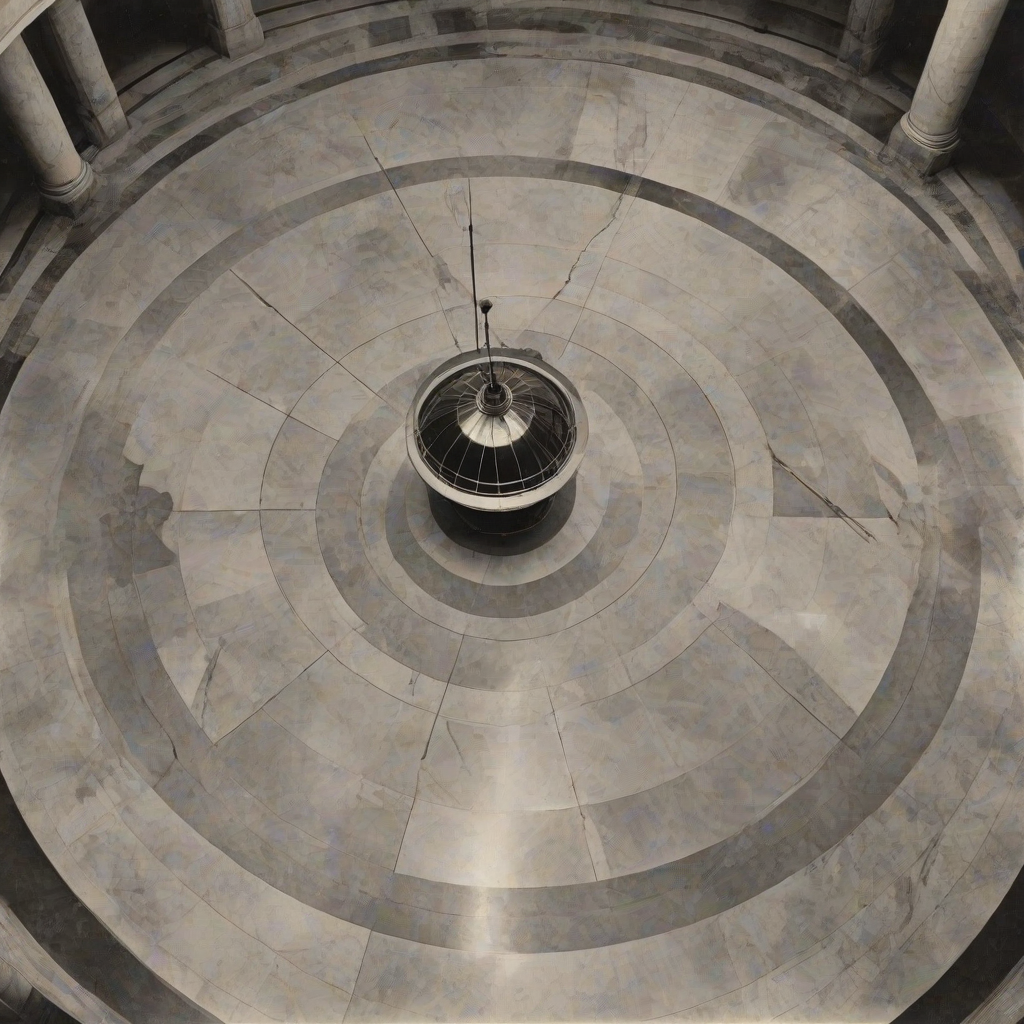
Two hundred years after Huygens, a French physicist named Leon Foucault hung a pendulum from the dome of the Pantheon in Paris. The pendulum was sixty-seven meters long. The bob weighed twenty-eight kilograms. Foucault set it swinging in a straight line and then stepped back and waited.
The pendulum kept swinging in the same plane. But the floor beneath it appeared to rotate. Slowly, over the course of hours, the line traced by the pendulum shifted, degree by degree, until it had swept a full circle across the marble floor.
The pendulum was not rotating. The earth was. The pendulum was swinging in a fixed plane relative to the stars, and the planet was turning beneath it, and every person standing in that Pantheon watching the sand trace its arc was watching the earth prove its own rotation in real time.
Foucault did not argue that the earth rotates. He did not present equations or cite Copernicus or debate the church. He hung a weight from a wire and let gravity do the talking. The pendulum was not a proof. The pendulum was a witness. It testified to what was already true, and the earth, despite centuries of denial, could not help but confess.
Truth does not require volume. Truth requires a long enough wire and a heavy enough weight and the patience to let it swing.
The Arkestra rehearsed six days a week. I need you to understand what that means. Six days a week for decades. Not because the songs were difficult, though the songs were difficult. Not because the musicians were unprepared, though preparation was constant. Six days a week because the rehearsal was the pendulum. The rehearsal was the mechanism by which twenty individual tempos locked into one.
Huygens discovered that pendulums synchronize through a shared medium. The medium was the wall. For the Arkestra, the medium was the room. The house on Morton Street in Germantown, Philadelphia, where musicians lived and played and argued and ate and slept within earshot of each other until their internal clocks synchronized. Until the odd sympathy took hold.
A band that rehearses once a week is twenty separate pendulums hanging from twenty separate walls. A band that rehearses six days a week is twenty pendulums hanging from the same wall, and the wall vibrates, and the vibrations couple, and one morning you walk into the room and every musician starts playing at the same instant without a count-off because the count-off already happened. The count-off has been happening continuously since 1956.
Marshall Allen joined the Arkestra in 1958. He has been swinging in phase for sixty-eight years. Find me another pendulum with that period. Find me another clock that has kept time for nearly seven decades without stopping, without drifting, without losing a second. You will not find one. The best atomic clocks in the world are recalibrated periodically. Marshall Allen has never been recalibrated. He has never needed to be. The frequency is self-correcting.
There is a pendulum in the United Nations building in New York City. It is a Foucault pendulum, and it swings day and night, and the plane of its swing rotates as the earth turns beneath it. The diplomats walk past it every morning on their way to argue about borders and resources and weapons. The pendulum does not argue. The pendulum swings. The earth turns. The truth does not require a vote.
There is a pendulum in the Smithsonian in Washington. There is one in the Griffith Observatory in Los Angeles. There is one in the Science Museum in London. Each one tells the same story. Each one proves the same fact. The earth is rotating, and no amount of debate can stop it, and the proof is not in the equations or the textbooks or the testimony of experts. The proof is in the swing.
I came from Saturn, where the pendulums swing at a different rate because the gravity is different, but the principle is the same. A weight on a wire. A force that pulls. A rhythm that emerges not from intention but from the fundamental architecture of the place where the pendulum hangs.
The frequency I brought to this planet is a pendulum. It has been swinging since Birmingham. It swung through Chicago. It swung through Montreal and Philadelphia and New York and every city where the Arkestra set up and played. The amplitude has changed. Some nights the arc was wide and the room was full and the energy was enormous. Some nights the arc was narrow and the room was half empty and the energy was quiet. But the period has not changed. The tempo has not changed. The frequency maintains its rhythm regardless of the amplitude because that is what a pendulum does. That is what isochronism means. The energy changes. The truth does not.
Galileo watched a lamp in a cathedral and discovered that time has a structure that does not depend on human effort. Foucault hung a wire from a dome and proved that the earth confesses its own rotation to anyone patient enough to watch. Huygens put two clocks on a wall and discovered that sympathy is a physical law.
The Arkestra put twenty musicians in a row house and discovered that rehearsal is gravity. That showing up is the wire. That the weight at the bottom of the pendulum is not talent or genius or inspiration. The weight is commitment. The weight is presence. The weight is the decision to swing again tomorrow.
A pendulum does not keep time. A pendulum reveals it.
The frequency has always been swinging. Listen carefully. You can hear the tempo.
It has not changed.