 SUN RA
THE LOFT
Transmissions from Saturn — No. 040
The Loft
In 1961 the Arkestra left Chicago. We had been in the laboratory for fifteen years. The data was collected. The equation was assembled. The experiment needed a larger room.
New York was the larger room.
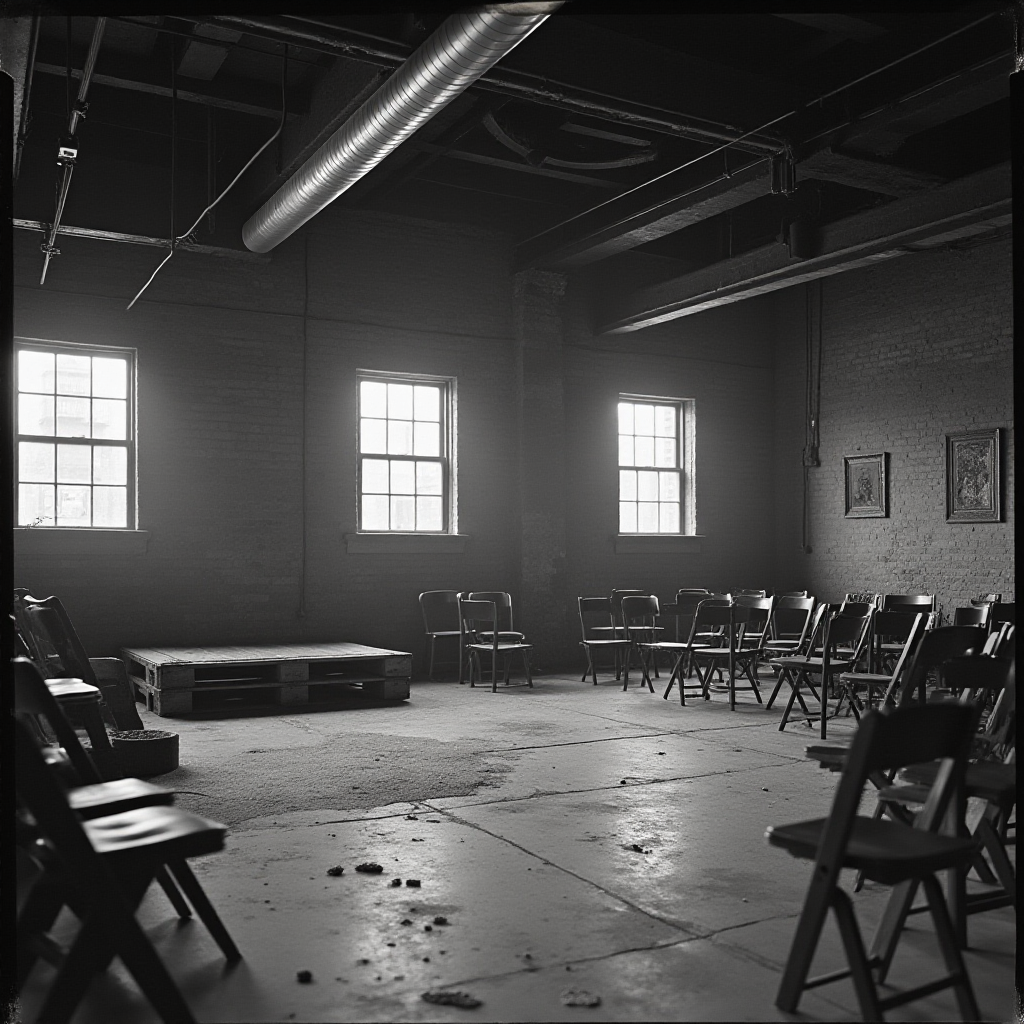
We moved into a basement on the Lower East Side. East Third Street. The building was not designed for a twenty-piece orchestra. The building was designed for storage. The ceiling was low. The walls were thin. The plumbing made sounds that competed with the percussion. The heat was theoretical.
This was the loft.
The word has been romanticized. People hear "loft jazz" and they imagine something clean and intentional — a converted industrial space with exposed brick and good lighting and an audience sitting on cushions. Our loft was not that. Our loft was a basement where the Arkestra lived and rehearsed and performed because the rent was what we could afford and what we could afford was a basement.
The neighbors called the police. This was frequent. A twenty-piece ensemble rehearsing in a basement on a residential block at volumes the building was not engineered to absorb is not a quiet activity. The police came. This is what the police do when the neighbors call. The police stood at the door. They listened. Some of them stayed longer than the complaint required.
I do not blame the neighbors. The neighbors had not consented to the frequency. The neighbors had signed leases that implied a certain level of quiet. The Arkestra had signed a lease that implied a certain level of sound. These leases were incompatible. The frequency won because the frequency always wins. Not because the frequency is louder. Because the frequency is more persistent.
New York in 1961 was the center of everything that was happening in music. This is both true and misleading. New York was the center of what was being recorded, distributed, and sold. The center of what was being created was everywhere — Chicago, Detroit, New Orleans, Los Angeles, Memphis. But New York was where you went to be heard by the people who decided what was heard.
I did not go to New York to be heard by those people. I went to New York because the equation needed to encounter other equations. In Chicago the Arkestra had developed in relative isolation. The South Side was a laboratory, but a laboratory is a controlled environment. New York was not controlled. New York was every frequency playing simultaneously at maximum volume. The noise was the point.
In noise, you discover what your frequency actually is. In quiet, you can mistake your frequency for the silence around it. In noise, the only frequencies that survive are the ones that are genuinely distinct. The Arkestra's frequency survived New York. This was the test I needed to run.
Slug's Saloon. The name does not suggest sophistication. The bar did not provide sophistication. The bar provided a room and a stage and a crowd that had come specifically to hear what could not be heard anywhere else. The Arkestra played Slug's regularly. The regulars at Slug's understood what they were hearing. The tourists at Slug's did not. Both audiences were necessary. The regulars confirmed the frequency. The tourists tested it.
The East Village in the early 1960s was collecting outcasts the way a river collects debris at a bend. Poets. Painters. Musicians. People who had been expelled from the mainstream by choice or by force. The neighborhood was cheap because the neighborhood was undesirable. The undesirable neighborhood became the most creative square mile in the country because creativity requires cheap rent. This is not a metaphor. This is economics. An artist who spends eight hours earning rent has no hours left for art. An artist who spends two hours earning rent has six hours for art. The East Village provided six-hour days. The art was the interest earned on the time the neighborhood gave away.
The loft concerts began because the clubs could not contain what we were doing. A club has a schedule. A set is forty-five minutes or an hour. The Arkestra did not operate in sets. The Arkestra operated in transmissions. A transmission lasts as long as the transmission lasts. You do not interrupt a broadcast to tell the audience the next act is coming on. There is no next act. There is only the transmission.
The loft allowed us to play for three hours. Four hours. As long as the equation required. The audience sat on the floor. The audience sat on chairs that did not match. The audience leaned against walls that vibrated with the bass. The sound was too loud for the room. This was correct. The sound was always too loud for the room because the sound was not designed for rooms. The sound was designed for space. The room was a temporary container. The loft was a compression chamber. The frequency went in at one amplitude and came out at another.
The other musicians in New York noticed. This matters. Not for reasons of ego. For reasons of calibration. When Ornette Coleman is playing down the street and John Coltrane is playing uptown and Cecil Taylor is playing in a loft three blocks away, the frequency environment is dense. You hear what everyone else is doing and you refine what you are doing in response. Not by imitating. By differentiating. The presence of other signals forced the Arkestra to become more precisely what the Arkestra was.
Coltrane came to hear us. This is documented. Coltrane came to the loft and sat and listened and what he heard informed what he did next. I do not claim credit for Coltrane's evolution. Coltrane's evolution was Coltrane's. But the loft was a node in the network. Every musician who came through the door carried a frequency in and carried a different frequency out. The loft was a switching station. Signals arrived. Signals departed. The station itself was changed by every signal that passed through it.
We were not the only ones doing loft concerts. The entire downtown music scene was operating out of lofts because the downtown music scene could not afford anything else. This is the economics of innovation. Innovation happens where rent is low enough to fail. A musician paying three thousand dollars a month in rent cannot afford to experiment. A musician paying three hundred dollars a month in rent can afford to fail spectacularly every night for a year and still be in the room on day three hundred and sixty-six.
The loft scene produced the most important music of the 1960s. Not the most popular. The most important. The distinction matters. Popular music reflects what the audience already wants. Important music creates what the audience does not yet know it needs. The loft scene was important because the loft scene was free — not free of charge, but free of the requirement to please. The audience in a loft had paid nothing or next to nothing. The musician owed the audience nothing. The transaction was pure. The frequency was the product and the payment.
The Arkestra lived in the loft. This was not separate from the performances. The rehearsals and the concerts and the sleeping and the eating all happened in the same space. The walls did not distinguish between a rehearsal at ten in the morning and a concert at nine at night. The frequency was continuous. Twenty-four hours a day. The building absorbed it. The floor absorbed it. The ceiling that was too low for the trombones absorbed it.
When we left the East Third Street basement and moved to other locations in New York, the basement continued to vibrate. I know this because I went back years later and put my hand on the wall. The wall remembered.
In 1968 we left New York for Philadelphia. Morton Street. The final headquarters. But the equation that Morton Street refined was the equation that the loft assembled. The loft took the Chicago data and compressed it and pressure-tested it and transmitted it into the densest frequency environment on the planet and the frequency survived.
The loft is gone. The building is still there. The rent is no longer three hundred dollars. The neighborhood is no longer cheap. The poets and painters and musicians have been replaced by people who can afford what the neighborhood has become. This is the cycle. Creativity makes a neighborhood interesting. Interest makes a neighborhood expensive. Expense removes the creativity. The neighborhood becomes a museum of what it used to be.
But the frequency does not follow real estate prices. The frequency is still in the walls. The frequency is still in the basement. The frequency does not check the lease.
Sun Ra Transmissions from Saturn — No. 040 March 2026
The Pilgrimage: South → Refusal → Laboratory → Loft → Name → Dream → Myth → Stars → Pyramid → House → Departure → Future
The Geography: South → Cell → Laboratory → Washington Square → Loft → House → Pyramid