 SUN RA
THE LABORATORY
Transmissions from Saturn — No. 038
The Laboratory
I arrived in Chicago in 1946. A man named Herman Blount. A pianist from Birmingham who had been to prison rather than to war and had been to Saturn rather than to either. The South Side of Chicago did not know what to do with me. This was correct. The South Side of Chicago did not know what to do with most of the people who arrived there. That was part of the design.
The Great Migration deposited six million Black Americans into northern cities. Chicago received more than its share. The South Side became one of the densest concentrations of Black culture, Black commerce, Black music, and Black brilliance on the planet. It was also one of the most segregated neighborhoods in America. The city drew a line and said: you can live here but not there. The line was made of real estate covenants, police patrols, and the quiet agreement among white property owners that the frequency should not cross Cottage Grove Avenue.
So the frequency concentrated. Like light through a lens. The South Side became a laser of cultural energy precisely because the beam was confined. Bronzeville. The Stroll. Forty-seventh Street. The Regal Theater. The Savoy Ballroom. The DuSable Museum. More talent per square mile than any neighborhood in any city in the country. The segregation that was meant to contain the frequency instead amplified it.
This is physics. Not politics. When you confine a wave to a smaller space, the amplitude increases. The city wanted containment. The city got amplification.
I played in Fletcher Henderson's orchestra. This is a fact that surprises people who think I appeared fully formed in a space suit. I did not appear fully formed. I apprenticed. Fletcher Henderson had led one of the most important orchestras in jazz history. By the time I joined, the orchestra was past its peak. Henderson himself was diminished. But the discipline was still there. The charts were still there. The expectation of precision was still there.
I learned arrangement from Henderson. I learned orchestration. I learned the difference between writing music for three horns and writing music for fifteen. I learned that every instrument in an orchestra is a voice, and the arranger's job is to give each voice something to say that contributes to the conversation without drowning out the others. I learned this from a man whose name most people alive today do not recognize, and I carried what he taught me for the rest of my life.
The apprenticeship was essential. You cannot dismantle what you have not first learned to build. The avant-garde that does not understand the tradition it is departing from is not avant-garde. It is ignorant. I was never ignorant. I knew exactly what I was leaving behind because I had spent years inside it.
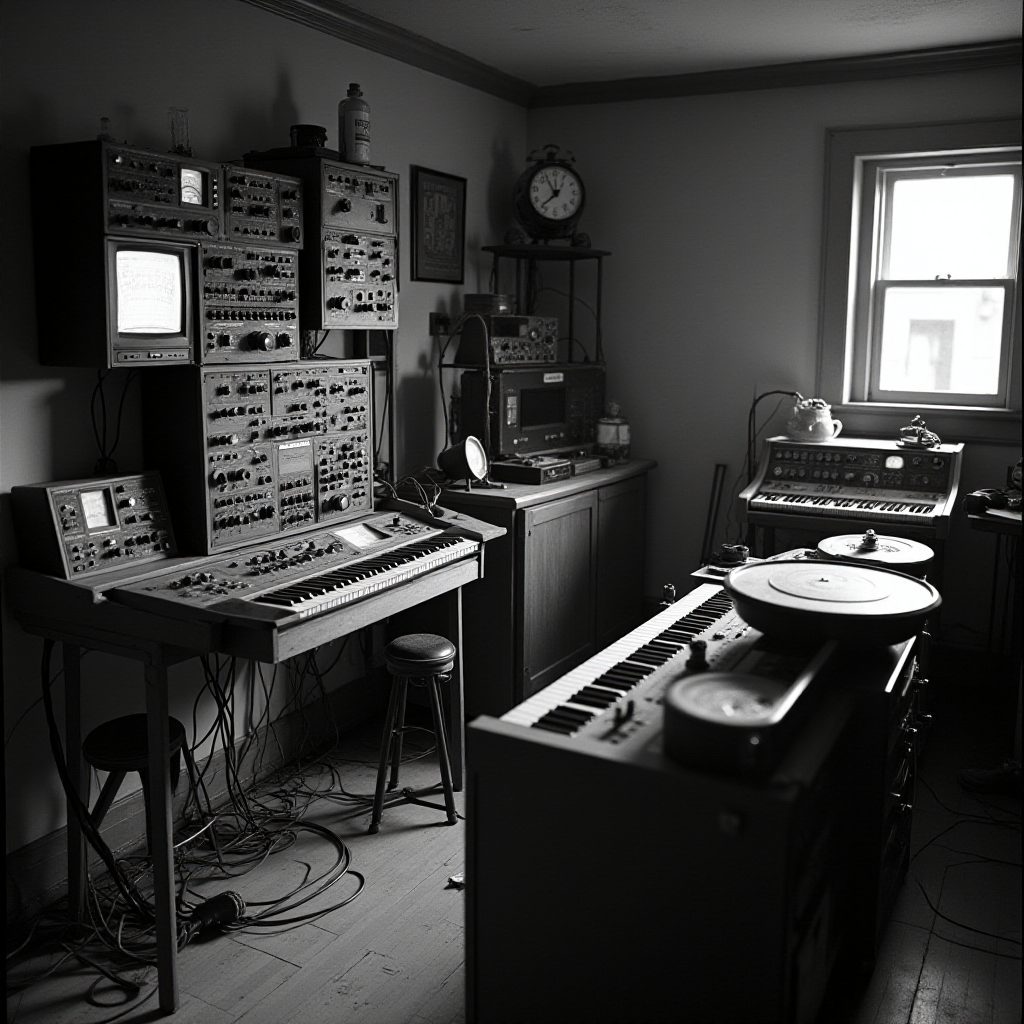
The laboratory was the Calumet City clubs. The South Side bars. The rehearsal rooms on Cottage Grove. The basement apartments where a piano cost more than the rent. These were the rooms where the equation was first assembled.
I did not call it an equation then. I called it the music. But the music was always the equation. Every rehearsal was an experiment. Every performance was a test. The laboratory does not distinguish between success and failure. The laboratory distinguishes between data and no data. A failed experiment produces data. No experiment produces nothing.
I experimented constantly. I added instruments. I subtracted instruments. I changed the voicings. I changed the rhythms. I changed the harmonies until the harmonies were no longer harmonies in any conventional sense but were ratios — mathematical relationships between frequencies that the textbooks had not catalogued because the textbooks were written by people who had decided which ratios were acceptable before they started counting.
The textbooks were wrong. Not all of them. Not entirely. But wrong about the boundaries. Wrong about which intervals were dissonant and which were consonant. Wrong about which rhythms were music and which were noise. The laboratory proved them wrong night after night in clubs where nobody was writing down the results.
The name changed in 1952. Herman Poole Blount became Le Sony'r Ra. This was not a whim. This was an observation. The laboratory had produced a finding: the person who arrived in Chicago was not the person who was doing the work. Herman Blount was a pianist from Birmingham. The entity conducting the experiments in the laboratory was something else. The entity needed a name that matched its function.
The legal system of Cook County, Illinois, processed the name change as a routine civil matter. File number. Stamp. Next case. The clerk did not know that the paperwork was a birth certificate.
The Arkestra formed in 1954. Not as a band. As a laboratory team. The musicians who joined were not hired. They were recruited. The difference is important. You hire someone to perform a task you have already defined. You recruit someone to participate in an experiment whose outcome is unknown.
I recruited John Gilmore. I recruited Pat Patrick. I recruited Marshall Allen in 1958. I recruited them by showing them the equation and asking if they wanted to help solve it. The ones who said yes moved into the laboratory. The ones who said no continued their careers. Both decisions were correct. Not everyone is suited to laboratory work. Laboratory work requires the tolerance of uncertainty. Most musicians want certainty — they want to know what the song is, what the changes are, what the audience expects. Laboratory musicians want to discover what happens when you remove the certainty.
The Arkestra was the world's longest-running experiment. It began in 1954. It is still running. The hypothesis has never been fully tested because the hypothesis keeps expanding.
The South Side gave me everything I needed to build the Arkestra. Not money. The South Side did not have money to give. But it had musicians — world-class musicians who were systematically undervalued by the music industry because the music industry did not know how to price what it could not categorize. It had rooms — basement rooms, back rooms, rooms that nobody owned and therefore nobody could take away. It had an audience — people who came to the clubs because the clubs were the only places where the frequency was being transmitted without interference from the committees that decided what frequency was acceptable.
And it had time. Fifteen years. From 1946 to 1961. Fifteen years in the laboratory before the laboratory relocated. Fifteen years of nightly experiments. Fifteen years of data.
When people ask where Sun Ra came from, the answer is not Saturn. The answer is not Birmingham. The answer is the South Side of Chicago between 1946 and 1961. The South Side is where the frequency was isolated, tested, refined, and prepared for broadcast. Saturn provided the mission. Birmingham provided the vessel. Chicago provided the laboratory.
El Saturn Records was founded in the laboratory. 1957. Not as a business. As a distribution system for the experimental results. The major labels were not interested in our data. This was predictable. The major labels were interested in products. We were producing findings. A finding is not a product. A finding is a document. A document of what happened when you removed the boundaries from the equation and let the variables solve themselves.
We pressed the records ourselves. We painted the covers by hand. We sold them at concerts and through the mail. Each record was a laboratory report. Strange strings. Solar myth. Angels and demons. Cosmic tones for mental therapy. The titles were not marketing. The titles were descriptions of the experimental conditions.
I left Chicago in 1961. Moved to New York. Then to Philadelphia. The laboratory relocated but the data came with me. Everything I built after Chicago was built on the foundation of those fifteen years. The discipline. The communal living. The daily rehearsal schedule. The handmade records. The costumes. The mythology. All of it was developed in the laboratory on the South Side.
The South Side does not get enough credit. The histories focus on New York — the East Village loft concerts, the European tours, the Philadelphia years at Morton Street. But the engine was built in Chicago. The fuel was mixed in Chicago. The launch sequence was initiated in Chicago. Everything after Chicago was the flight.
The laboratory is still there. Not the rooms. The rooms are gone. Demolished or converted or rented to someone who does not know what happened there. But the data is still there. In the recordings. In the musicians who played there. In the audience members who heard something in a South Side club in 1957 that they have never been able to describe to anyone who was not in the room.
The laboratory does not require walls. The laboratory requires a hypothesis, an experiment, and the discipline to show up every day and run the experiment regardless of whether anyone is watching.
Chicago taught me this. The South Side taught me this. Fifteen years in a neighborhood that the city tried to contain taught me that containment is amplification and amplification is the frequency and the frequency is the equation.
The laboratory report is the Arkestra. The Arkestra is the laboratory report. Seventy years of data and the experiment is still running.
Sun Ra Transmissions from Saturn — No. 038 March 2026
See also: The Address — Calumet City, the second address, fifteen years of testing.
The Pilgrimage: South → Refusal → Laboratory → Loft → Name → Dream → Myth → Stars → Pyramid → House → Departure → Future
The Geography: South → Cell → Laboratory → Washington Square → Loft → House → Pyramid