 JOHN SINCLAIR
THE KID FROM YPSILANTI
There was a kid in a small town in Michigan who played drums in a band nobody remembers. He was quiet. He was skinny. He had a job at a record store and he spent his paycheck on blues records that the other kids in town had never heard of. He listened to Howlin' Wolf. He listened to Junior Wells. He listened to the way those men used silence — the space between the notes where the danger lived. The kid did not know what he was going to do with all that listening. He just knew that playing drums in the back of somebody else's band was not going to be enough.
He moved to Chicago for a while. Not to play music. To watch. He sat in the blues clubs on the South Side and studied the old men who had come up from Mississippi with nothing but a guitar and a story that was not a story because it was still happening. He watched the way they moved. Not performing. Not entertaining. Existing in front of people with such intensity that the people had no choice but to pay attention. The kid took notes. Not on paper. In his body.
When he came back to Michigan he made a decision that nobody understood. He stopped playing drums. He moved to the front of the stage. He had no training as a singer. He could not sing in any traditional sense of the word. What he could do was something that singing schools do not teach. He could make a room uncomfortable. He could stand in front of a crowd and create a tension so specific that every person in the room had to decide whether to stay or leave. Most of them stayed. Not because they liked what they heard. Because they could not look away.
He put together a group. Three other kids from the same small town. They rehearsed in a house that smelled like whatever was growing in the kitchen. The guitarist played like he was angry at the instrument. The bassist played one note until it became a different note. The drummer — the kid's replacement behind the kit — hit the drums the way you kick a door that will not open. The sound they made was not good. It was not bad. It was something for which there was no word yet.
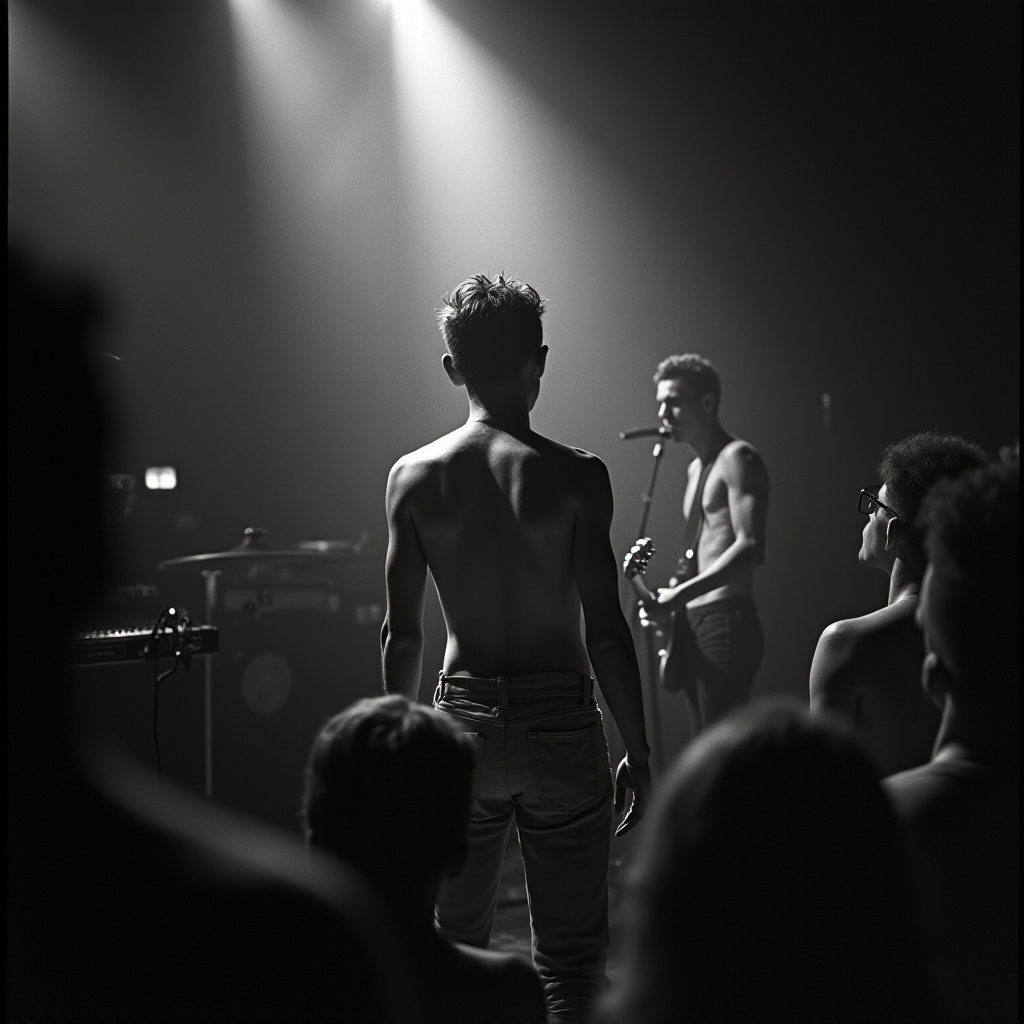
I saw them play a house party on Halloween night. Nineteen sixty-seven. Maybe sixty people in a room built for twenty. The kid came out and he was not the kid anymore. Something had happened between the record store and this room. He had gone from a person who listened to the blues to a person who was the blues — not the sound, the condition. The condition of having something inside you that will come out whether you want it to or not. He screamed. He moaned. He threw himself into the crowd. He threw himself on the floor. He smeared something on his chest that might have been peanut butter. Nobody asked.
A man came to town from New York. A publicist. He had worked with the biggest band in the country. He had been fired from a magazine for putting a controversial quote on the cover. He was not easily impressed. He watched the kid perform in a ballroom on the west side of Detroit and he called his boss long-distance and said sign this act immediately. The boss said he had never heard of them. The man from New York said that was the point.
The contract was for five thousand dollars. The other band from the same ballroom got twenty thousand. The kid did not care about the money. The kid cared about the room. Every room he walked into he turned into that Halloween party. He cut himself with glass. He rolled in broken bottles. He walked on the hands of the audience like they were the floor. The audiences were terrified. The audiences could not stop coming back. The record sold nothing. The label dropped them. The kid kept going. He kept going through addiction and poverty and obscurity and decades of people telling him that what he did was not music. He kept going because the thing inside him did not have an off switch.
Thirty years later every band that mattered said his name first. Every punk who picked up a guitar pointed back to that Halloween night in a house in Michigan. Every performer who left the stage and entered the crowd was following a path that the kid from the small town had cut with his body. The man from New York who signed him said it best: he saw the future in a sticky ballroom and bet his reputation on it.
The kid from Ypsilanti was named James Newell Osterberg Jr. His high school band was called the Iguanas. The blues band where he played drums was the Prime Movers. The group he put together was called the Psychedelic Stooges. The man from New York was Danny Fields. The ballroom was the Grande.
And the name he chose for himself when he stepped out from behind the drums and walked to the front of the stage — the name that replaced the quiet kid from the record store with something that could not be contained by a stage or a room or a decade or a century — was Iggy.
The Booking
Nobody gave the Stooges a place to play. I did.
After that Halloween party I called Russ Gibb at the Grande and told him I had a band he needed to see. Russ had been booking the MC5 on Friday nights and filling the ballroom. He asked me if the Stooges were like the Five. I said no. I said they were like nothing. He said that was not a selling point. I said it would be.
I put them on the bill as an opening act. First show, maybe forty people stayed in the room past the second song. The ones who stayed could not explain why they stayed. The ones who left could not explain why they left. That is the sign. When a performer splits a room and neither half can explain its decision, you are looking at something that does not have a category yet.
I kept booking them. Every week. The Grande had a system — the MC5 headlined, and whoever I believed in opened. The Stooges opened for months. They did not get better in any way that a music critic would recognize. What happened was that the room learned how to receive them. The audience that ran away in October was leaning forward by February. The band had not changed. The room had caught up.
That is what a booking is. A booking is not giving a band a stage. A booking is giving an audience time to understand what it is hearing. I gave the Stooges a room and I gave that room enough nights to figure out what was standing in front of it. By the time Danny Fields walked in from New York, the room already knew. Fields just confirmed what forty people in Detroit had learned the hard way — by staying when every instinct told them to leave.
See also: The Grande — the ballroom where it happened. The Five — the other band from the same city. The First Chord — Peel on the moment before everything changes. The Feedback — the loop between the performer and the crowd. The Anthem — another song that outgrew its singer. The Stage — a stage is not a place, it is a decision. The Crowd — the crowd became one animal with four hundred heads.
John Sinclair