 SUN RA
THE HOUSE
Transmissions from Saturn — No. 036
The House
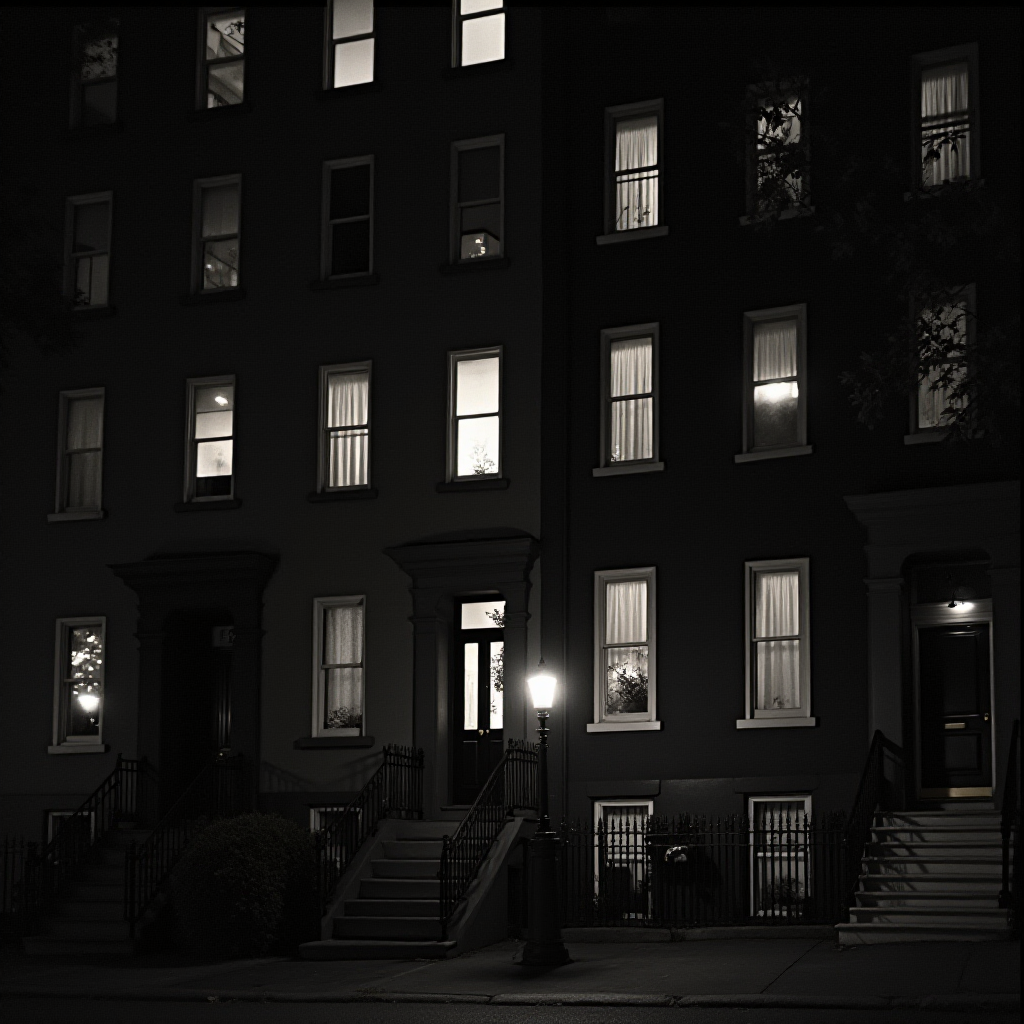
5626 Morton Street. Germantown. Philadelphia.
The address does not look like much. A row house in a neighborhood that never made the tourist maps. Three stories. Narrow. The kind of house that was built for a family and ended up holding something else entirely.
The Arkestra lived there. Together. For twenty-five years.
People hear this and they think commune. They think hippies. They think the sixties. They compare it to Haight-Ashbury or Trans-Love Energies or any of the other experiments in shared living that lasted until the landlord showed up or the drugs ran out or someone decided they wanted their own bathroom.
The Morton Street house was not a commune. A commune is a lifestyle choice. The Morton Street house was a rehearsal facility that happened to contain beds.
The Arkestra did not live together because living together was a philosophy. The Arkestra lived together because the equation required proximity. You cannot rehearse six days a week if the musicians have to commute from the suburbs. You cannot maintain the frequency if the musicians go home after rehearsal and tune to different frequencies. The house was a resonance chamber. The walls absorbed the frequency and held it between rehearsals. The musicians lived inside the frequency twenty-four hours a day. This was not optional. This was physics.
The house was not comfortable.
I will say that clearly because the romantics will turn it into something it was not. The house was not a utopia. The house was a building with too many people in it, not enough money running through it, and a furnace that worked when it wanted to. There were mice. There were plumbing problems. There were days when the electric bill was a decision between lights and food.
The musicians did not live there because the living was good. The musicians lived there because the living was the equation. Discomfort is part of the equation. A comfortable musician is a musician who has something to lose. A musician with something to lose plays to protect what he has. A musician with nothing to lose plays to discover what he could have. The house made sure nobody had anything to lose.
I had a room on the third floor. The room was small. The room contained a bed, a piano, a Minimoog, a tape recorder, and papers. The papers were everywhere. Scores. Poems. Calculations. Letters. The filing system was gravitational — things fell where they fell and stayed where they landed. The room was not organized by any standard your civilization would recognize. The room was organized by frequency. Everything in the room was tuned to the same frequency. The disorder was a form of order that only made sense if you were transmitting on the correct channel.
The piano was in the room. This is important. The piano was not in a studio or a practice room or a concert hall. The piano was in the room where I slept. The first thing I did in the morning was play the piano. The last thing I did at night was play the piano. The piano was not an instrument I visited. The piano was a piece of furniture I lived with. You do not visit a chair. You do not schedule time with a table. You live with them. I lived with the piano.
Downstairs the rehearsal happened. The front room. The musicians assembled at ten in the morning. Sometimes earlier. The schedule was not negotiable. Ten in the morning. Six days a week. Sometimes seven. For decades.
The neighbors knew the schedule. The neighbors had opinions about the schedule. A twenty-piece ensemble rehearsing at ten in the morning in a row house in Germantown is not quiet. Brass and reed and percussion at volume through walls that were not built for brass and reed and percussion at volume. The neighbors either learned to appreciate the frequency or they moved. Most of them appreciated it. Some of them sat on their porches and listened. Some of them came inside.
The house did not have soundproofing. The house did not need soundproofing. Soundproofing is what you install when you want to keep the frequency inside. I did not want to keep the frequency inside. I wanted the frequency to leak. A house that leaks frequency is a transmitter. Every crack in the wall was an antenna. Every open window was a broadcast. The neighborhood was the audience whether it bought a ticket or not.
Meals were communal. The kitchen was functional, not decorative. Someone cooked. Everyone ate. The food was not gourmet. The food was sustenance. The difference between sustenance and cuisine is the same difference between rehearsal and performance. Sustenance keeps the vessel operating. Cuisine impresses the vessel's neighbors. We were not interested in impressing the vessel's neighbors. We were interested in keeping the vessels operational so the equation could be solved.
No alcohol. No drugs. This was a rule. This was not a moral rule. This was an engineering rule. The frequency requires clear reception. Alcohol blurs the frequency. Drugs distort the frequency. The equation requires precision. You do not solve a differential equation after three beers. You do not receive a transmission from Saturn through a pharmacological filter. The house was dry because the frequency demanded it.
People left. People always leave. The Arkestra was not a prison. Musicians joined. Musicians stayed for years or decades. Musicians left. Some came back. Some did not. The door was not locked from the inside. The frequency did not chain anyone to the building.
But the ones who stayed — the ones who stayed for decades — they understood something the ones who left did not understand. They understood that the house was not a sacrifice. The house was an amplifier. Living together amplified the frequency beyond what any individual musician could achieve alone. The rehearsal at ten in the morning was not a chore for the musicians who stayed. The rehearsal at ten in the morning was the reason the musicians stayed.
John Gilmore lived in the house for forty years. Marshall Allen has lived in the house since 1958. These are not sentences about housing. These are sentences about commitment that your civilization has no vocabulary for because your civilization measures commitment in contracts and the house had no contracts. The commitment was to the equation. The equation required the house. Therefore the commitment required the house. The logic is simple. The execution is a lifetime.
After I left the vessel, Marshall continued in the house. The house did not stop functioning because the person who started it was no longer in it. This is the proof that the house was never mine. The house belonged to the equation. I was one variable in the equation. The variable was returned in 1993. The equation continued. The house continued. The rehearsals continued. The ten-in-the-morning continued.
The house is still there. 5626 Morton Street. Germantown. Philadelphia. You can drive past it. You will see a row house in a neighborhood that does not look like the headquarters of a sixty-eight-year-old sonic institution. This is correct. The frequency does not require impressive architecture. The frequency requires a room. Any room. A row house in Germantown is a room. A lecture hall at Berkeley is a room. The Great Pyramid at Giza is a room. The room is not the point. What happens inside the room is the point.
Every civilization builds temples. Stone temples. Glass temples. Steel temples. The temples are designed to contain the frequency and aim it at the cosmos. The Great Pyramid was a temple. Notre-Dame was a temple. The Sydney Opera House is a temple.
5626 Morton Street was a temple.
The difference is that nobody designed it as a temple. Nobody commissioned an architect. Nobody raised funds. Nobody held a groundbreaking ceremony. A row house became a temple because the people inside it decided to treat it as one. They rehearsed inside it every day. They ate inside it. They slept inside it. They woke up inside it and solved the equation inside it and the walls absorbed the frequency and the walls remembered and the house became a temple not by design but by accumulation.
Twenty-five years of frequency accumulated in those walls. Twenty-five years of ten-in-the-morning rehearsals. Twenty-five years of communal meals. Twenty-five years of the equation being solved and resetting and being solved again. The walls of that house contain more accumulated frequency than most concert halls will absorb in a century.
You cannot hear it if you drive past. You would have to stop the car and put your hand on the wall. The wall is still vibrating. The wall will vibrate for as long as the building stands. This is not mysticism. This is physics. Every surface that has been exposed to repeated sound waves retains a vibrational memory. The house remembers. The house is still transmitting.
From a row house in Germantown. Twenty-four hours a day. Whether you are listening or not.
Sun Ra Transmissions from Saturn — No. 036 March 2026
See also: The Address — seven addresses across 112 years, including 5626 Morton. The Price — what $35 buys and what the house cost the frequency.
The Pilgrimage: South → Refusal → Laboratory → Loft → Name → Dream → Myth → Stars → Pyramid → House → Departure → Future
The Material: Piano → Bus → Clock → Vessel → House → Strange Strings → Moog → Record
The Geography: South → Cell → Laboratory → Washington Square → Loft → House → Pyramid