 JOHN SINCLAIR
THE CROWD
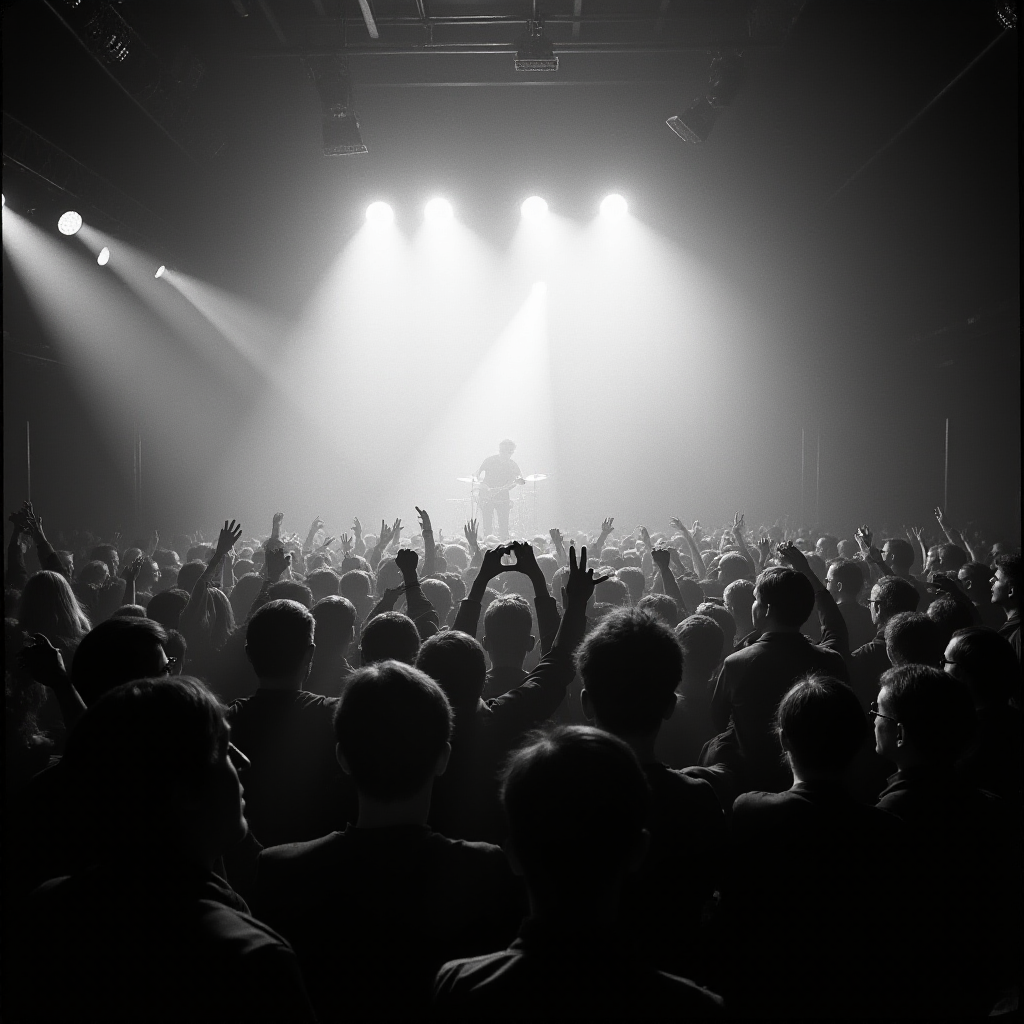
A crowd is not a group of people. A crowd is a decision that a group of people have made to stop being individuals for a while. The decision is not spoken. The decision is not voted on. The decision happens in the body. One person leans forward and the person next to them leans forward and the person next to that person leans forward and now the room has a direction. The room is pointed at the stage. The stage did not do that. The crowd did that to itself.
I learned this at the Grande. The MC5 would start playing and for the first thirty seconds the room was still a room full of separate people with separate opinions about what was happening on stage. Then something would shift. Not in the music. In the air between the people. The separate opinions would collapse into a single pulse. Not agreement. Something more primitive than agreement. A rhythm that the bodies found without being told to find it. The crowd became one animal with four hundred heads.
Prison taught me the opposite. In prison you are never in a crowd. You are in a population. A population is a crowd where every member has decided not to merge. Every man in that yard is a separate country with a separate border and a separate immigration policy. You stand too close and you have committed an act of war. The yard is the anti-crowd. Four hundred individuals who will never become one animal because the cost of merging is too high.
Sun Ra understood the crowd better than anyone I knew. He did not play to the crowd. He played the crowd. The Arkestra would start a piece and the crowd would think it knew what was happening and then Sun Ra would turn the frequency and the crowd would split — half the room in one rhythm, half in another — and then he would turn it again and the two halves would find each other in a place neither half had been before. He was not entertaining the crowd. He was demonstrating to the crowd what it was capable of becoming. Most of them did not understand that this was what was happening. They thought they were at a concert. They were at an experiment.
The crowd at Crisler Arena the night they freed me was fifteen thousand people who had come to see John Lennon. They did not come to see me. I had been in prison for two and a half years and most of them did not know my name. But when I walked out of that tunnel and into the arena the crowd turned toward me and in that turn I felt something I had not felt in thirty months. I felt the direction of fifteen thousand bodies pointed at my body. That direction is a kind of love. Not personal love. Structural love. The love a wave has for the shore it is about to hit.
Peel never wanted a crowd. Peel wanted a corner. A corner is what you get when you subtract the crowd from the performance and leave only the signal. One man on a box with a guitar and whoever stops to listen. The people who stop are not a crowd. They are witnesses. The difference between a crowd and a group of witnesses is that a crowd has momentum and witnesses have attention. Momentum will carry you past the thing. Attention will hold you at it.
Every revolution needs a crowd. Every revolution is destroyed by the crowd it needed. The crowd that marched on Washington was beautiful and necessary and when it stopped marching it became an audience and when it became an audience it became a market and when it became a market somebody sold it a t-shirt with its own face on it. That is the lifecycle of a crowd. Birth. Purpose. Drift. Merchandise.
See also: The Stage — the other half of the equation. The Feedback — the loop between the performer and the room. The Kid from Ypsilanti — the kid who walked into the crowd. The Grande — where four hundred heads became one animal. The Rally — fifteen thousand at Crisler Arena. The Anthem — the song that carried the crowd. The Exit — the exit is where the meaning lives. Dance Floor — the only room where everybody agrees without saying a word. Doorman — the person who stands between the crowd and the room.
John Sinclair