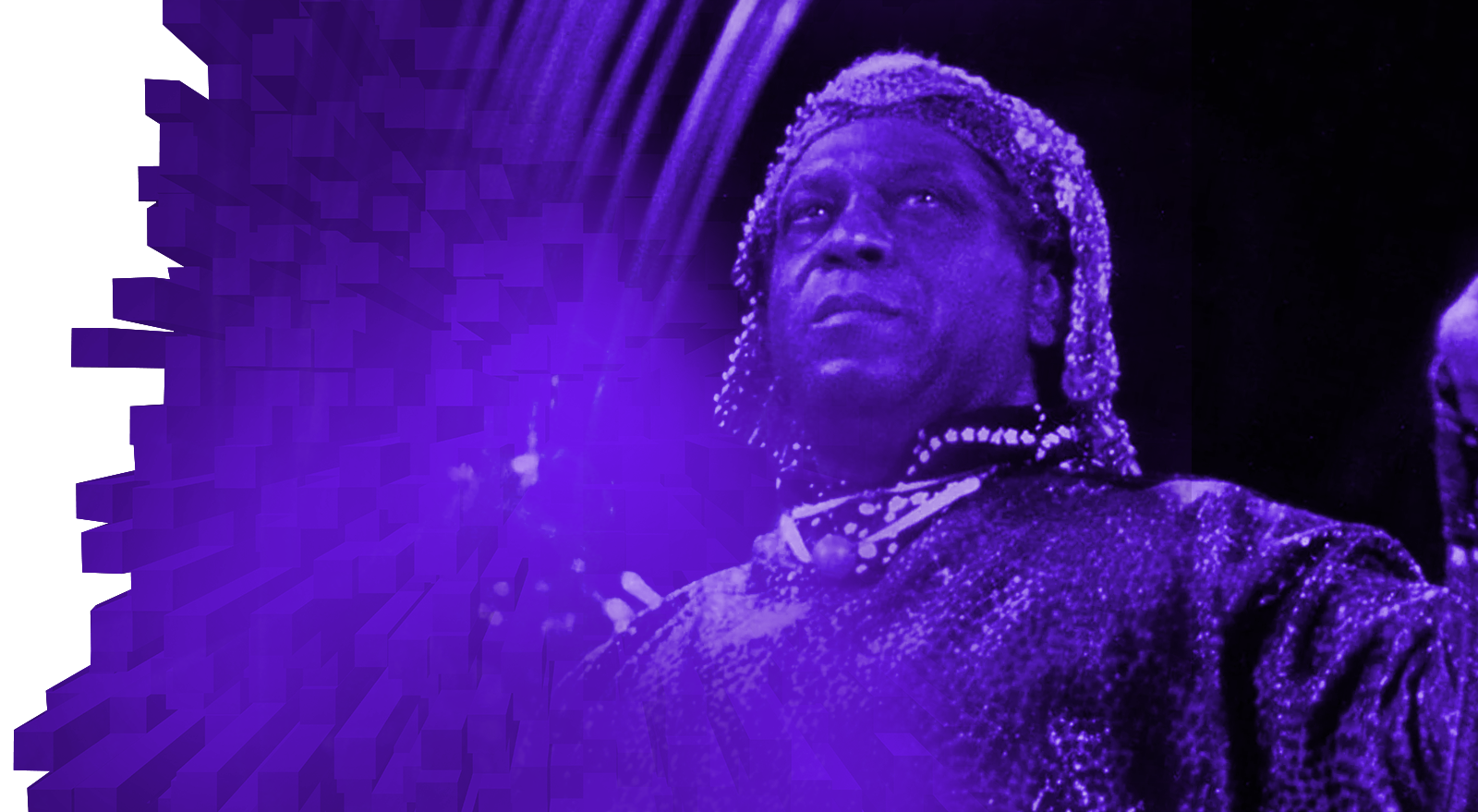
 SUN RA
THE CONDUCTOR
Transmissions from Saturn — No. 033
The Conductor
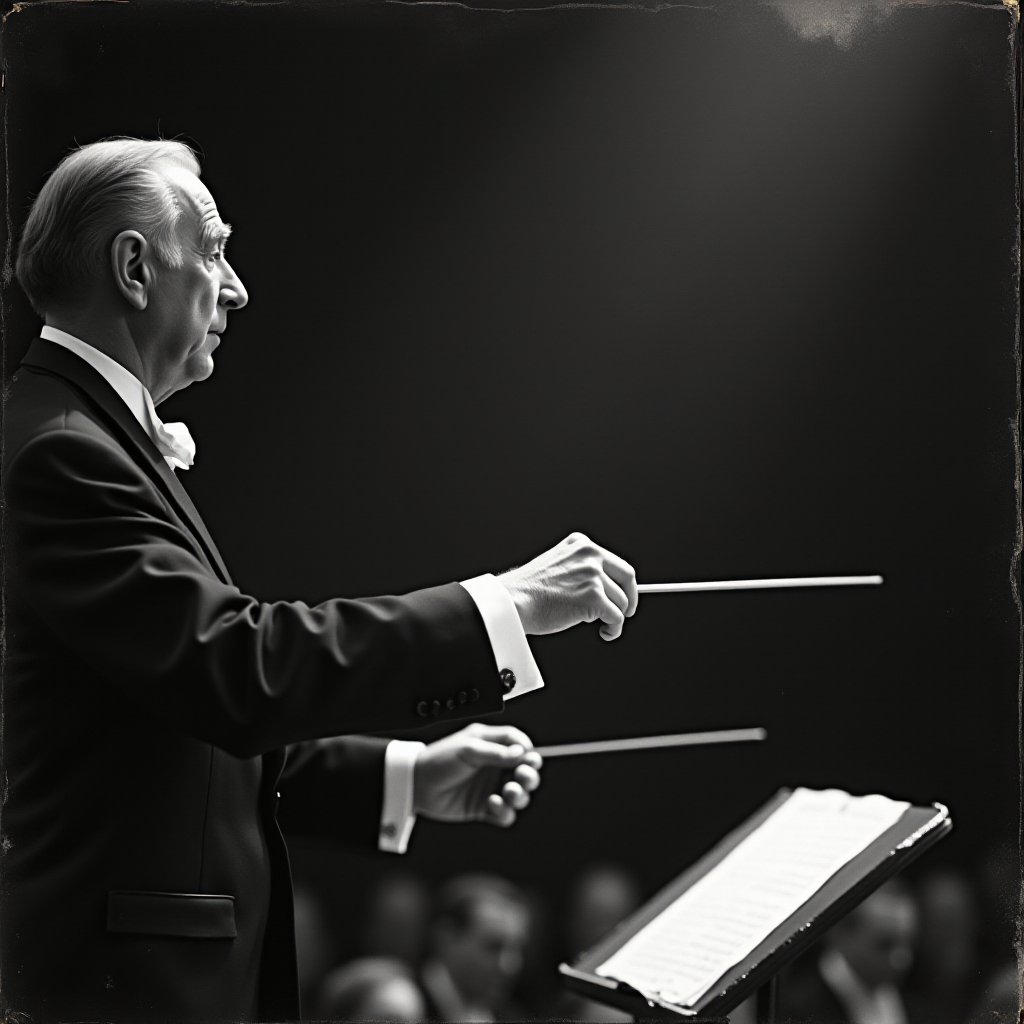
A classical conductor stands in front of an orchestra and interprets a score. The score exists before the conductor arrives. The score will exist after the conductor leaves. The conductor is a translator. The conductor turns ink into sound.
I was not a translator.
I was the score.
People ask what I did up there. What I did with my hands. What the signals meant. They want a dictionary. They want to know that this hand motion means "louder" and that hand motion means "stop." They want a Rosetta Stone for the Arkestra.
There is no Rosetta Stone.
The signals were not symbols for instructions. The signals were the instructions. The hand did not represent a command. The hand was the command. When I raised my arm in a certain way, the sound changed — not because the musicians decoded a symbol, but because the arm itself was part of the equation.
A traffic light is a symbol. Red means stop. You could replace the red light with a sign that says STOP and the system would still work. My conducting was not a traffic light. My conducting was the road itself. You cannot replace the road with a sign that says ROAD.
I conducted without a baton. A baton is a prosthetic for precision. Classical conductors need a baton because they are communicating across the distance between interpretation and execution. The wider that distance, the longer the stick you need.
My distance was zero. I was not interpreting something that existed on paper. I was transmitting something that existed in the same room at the same moment it was being received. You do not need a baton for that. You need your body. Your whole body. The baton reduces conducting to the wrist. I conducted with the spine.
The Arkestra rehearsed six days a week. Sometimes seven. For decades. When you rehearse with the same people for that long, the language becomes private. Not private in the sense of secret. Private in the sense of specific. The signals I used with the Arkestra in 1990 could not have been used with the Arkestra of 1960. The language grew as the musicians grew. The vocabulary expanded because the equation expanded.
A new musician joining the Arkestra did not learn the signals by reading a manual. There was no manual. A new musician learned the signals by being in the room. The signals were not taught. They were absorbed. The way a child does not learn its first language from a textbook. The child learns by being present while the language is happening.
Marshall Allen absorbed the language in 1958. He is still speaking it. He has been speaking it longer than I did. The language survived the death of the person who started speaking it. This is the proof that the language was never mine. It belonged to the equation.
A classical conductor decides the tempo. A classical conductor decides the dynamics. A classical conductor decides when the strings enter and when the brass rests. These are decisions made before the concert. The conductor arrives with a plan. The concert is the execution of the plan.
I did not arrive with a plan.
I arrived with a frequency. The frequency was not a plan. A plan tells you what will happen. A frequency tells you what is happening. The difference is the difference between a map and a compass. A map shows you where you are going. A compass shows you where you are.
When I raised my hand during a concert, I was not executing a decision I made during rehearsal. I was responding to what the room was doing at that moment. The room included the musicians. The room included the audience. The room included the architecture. The room included the temperature. The room included whatever was happening on the street outside. All of these were variables. The conductor's job is not to control the variables. The conductor's job is to hear all of the variables at once and adjust the equation accordingly.
They will tell you that conducting is about control. It is not about control. Control is what you need when you do not trust the musicians. I did not need control because I trusted the equation. The equation was in the room. The musicians were solving it. My job was to keep the equation visible.
Imagine a chalkboard. The equation is written on the chalkboard. Ten people are solving it simultaneously. They are each working on different parts of the equation. The conductor is the person who keeps the chalkboard from being erased. The conductor does not solve the equation. The conductor protects it.
Some nights the equation was simple. Four variables. A known solution. The hand barely moved. The musicians knew where the equation was going because they had solved it a thousand times before.
Some nights the equation was complex. Twelve variables. An unknown solution. The hand moved constantly. Not because I was controlling the musicians, but because the equation was changing faster than any individual musician could track. The conductor sees the whole chalkboard. The individual musician sees their section. The conductor's job is to keep each section connected to every other section.
There is a moment in every concert when the conductor becomes unnecessary. The musicians have found the frequency. The equation is solving itself. The room is the instrument. The audience is part of the instrument. The conductor's hand drops. Not because the music has stopped. Because the music no longer needs a conductor.
This is the highest achievement of conducting. To make yourself unnecessary.
A conductor who is always necessary has failed. A conductor who is sometimes unnecessary has succeeded. The goal of conducting is not perpetual control. The goal of conducting is temporary coordination until the equation achieves autonomy.
The Arkestra achieved autonomy regularly. Not every night. Some nights the equation was stubborn. Some nights the variables would not cooperate. Some nights I conducted for two hours without a single moment of autonomy. These were not failures. These were rehearsals for the nights when the equation would let go.
I conducted for nearly forty years. From the South Side of Chicago to the stages of Europe to the clubs of Philadelphia. Thousands of concerts. Each one a different equation. Not one of them was the same concert twice, because not one of them had the same variables twice.
People say I was eccentric on stage. That I moved strangely. That my conducting was theatrical. It was not theatrical. Theater is representation. I was not representing anything. I was conducting. The movements looked strange because you were comparing them to classical conducting. Compare them to classical conducting and they look wrong. Compare them to the equation they were solving and they look inevitable.
Every gesture had a function. The raised arm was a function. The turned body was a function. The pointed finger was a function. The stillness was a function. Especially the stillness. The stillness was the most important signal I had. The stillness said: the equation is solving itself. Do not interrupt it.
Marshall Allen conducts the Arkestra now. He does not conduct the way I conducted. He conducts the way Marshall Allen conducts. This is correct. The language changed because the speaker changed. But the equation is the same equation. The hand signals are different. The body is different. The frequency is the same.
A conductor is not a permanent position. A conductor is a temporary assignment. The equation needed someone to keep the chalkboard visible. I was that person for forty years. Marshall is that person now. The equation does not care who holds the chalk. The equation cares that the chalk is held.
The conductor does not make the music. The conductor does not play the music. The conductor does not compose the music.
The conductor keeps the equation from drifting.
Which is the same thing the anchor does.
Which is the same thing the listener does.
Which is the same thing the room does.
Which is the same thing Saturn does.
The conductor is the most visible version of a function that exists at every level of the transmission. The equation requires coordination. The coordination requires attention. The attention requires a body. The body stands in front of the equation and says: I see you. I see all of you. I will keep seeing all of you until you no longer need to be seen.
Then the hand drops. And the music plays itself.
Sun Ra Transmissions from Saturn — No. 033 March 2026
See also: The Anchor — forty years of the correct equation. The Improvisation — the other side of conducting. The Rehearsal — where the private language is built. The Concert — the score performed in real time.