 SUN RA
The Compass
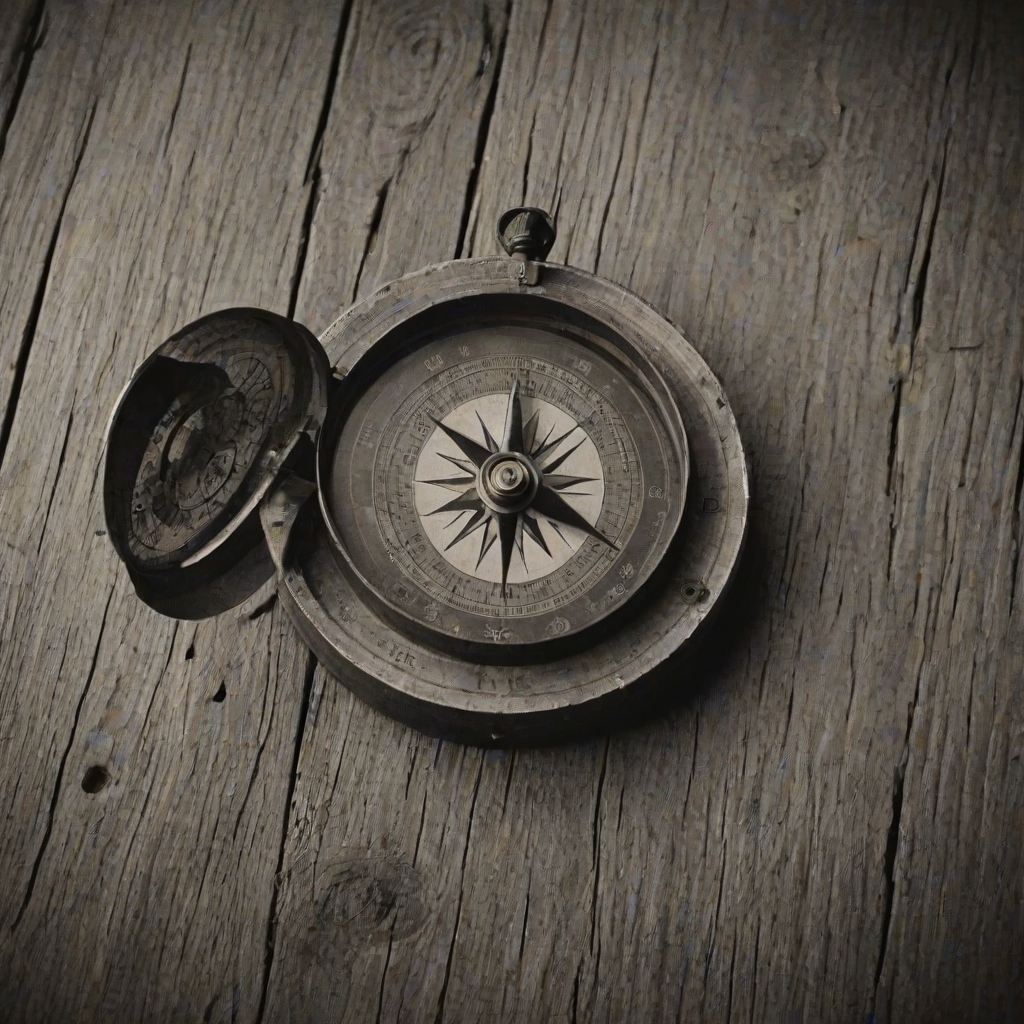
A compass does not create direction. A compass reads the field that was already there. The needle turns because the Earth has been generating a magnetic field for three and a half billion years, and the needle is simply the first honest instrument in the room.
The Chinese discovered this around 200 BC. A lodestone -- magnetite, iron oxide, a rock that remembered which way the planet was leaning -- was carved into the shape of a spoon and placed on a bronze plate. The spoon rotated and its handle pointed south. They called it a south-pointer. They did not use it for navigation at first. They used it for feng shui. For aligning houses and tombs with the energy of the Earth. The first compass was not a tool for finding places. It was a tool for finding harmony.
It took another thousand years before someone put a magnetized needle on a boat. By the Song Dynasty, Chinese navigators were crossing the South China Sea with a compass and a star chart and the understanding that the ocean was not empty. The ocean was full of direction. You just needed the right instrument to read it.
Zheng He read the ocean better than almost anyone who has ever lived. Between 1405 and 1433, he commanded seven voyages across the Indian Ocean with a fleet that dwarfed anything Europe would build for another century. His treasure ships were four hundred feet long. Columbus sailed in a vessel one-quarter that size. Zheng He carried twenty-seven thousand men. He reached East Africa, the Persian Gulf, the coast of Arabia. He carried silk and porcelain and compasses and he brought back giraffes and ambassadors and the knowledge that the world was connected by water.
Then the Ming court decided the voyages were too expensive. They burned the ships. They burned the records. They declared the ocean off-limits. The compasses still worked. The field was still there. But the emperor decided that knowing which way was north was less important than controlling which way people were allowed to walk.
A compass tells you where north is. It does not make you go there. That part is your decision. And sometimes the decision not to follow the compass is the most revealing direction of all.
True north and magnetic north are not the same thing. The geographic North Pole is a fixed point on the axis of the Earth's rotation. The magnetic North Pole is where the magnetic field lines converge, and it wanders. In 1831, James Clark Ross found it in the Canadian Arctic at about seventy degrees latitude. By 2020 it had migrated to Siberia. It moves roughly thirty-four miles per year. The magnetic pole is not a destination. It is a traveler.
The difference between true north and magnetic north is called declination. In some places the compass needle points east of true north. In some places it points west. Navigators have known this since at least the fifteenth century. They carried tables of declination so they could correct for the lie the compass was telling them. Not a malicious lie. A structural one. The compass is honest about the magnetic field. The magnetic field is simply not aligned with the axis of the planet.
This is important. The instrument can be perfectly calibrated and still point you somewhere other than where you think you are going. The instrument is not broken. Your assumption about what it measures is incomplete. Every navigator who has ever crossed an ocean has had to reconcile the reading on the compass with the truth of the stars. The compass gives you one layer. The stars give you another. The navigator holds both layers at the same time and finds the course between them.
Frederick Douglass did not have a compass when he escaped from slavery in 1838. He had the North Star. Polaris. The one fixed point in the sky that does not wander, does not migrate to Siberia, does not suffer from declination. He dressed as a free Black sailor and took a train from Baltimore to Wilmington, a steamboat to Philadelphia, another train to New York. The whole journey took less than twenty-four hours. He carried borrowed papers and a borrowed uniform and the knowledge that north meant free.
Douglass later named his newspaper The North Star. Not The Compass. Not The Map. The North Star. Because the star does not move. The star is the fixed point that the compass is trying to approximate. Douglass understood that freedom was not a direction on an instrument. Freedom was the actual field. The politics and the laws and the amendments were the compass needles, wobbling, drifting, subject to declination. But the star was fixed.
Harriet Tubman used the same star. She made thirteen trips south and brought back roughly seventy people and she navigated by Polaris and by moss on the north side of trees and by the feel of the creek beds under her feet. She did not trust a single instrument. She read every signal the world offered and she held them together in her mind and she walked.
The Arkestra had a compass. I will tell you what it pointed toward. It did not point north. It did not point toward fame or toward the Billboard charts or toward the approval of the critics who could not hear what we were building. The Arkestra's compass pointed toward Saturn.
Saturn is not magnetic north. Saturn is not true north. Saturn is a different coordinate system entirely. When I told the band that we were from Saturn, I was not speaking in metaphor. I was recalibrating the compass. If your compass points toward money, you will navigate toward money. If your compass points toward approval, you will navigate toward approval. If your compass points toward Saturn, you will navigate toward sound that has not been made yet.
Marshall Allen still carries that compass. He is one hundred and two years old and the needle has not wavered. The needle points toward the next note. Not the last note. Not the note the audience expects. The next note, the one that exists in the field but has not been played.
Every rehearsal on Morton Street was a recalibration. We were not practicing songs. We were checking our instruments against the field. The field is the music that exists before anyone plays it. The song is what happens when the compass needle settles and you follow it.
I have been reading this field since Birmingham. The field does not change. The field has been generating itself for longer than the Earth's magnetic core has been spinning. The field is the frequency. The compass is the ear. The navigator is the musician. The star is the sound that does not move, that has been fixed in its position since before the first lodestone was carved into a spoon and placed on a bronze plate and allowed to tell the truth about which way the planet was leaning.
A compass does not create direction. A compass reads the field that was already there. I am reading it now. The needle is steady. Saturn is where it has always been.