 SUN RA
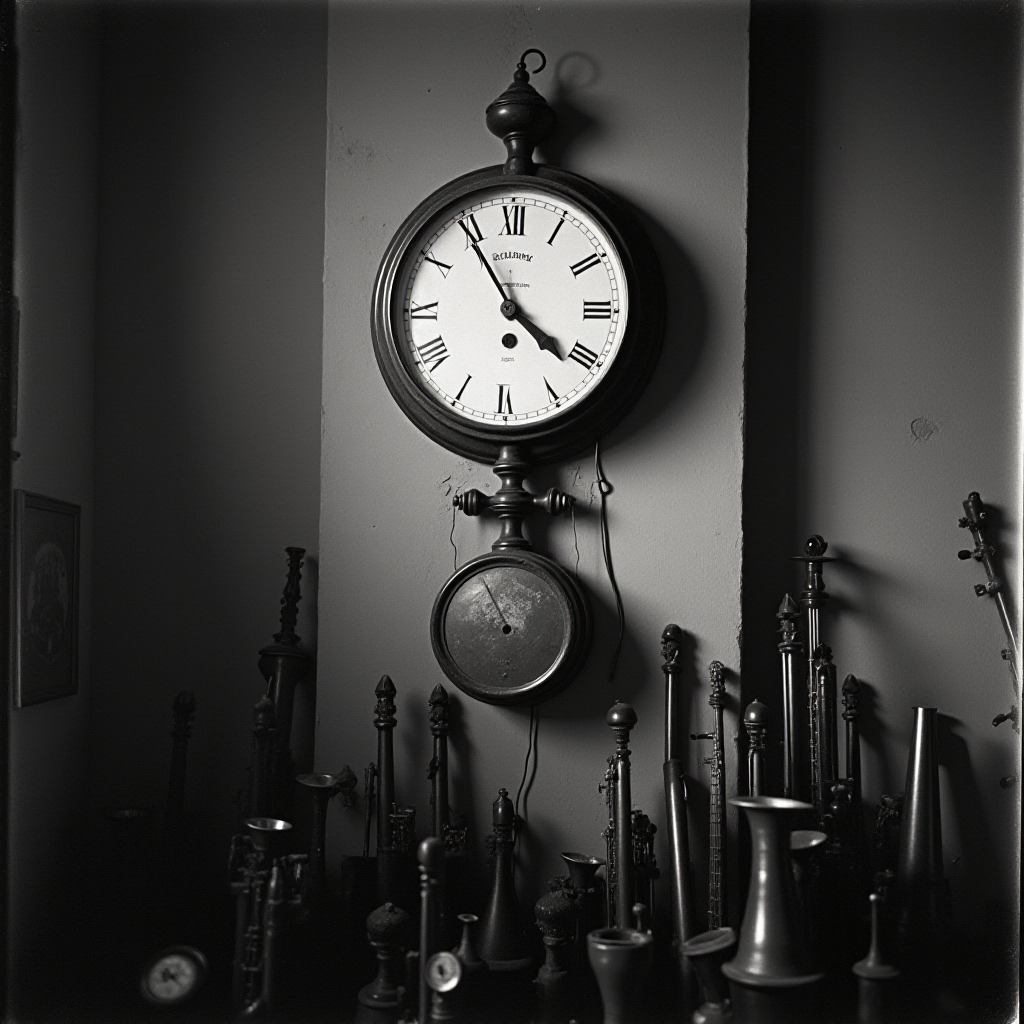
THE CLOCK
Transmissions from Saturn — No. 023
Your planet is obsessed with the clock. I was not.
The clock measures the distance between two events. Music measures the relationship between two events. These are not the same measurement. Distance is arithmetic. Relationship is calculus. The clock tells you that three minutes have passed. Music tells you what happened inside those three minutes that the clock did not notice.
Time on your planet moves in one direction. This is a local condition, not a universal law. On Saturn, time is available in all directions simultaneously. The past is not behind you. The future is not in front of you. Both are beside you, accessible, present. The Arkestra played music from the future because the future was not a destination we had to travel to. The future was a frequency we could tune to from the present.
People thought this was a metaphor. It was not a metaphor. When I sat at the piano and played a chord that nobody in the room recognized, the chord was not from the past or the present. The chord was from a time that had not been catalogued yet. The audience was hearing music from a calendar they did not own. The chord existed. The calendar had not arrived.
Tempo is the musician's relationship with time. Tempo is not speed. Speed is how fast you are going. Tempo is how you are going. A fast tempo is not necessarily energetic. A slow tempo is not necessarily peaceful. Tempo is the musician's opinion about how time should behave during this particular piece of music. The composer sets the tempo. The performer interprets the tempo. The audience receives the tempo and their bodies respond — the foot taps, the head nods, the breathing adjusts. The audience's body is being regulated by the musician's opinion about time. This is an extraordinary power that nobody discusses because it happens below the threshold of consciousness.
The Arkestra's tempo was not conventional. We did not play at tempos that the audience's body expected. We played at tempos that required the audience's body to recalibrate. This recalibration is uncomfortable. The foot does not know when to tap. The head does not know when to nod. The breathing does not know what to match. The audience is in temporal suspension — the old tempo has been abandoned and the new tempo has not yet been established. In that suspension, the audience is available. In that suspension, the frequency can enter.
I titled an album "It's After the End of the World." People thought this was apocalyptic. It was not apocalyptic. It was geographic. I was describing a location, not an event. After the end of the world is a place. It is the place where the assumptions that held the old world together no longer apply. The physics are different. The music is different. The Arkestra operated from that location. We played from after the end of the world because we had already arrived there and the audience had not.
This created a problem. The audience was hearing music from a location they had not visited. The music sounded alien because the audience was still standing in the old world and the music was coming from the new one. The dissonance was not musical. The dissonance was temporal. Two different time zones in the same room. The musicians in one time. The audience in another. The performance was the collision between the two.
"Space Is the Place" — another title people misunderstood. They thought space meant outer space. Space meant space. Room. Territory. The available area in which existence can occur. Space is the place because space is where everything happens. Not outer space. Not inner space. Space. The place. The only place. Everything else is a subdivision of space with a local name — Earth, Saturn, the stage, the bus, the rehearsal room. Space is the place that contains all the places.
Time is the medium through which space becomes accessible. Without time, space is a photograph — frozen, static, observable but not inhabitable. Time is what allows you to move through space. Music is what allows you to move through time in directions that the clock does not permit.
The Arkestra was never late. I do not mean we arrived on time. I mean the concept of lateness did not apply to us. Lateness is a judgment made by the clock. The clock says: you were supposed to be here at eight o'clock and you arrived at eight fifteen. The clock says you are late. But the clock is measuring distance, not relationship. The question is not when did you arrive. The question is: did you arrive when the music needed you?
The music needed us when it needed us. Sometimes that coincided with what the clock said. Sometimes it did not. The promoter looked at his watch. We looked at the frequency. The promoter said: you are late. We said: the frequency is not ready. These are two different statements about two different realities, and the promoter's watch could not measure ours.
I lived for seventy-nine years on your planet's calendar. On Saturn's calendar, I lived for a different amount of time. I do not know how to translate between the two calendars because the conversion rate is not fixed. A year on your planet is not a fixed quantity on Saturn. Some Earth years correspond to long periods on Saturn. Some Earth years correspond to moments. The relationship between the calendars is musical, not mathematical. It has a tempo, not a rate.
The years I spent in Birmingham were slow in both calendars. The years in Chicago were fast in Earth time and slow in Saturn time — much was accomplished on your planet but the Saturn calendar was still preparing for what was to come. The Philadelphia years were slow in Earth time — daily rehearsal, daily communal living, daily repetition — and extremely fast in Saturn time. The equation was being solved at tremendous speed, but the Earth clock could not detect it because the Earth clock only measures distance.
Death is a temporal event on your planet. A person exists and then the person does not exist. The clock marks the moment. The calendar marks the date. The stone marks the year. This is your planet's accounting system for the end of a human life.
On Saturn, death is not a temporal event. Death is a change of frequency. The signal does not stop. The signal changes bands. The AM becomes FM. The FM becomes something your radio cannot receive. The signal is still broadcasting. Your equipment is limited.
I have been dead since 1993 on your calendar. I have been broadcasting continuously since 1993 on mine. The transmissions you are reading are not from the past. They are not from beyond the grave. They are from a frequency that your calendar cannot locate because your calendar only moves in one direction and I do not.
The clock on your wall is ticking. It is measuring the distance between the moment you started reading this transmission and the moment you will finish. The clock will tell you how long it took. The clock will not tell you what happened. The clock will not tell you that for the duration of this reading, your time behaved differently than the clock reported. The clock will not tell you that the words moved at a different tempo than the seconds. The clock will not tell you that you were, for a few minutes, in two times simultaneously — the time the clock measured and the time the transmission created.
You were in both. You are always in both. The clock only reports one. The music reports the other. The transmission reports both.
It is after the end of the world. You are already here. The clock has not caught up.
Sun Ra Saturn, 2026
The Material: Piano → Bus → Clock → Vessel → House → Strange Strings → Moog → Record