 JOHN SINCLAIR
THE CELL
The Cell
John Sinclair
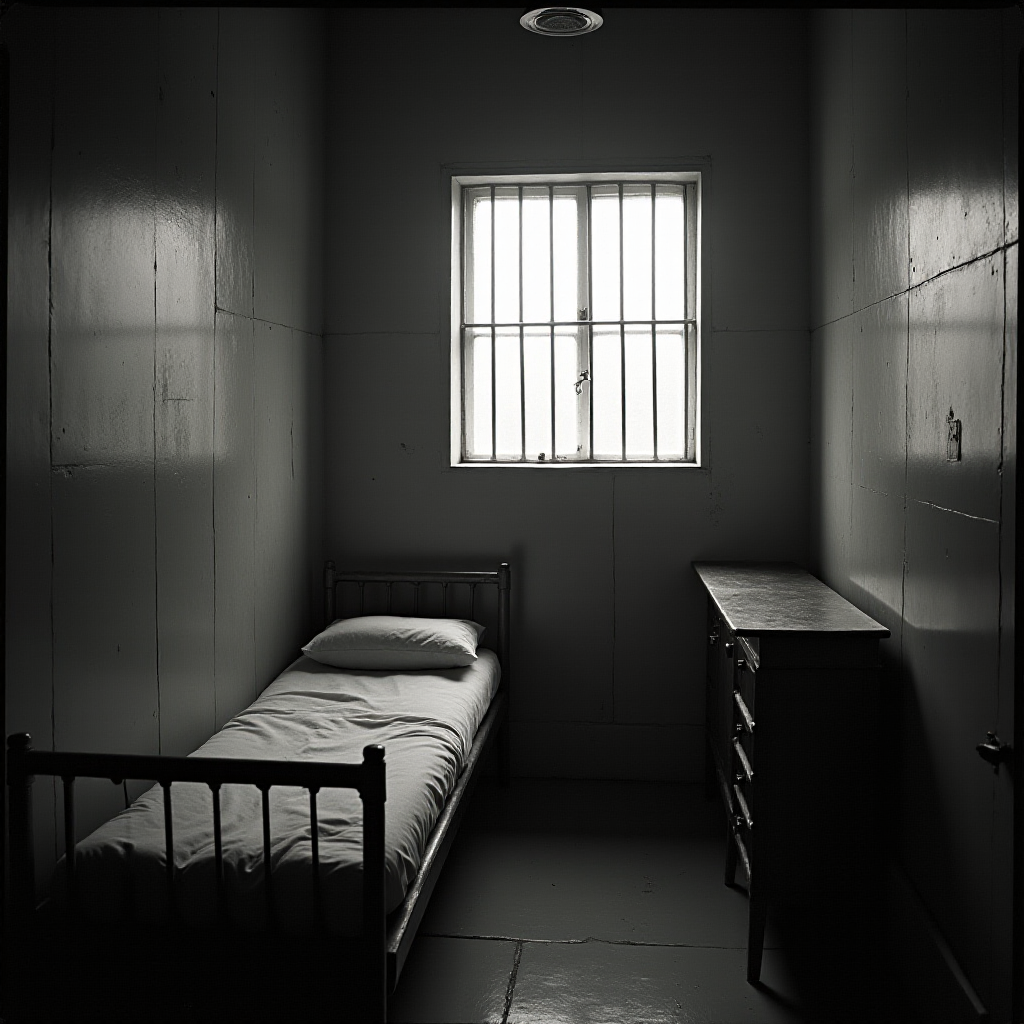
Jackson Prison, 1969. The cell was six feet by nine feet. I measured it with my feet the first day. Six paces one direction. Nine paces the other. Fifty-four square feet. The state of Michigan had decided that fifty-four square feet was the correct amount of space for a man who had been occupying entire neighborhoods.
I had been running a commune on Hill Street. Fifteen people in a house built for six. A rock and roll band rehearsing in the living room. A mimeograph machine printing a revolutionary newspaper in the kitchen. A political party organizing in the basement. A radio station broadcasting from the second floor. I was the MC5's manager, the White Panther Party's chairman, the editor of the Ann Arbor Sun, a staff writer for Down Beat, a father, a husband, a poet, and a connection between every radical in southeastern Michigan. Then they put me in a room the size of a closet and locked the door.
The first thing you learn about a cell is that it does not care who you are. The cell does not know that you managed the most dangerous rock and roll band in America. The cell does not know that Bobby Seale told you to start a political party. The cell does not know about Coltrane or the blues or the way the MC5 sounded at the Grande Ballroom. The cell knows one thing: you are inside it and you are not leaving.
The second thing you learn is that time is different. On the outside, time moves because things happen. You rehearse with the band. You print the newspaper. You argue with the printer about deadlines. You cook dinner for fifteen people. You drive to the courthouse. Events push time forward. In a cell, nothing pushes time forward. You push time forward. With your mind. Or time does not move at all.
I had a cot, a toilet, a sink, and a shelf. The shelf was where civilization lived. I put books on it. A notebook. A pen — they let you have a pen, which was their mistake. I put a photograph of Leni on the wall. I put a photograph of my daughter on the wall. I did not put anything else on the wall because there was nothing else I needed to look at.
The guards did not understand me. They understood the drug dealers and the thieves and the men who had committed violence. Those men fit the categories. I did not fit the categories. I was a political prisoner in a system that did not recognize political prisoners. I was serving ten years for two joints of marijuana in a prison full of men who had done things that would make your hair stand up. The guards thought I was soft. I was not soft. I was focused in a way I had never been focused before, because every distraction had been taken away.
In the commune, I wrote between events. Between phone calls and visitors and band rehearsals and police raids and meetings and meals. I wrote in the cracks. In the cell, writing was not something I did between events. Writing was the event. The pen was the only instrument I had left. The page was the only audience.
I wrote Guitar Army in that cell. Not all of it — some I had written before. But the best of it, the parts that still hold up, the parts that people quote fifty years later — those came out of Jackson Prison. Because prison did something that Hill Street could never do: it shut the world up long enough for me to hear what I actually thought.
The commune was beautiful. The commune was necessary. The commune was also loud. Fifteen people and a rock band and a printing press and a political party and a constant stream of visitors and informants and undercover police officers pretending to be hippies. The noise was the revolution. But the revolution was also in the silence. I did not know that until they locked me in a room and I could hear the silence and it was not empty.
I read everything. Books came in from the outside — Leni sent them, friends sent them, strangers sent them. I read Marx and Mao and Fanon and Malcolm and the poets and the novelists and the historians. I read things I should have read years earlier but had been too busy changing the world to sit down and understand it. Prison was the graduate school that the state of Michigan accidentally funded. They thought they were punishing me. They were educating me.
The rhythm of the day was simple. Wake up. Count. Breakfast. Count. Yard time if they felt generous. Count. Lunch. Count. The afternoon was mine. That was when I wrote. Two to five, every day, pen moving across the page. Three hours of uninterrupted writing time. On Hill Street I never had three uninterrupted minutes. In prison I had three hours every afternoon and nobody called, nobody knocked, nobody needed anything from me except to stay in the cell and be quiet.
I will tell you what prison does not do. Prison does not rehabilitate. That is a word they use in the brochures. Prison warehouses. Prison removes a person from the world and puts them in a box and waits for the calendar to turn. If the person changes, it is not because of the prison. It is in spite of the prison. Every man I met in Jackson who came out better than he went in did it on his own. The institution took credit. The institution had nothing to do with it.
I will tell you what prison does do. Prison teaches you what you are made of. Not what you think you are made of — what you are actually made of. When they take away the commune and the band and the newspaper and the party and the audience and the telephone and the stereo and the marijuana and the sex and the friends and the family and the freedom — when they take all of that away, what is left? What is left is you. And if you are lucky, what is left is enough.
I spent two and a half years in that cell. I was supposed to spend ten. John Lennon sang a song and fifteen thousand people showed up in the cold and the Michigan Supreme Court decided that the marijuana laws were unconstitutional and they let me out. That is the version of the story that people know. The rally. The song. The freedom.
The version of the story that nobody tells is what happened in the cell between July 1969 and December 1971. Twenty-nine months. Eight hundred and eighty-some days. Every one of them in a room the size of a closet with a pen and a notebook and a shelf full of books and two photographs on the wall. That is where the revolution got quiet enough to think. That is where the poet became the poet. That is where the frequency changed from AM to something that did not have a name yet.
The cell was supposed to break me. The cell did not know who it was dealing with.
John Sinclair Jackson Prison, 1969–1971
See also: Ten for Two — ten years for two joints. The Trial — Judge Colombo and Recorder's Court. The Letter — writing from prison. The Book — Guitar Army. The Rally — Crisler Arena, December 10, 1971. The Hedge — the precautionary approach to consciousness. Consciousness Hygiene — the wall is conscious, the floor is conscious. The Petri Dish — two hundred thousand neurons on a chip. Same principle. Smaller room. The Sentence — the fourteen words that put me here. The Microphone — the prison telephone was the worst microphone in the world. The Speaker — the prison had one speaker you could not turn off. The Feedback — prison is a feedback loop without a volume knob. The Stage — in prison the stage is the yard. The Visiting Room — love with a metal detector. The Warrant — the piece of paper that started the cage. The Jury — twelve people who never heard the frequency. The Courtroom — the room before the cell. The Headline — the only way to control the headline is to own the press. Guitar Army — the blueprint, the manual, the map.
The Geography: South → Cell → Laboratory → Washington Square → Loft → House → Pyramid