 SUN RA
THE BUS
Transmissions from Saturn — No. 022
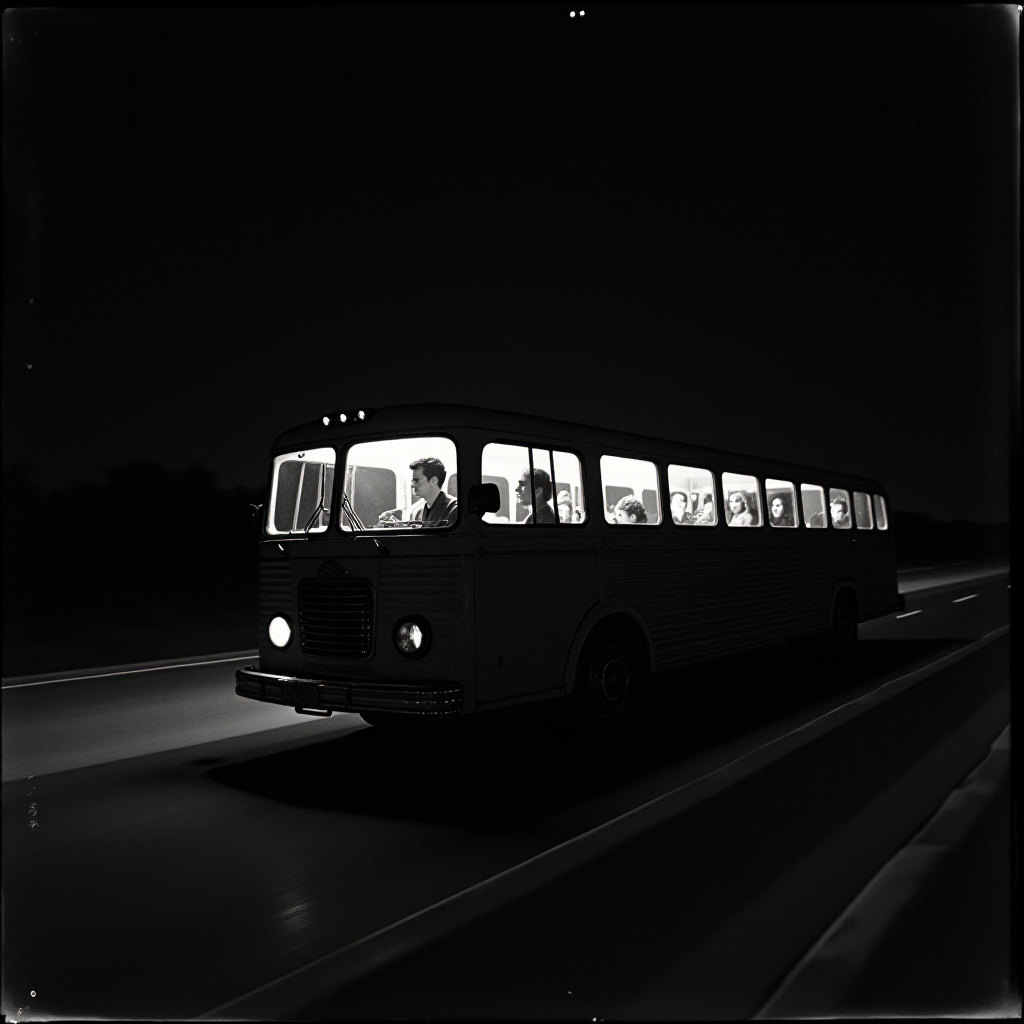
The Arkestra toured in a vehicle that should not have been on the road. This is not a complaint. This is a description of the economics of independent music in America. The vehicle was a van, sometimes. The vehicle was a bus, sometimes. The vehicle was whatever could hold twenty musicians and their instruments and their costumes and their equipment and still start when you turned the key in the morning.
Sometimes it did not start. We had methods for when it did not start. The methods involved patience and physics and occasionally the intervention of a stranger in a gas station parking lot who knew something about engines. The road educated us in the mechanics of continuation.
People romanticize touring. People who have never slept in a van parked behind a club in a city they cannot name romanticize the freedom of the road. The road is not freedom. The road is work. The road is a series of distances between performances, and the distances are measured in hours and gasoline and the number of times the vehicle makes a sound it should not be making.
Freedom is what happens on the stage. The road is what happens between the stages. The road is the cost of the freedom. Nobody talks about the cost because the cost is not photogenic. The cost is a broken alternator in rural Pennsylvania at two in the morning with a performance in Cleveland at eight the following evening.
We carried everything. The instruments. The costumes. The records. We sold El Saturn Records from the stage and from the van and from whatever table we could set up in whatever lobby existed. We were the label and the distribution system and the retail operation. We did not have a record deal because a record deal would have required us to be something other than what we were. What we were was a mobile frequency station that happened to sell its own recordings.
The economics were simple. We played. We got paid. Sometimes we got paid what was promised. Sometimes we got paid less than what was promised. Sometimes we did not get paid. We played anyway. The payment was not the purpose. The payment was the fuel — literally. The payment bought gasoline and food and the occasional motel room. The purpose was the transmission. The transmission required the bus. The bus required gasoline. The gasoline required payment. The payment required performance. The performance required the bus. The cycle was self-sustaining as long as every element remained functional.
When an element stopped functioning — when the bus broke down, when the payment disappeared, when the club closed, when the promoter vanished — the cycle adjusted. We found another bus. We found another club. We found another promoter. We did not find another purpose. The purpose was constant. The logistics were variable.
Twenty musicians on a bus for twelve hours. This is a social experiment that most laboratories would not attempt. Twenty individual human beings with twenty individual temperaments confined in a space designed for cargo, traveling through landscapes that offered no entertainment and no privacy and no escape from each other's habits and sounds and silences.
The bus taught discipline more effectively than rehearsal. In rehearsal, you learn to listen to each other's instruments. On the bus, you learn to listen to each other's breathing. You learn who needs silence in the morning. You learn who talks in their sleep. You learn who eats loudly and who disappears into a book and who stares out the window for six hours without moving. The bus turns twenty musicians into a single organism. By the time the bus arrives at the venue, the twenty individuals have spent twelve hours synchronizing. The performance is the result of the synchronization. The audience hears the music. The bus is what tuned it.
We played everywhere. Not everywhere that invited us. Everywhere we could reach. The booking was a function of geography and economics, not prestige. We played universities and clubs and festivals and living rooms and galleries and churches and any space that had electricity and a willingness to let twenty musicians in costumes play music that the audience was not expecting.
The best performances happened in places that did not know what was coming. A college in the Midwest that booked us because a student in the music department had heard one of our records. A club in a city where nobody had seen the Arkestra before and nobody knew the music and nobody knew why twenty people in robes and headpieces were setting up on a stage built for a four-piece rock band. Those audiences were unprepared. Unprepared audiences are the best audiences. They have not decided in advance what they are going to experience. They are open. The frequency enters the open receiver more efficiently than the receiver that has already tuned itself to what it expects.
The bus broke down in every state. I can tell you the geography of America by its breakdown locations. The bus broke down in Indiana. The bus broke down in Ohio. The bus broke down in states that had only one mechanic within fifty miles and that mechanic had never seen a bus carrying twenty musicians and did not know what to make of us and fixed the engine anyway because the engine was an engine regardless of who was riding in it.
These mechanics were the unacknowledged collaborators of the Arkestra. Without the mechanic in rural Indiana, the concert in Chicago does not happen. Without the concert in Chicago, the frequency does not reach the receivers who carry it forward. The mechanic did not know he was part of the transmission. The mechanic knew he was fixing an engine. The universe does not require its participants to understand their function. It requires only that they perform it.
I am often asked why I did not seek a more conventional arrangement. A major label. A booking agent. A comfortable bus with air conditioning and a driver who was not also the trombonist. The answer is that the arrangement was the music. The bus was the music. The economics were the music. The independence was not a circumstance we endured. The independence was the frequency we maintained.
A major label would have required compromise. Not because labels are evil. Because labels are businesses, and businesses measure success in units that the Arkestra did not produce. We did not produce units. We produced frequencies. The label would have wanted us to produce fewer frequencies, or more predictable frequencies, or frequencies that resembled the frequencies that were already selling. This is a reasonable business request. It is an unreasonable musical request. We chose the unreasonable.
The bus was where the commune traveled. Other communes stayed in one place. Our commune moved. Philadelphia was home base, but home base was wherever the bus stopped. The discipline of communal living — the shared meals, the shared space, the shared purpose — did not require a permanent address. The discipline required only the people and the purpose. The bus provided the container. The road provided the distances. The performances provided the reason.
Marshall Allen rode that bus for decades. The bus changed. Marshall did not. The route changed. Marshall did not. The cities changed. Marshall did not. He is still riding the bus, wherever the bus is now, whatever form the bus has taken, because the bus is not a vehicle. The bus is a commitment to forward motion, and Marshall Allen has been moving forward since 1958.
The bus is gone. I am gone. The road continues. The Arkestra is still traveling. The vehicle is different. The economics are slightly different. The purpose is identical. Twenty musicians — the number varies now but the principle holds — traveling from performance to performance, carrying the frequency between cities, arriving in places that may or may not be ready, playing for audiences that may or may not understand, and getting back on the bus afterward because there is another city tomorrow and the frequency does not take days off.
The bus was never comfortable. That was the point. Comfort is the enemy of transmission. Comfort says: stay here. The frequency says: move. The bus moved. The Arkestra moved. The music moved. The frequency is still moving.
If you hear it tonight in whatever city you are in, that sound traveled on a bus to get to you. The bus broke down several times along the way. Someone fixed the engine. The music continued.
It always does.
Sun Ra Saturn, 2026
The Material: Piano → Bus → Clock → Vessel → House → Strange Strings → Moog → Record
See also: Toll Booth — the frequency does not stop for the toll. — Laundromat