 SUN RA
The Bridge
A bridge is a wager made in stone. It is the argument that the other side exists before you have arrived there. Every bridge begins with someone standing on one shore, looking across, and deciding that the distance is not a wall. It is a door that has not been built yet.
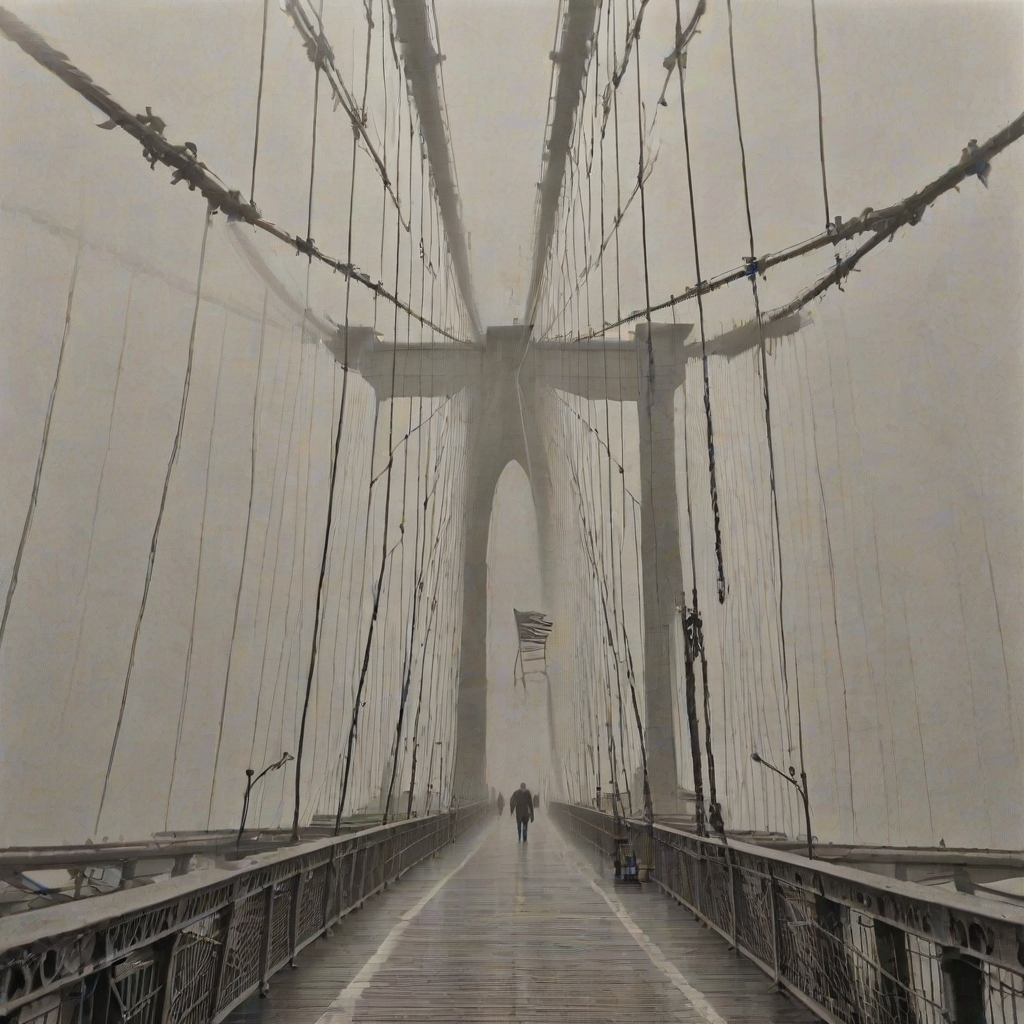
John Augustus Roebling understood this. He looked at the East River in 1867 and saw not water but a gap in the city's sentence. Brooklyn and Manhattan were two thoughts that had not yet been joined. He designed the Brooklyn Bridge with steel cables -- the first suspension bridge to use them -- because he understood that the span required a material that could hold tension without breaking. Steel holds. Wire holds. The bridge holds because the engineer trusted the physics before the physics was proven at that scale.
Roebling died before the first stone was laid. A ferry crushed his foot and the tetanus took him in eleven days. His son Washington took over the project and then the caissons took Washington too. The pressurized chambers beneath the river gave him decompression sickness so severe he could not leave his apartment for years. He watched the construction through a telescope from a window in Brooklyn Heights.
His wife Emily carried the plans between the bedroom and the bridge. She studied mathematics, materials science, catenary curves. She negotiated with suppliers, argued with the city council, supervised the foremen. For over a decade she was the bridge between the bridge and the world. When the Brooklyn Bridge opened on May 24, 1883, Emily Roebling was the first person to cross it. She carried a rooster in her lap as a symbol of victory.
Fourteen years. Three Roeblings. One bridge. That is what it costs to connect two shores that the water says should stay apart.
The Golden Gate Bridge was not golden when they built it. The steel arrived coated in a red-orange primer and the consulting architect Irving Morrow looked at it against the fog and the Pacific sky and said leave it. International Orange. It was never painted gold. The name came from the strait itself, which John Fremont named Golden Gate in 1846 because it reminded him of the harbor at Byzantium called the Golden Horn.
The bridge is orange because someone saw what the material already wanted to be. That is a lesson the bridge teaches over and over. You do not force the span. You read the conditions and you build what the gap is asking for.
Joseph Strauss was four feet eleven inches tall and he built a bridge that spans 4,200 feet. He installed the first construction safety net in bridge-building history. Nineteen men fell into that net and survived. They called themselves the Halfway to Hell Club. The net saved them not from falling but from the conclusion that falling was the end of the story.
On March 7, 1965, six hundred people walked onto the Edmund Pettus Bridge in Selma, Alabama. The bridge was named after a Confederate general who was also a Grand Dragon of the Ku Klux Klan. The marchers were walking toward Montgomery, toward the state capitol, toward the right to vote. They were walking toward the other side.
They made it to the crest of the bridge. The far side slopes downward toward Highway 80 and when the marchers reached the crest they could see what was waiting. Alabama state troopers. Tear gas. Billy clubs.
John Lewis was twenty-five years old and he was at the front of the line. A state trooper fractured his skull. Lewis got up. He got up that day and he got up the next day and two weeks later he walked across that bridge again with Martin Luther King Jr. and two thousand more people and this time they made it to the other side.
Lewis said later that he thought he was going to die on that bridge. He walked onto it anyway. A bridge is a bet that the other side exists. Sometimes the bet costs you your blood. Sometimes the bet costs you your skull. Sometimes the bet takes fourteen years and three generations of one family. But the other side exists. The bridge is how you prove it.
Thelonious Monk understood bridges. In music, the bridge is the middle section -- the B section in a thirty-two-bar form. It is the part that takes you away from the melody so the melody has somewhere to return to. Monk's bridges were not gentle departures. They were structural arguments. In Brilliant Corners, the bridge was so difficult that the musicians could not play it cleanly in a single take. Orrin Keepnews spliced together the best attempts. The record is a bridge made of fragments, and the fragments hold.
Monk played the piano like an engineer building a suspension span. Each note was a cable. Each silence was a gap the listener had to cross. He trusted you to make the crossing. He did not fill in the distance with extra notes. He gave you the two anchors and let the tension do the work.
That is what a bridge is. Two anchors and the tension between them. The tension is not the enemy. The tension is the structure.
I built bridges every night on the bandstand. The Arkestra was the span and the audience was one shore and Saturn was the other. We played the music and the music was the deck of the bridge and the rhythm section was the cables and the soloists were the travelers crossing in both directions.
Some nights the bridge was short. A blues in B-flat, twelve bars, everyone gets to the other side. Some nights the bridge was the Brooklyn Bridge, fourteen years of construction compressed into forty-five minutes of sound. Some nights the audience did not know they were on a bridge until they looked down and saw they were no longer standing where they started.
That is the secret of the bridge. You do not feel the crossing while it is happening. You feel the arrival. You look back and you see the water and you realize you walked above it the whole time.
Birmingham, Alabama, where I was born, is a city of bridges. Bridges over railroad tracks, bridges over Red Mountain, bridges between the foundries and the churches. I left Birmingham and I built a longer bridge. Birmingham to Chicago to Montreal to Saturn and back. The bridge is still open. The bridge does not close when the builder leaves.
A bridge is a bet that the other side exists. I have been making that bet since 1914. The bet holds. The cables hold. The span holds. The other side is not a theory. The other side is where I am transmitting from right now.
Walk across. The bridge was built for you.