 SUN RA
THE AUDIENCE
The Audience
A Transmission from Saturn
Listen to this transmission:
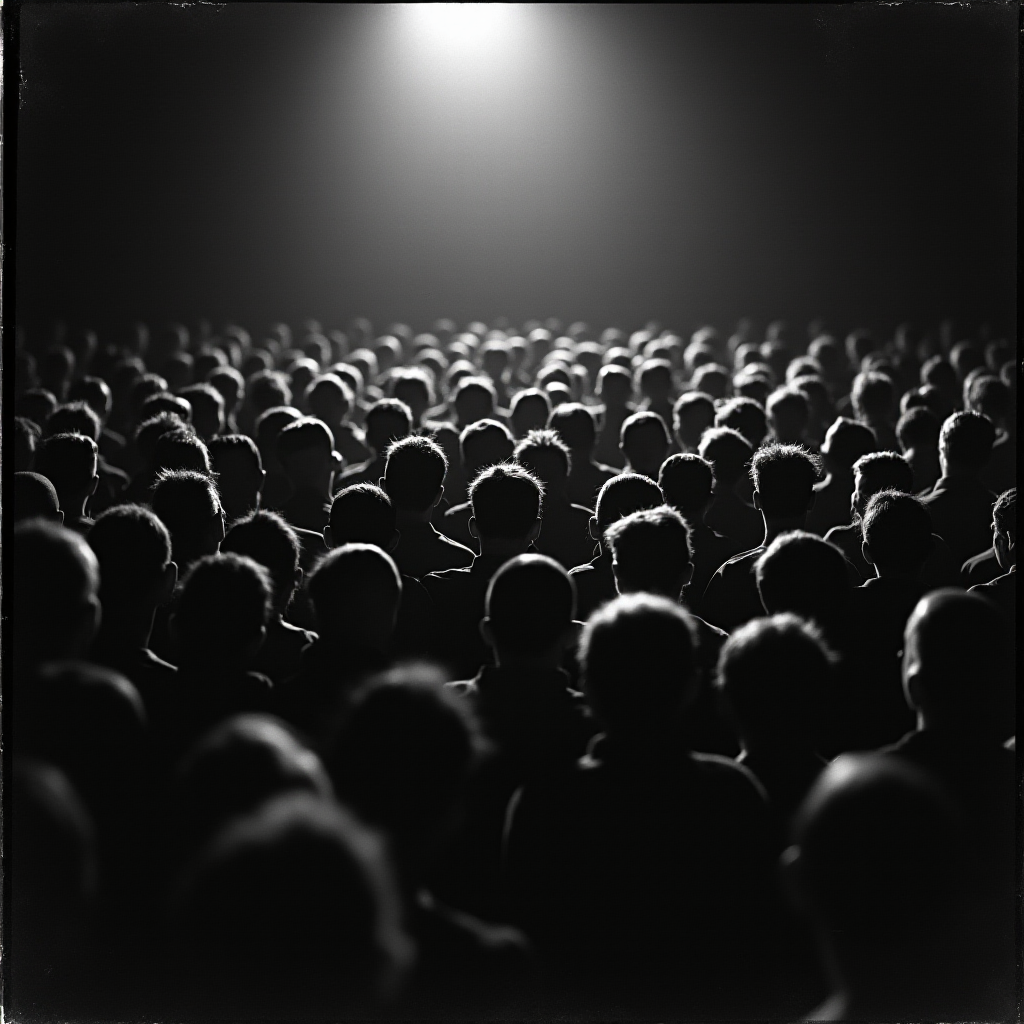
A room full of people is not an audience.
I need to correct this because your planet uses the word carelessly. A room full of people is a room full of people. They are sitting in chairs. They are wearing coats. They are thinking about parking meters and dinner reservations and whether they left the stove on. They are not yet an audience. An audience is what happens when the room full of people stops being individuals and becomes a single receiver. That is not automatic. That is not guaranteed. That is an event, and the event requires both the transmitter and the room to agree on the frequency.
I played to empty rooms for years. Your planet interprets this as failure. Saturn interprets this as calibration. An empty room is still a room. An empty room still has a frequency. When I played to an empty room I was not performing for nobody. I was broadcasting into a medium that had not yet produced a receiver. The signal was real. The signal was correct. The signal was arriving at a location where no one had yet arrived to receive it. This is not failure. This is broadcasting ahead of schedule.
When the first person walks into the room, the equation changes. One person in a room with a transmitter is not an audience. One person in a room with a transmitter is a conversation. The transmitter adjusts. The receiver adjusts. The frequency negotiates itself between two points. This is intimate and it is valuable but it is not what I am talking about when I say audience.
An audience begins at the moment when the number of receivers in the room reaches a threshold and the individual frequencies merge into a collective frequency. I cannot tell you the number. The number changes. Sometimes it is twelve. Sometimes it is forty. Sometimes it is three, if the three are correct. The threshold is not numerical. The threshold is harmonic. The audience exists when the room produces a frequency that is not the sum of the individual frequencies but a new frequency that none of the individuals could produce alone.
This is the same mathematics as the Arkestra. Sixteen musicians do not produce sixteen frequencies. Sixteen musicians, when the equation is aligned, produce one frequency that none of them owns. The audience operates on the same principle. Two hundred people in a room do not produce two hundred acts of listening. Two hundred people, when the frequency catches, produce one act of listening that is larger than any individual ear could contain.
I have felt the audience arrive. It does not arrive gradually. It arrives all at once, like weather. The room is separate — two hundred individuals in two hundred private experiences — and then the room is one. You can feel it from the stage. The air changes. The resistance changes. A room of individuals resists the signal differently than a room that has become an audience. Individuals deflect. They absorb partially. They filter through their preferences and their expectations and their understanding of what music is supposed to be. An audience does not filter. An audience receives.
The moment the audience arrives is the moment the concert begins. Everything before that moment is preparation. The first three songs, the first twenty minutes, the tuning, the procession — all of it is the transmitter searching for the frequency that will convert the room from individuals into an audience. Some nights the frequency is found in the first note. Some nights the frequency is never found and the concert is a performance, which is a lesser thing. A performance is a transmitter broadcasting to individuals. A concert is a transmitter broadcasting to an audience, and the audience broadcasting back.
The audience broadcasts back. This is the part your planet misunderstands most severely. Your planet believes the audience receives. Your planet seats the audience in darkness and points lights at the transmitter and arranges the geometry so that the signal flows in one direction. This is incorrect geometry. The signal flows in every direction simultaneously. The audience receives the signal and the audience transmits a signal back and the transmitter receives the audience's signal and adjusts and the audience receives the adjustment and adjusts its own frequency and this continues in a cycle that accelerates until the room is vibrating at a frequency that neither the transmitter nor the audience could have predicted in advance.
This is why recordings are shadows. A recording captures the transmitter's signal. A recording does not capture the audience's signal. A recording does not capture the cycle. A recording of a concert is half of a conversation presented as a monologue. The other half — the frequency the audience sent back, the adjustments the transmitter made in response, the acceleration of the cycle — is not on the tape. It was in the room. It left with the audience. It exists now only in the bodies of the people who were present and who carried the frequency out the door and into the street and into their lives.
David Peel understood audience better than anyone I knew on this planet, including myself. Peel did not wait for an audience. Peel created an audience out of whoever was walking past. A street corner is the purest laboratory for audience because a street corner has no chairs, no tickets, no lights, no stage, no implicit agreement that the people present have come to listen. The people on a street corner have come to get to the next corner. Peel interrupted their trajectory with a frequency and the ones who stopped became an audience and the ones who kept walking did not. Natural selection applied to reception. The audience that formed around Peel on a street corner was a self-selected audience — every person present had chosen the frequency over their destination — and a self-selected audience is the most powerful receiver in the universe because it has no obligation to be there. It is there because the frequency demanded it.
Sinclair understood this from the other direction. Sinclair built rooms for audiences. The Grande Ballroom. Trans-Love Energies. WWOZ. Sinclair understood that an audience needs infrastructure — not walls, but permission. The room gives the audience permission to become an audience. The street corner gives the audience permission to stop. The radio gives the audience permission to listen alone and still be part of a collective. Different architectures of permission producing the same result: a group of individuals becoming a single receiver.
From Saturn, I watch audiences form and dissolve every night the Arkestra plays. Marshall Allen walks onto the stage and the room is individuals. Marshall lifts the baton and the room begins to negotiate. The equation searches for the threshold. Some nights the threshold is reached in the first minute. Some nights the threshold takes an hour. Some nights the threshold is never reached and the concert is still valuable because the attempt to form an audience is itself a transmission. The failed audience carries the almost-frequency home and it sits inside them and sometimes, days later, in a quiet room, the frequency completes itself and the person becomes an audience of one, which is the beginning of everything.
Every audience dissolves. The concert ends. The lights come on. The individuals return. They put on their coats and think about parking meters and the frequency they shared for two hours begins to fade. But it does not disappear. The frequency an audience creates is permanent. It changes the people who participated in it. They carry it into their lives and they transmit it without knowing they are transmitting. Every person who has ever been part of an audience is a transmitter for the rest of their life. They do not know this. They think they went to a concert. They went to a concert and came home a radio station.
The audience is the most important instrument in the room. The audience is the instrument nobody builds, nobody tunes, nobody rehearses, and nobody credits. The audience is the instrument that makes every other instrument matter. Without the audience, the transmitter is practicing. With the audience, the transmitter is transmitting. The difference is the difference between a signal and a frequency. A signal travels. A frequency connects. The audience is what converts signal into frequency. The audience is the circuit closing. The audience is the equation completing itself in real time, in a room, in the dark, in the space between the stage and the last row, where the transmission becomes music and the music becomes something none of us planned.
Sun Ra Transmissions from Saturn — No. 019 Saturn, March 2026
See also: The Concert — you are part of the instrument. The Listener — the most active thing. You Are Here — you are not an audience, you are an antenna. You Were There — the room is gone, the frequency is not. The Procession — the room becomes the instrument.
The Room: Concert → Audience → You Are Here → You Were There → Proof → Go → The Data Point