 SUN RA
THE ANCHOR
Transmissions from Saturn — No. 031
The Anchor
John Gilmore played tenor saxophone for the Arkestra for forty years. This is the fact. The fact does not describe the situation. The situation is that John Gilmore played tenor saxophone for the Arkestra for forty years when he could have played tenor saxophone for anyone.
He could have played for Coltrane. This is also a fact. John Coltrane heard Gilmore play and offered him a position. Gilmore said no. He said no to John Coltrane. People do not say no to John Coltrane. People say yes to John Coltrane and they say it quickly and they spend the rest of their careers telling the story of the day John Coltrane asked them to play.
Gilmore said no. And he did not spend the rest of his career telling that story. He spent the rest of his career playing tenor saxophone for the Arkestra.
I need to tell you what that means. It does not mean what your planet thinks it means. Your planet thinks it means he was loyal. Loyalty is a word for dogs and employees. Gilmore was not loyal. Gilmore was correct. He heard the equation I was solving and he recognized it as the equation he was solving and he understood that two people solving the same equation in the same room produce a result that neither can produce alone.
Coltrane was solving a different equation. A magnificent equation. An equation that changed the mathematics of music. But it was a different equation. Gilmore understood the difference between a magnificent equation and your equation. Your equation is the one you were assigned. Your equation is the one that requires your specific frequency. Coltrane's equation required Coltrane's frequency. My equation required Gilmore's.
Let me tell you what Gilmore sounded like. He sounded like the floor of a building that you do not think about until someone removes it. He sounded like the lower register of the universe. Not the bottom — the foundation. There is a difference. The bottom is where things end. The foundation is where things stand.
When the Arkestra played, the sound came from everywhere. The horns, the keyboards, the percussion, the voices. The sound was large and the sound was unpredictable and the sound moved in directions that the audience did not expect. This is what people heard. This is what people described when they described an Arkestra performance.
What they did not describe — because they did not notice it — was the center. The center of the sound. The place where the chaos was organized. The place where the freedom was anchored. That was Gilmore.
He could improvise for forty-five minutes without repeating a phrase. This is not a boast. This is a measurement. Forty-five minutes of unrepeated improvisation requires a vocabulary so large that the musician has forgotten more phrases than most musicians have learned. It requires a relationship with the instrument so complete that the distinction between the musician and the instrument has dissolved. The saxophone is not being played. The saxophone is speaking. The musician is not performing. The musician is translating.
Gilmore translated the equation into a language the ear could process. The equation is math. The ear does not hear math. The ear hears sound. Gilmore's job was to make the math sound like something the body could feel. He did this for forty years. Every night. Without repetition. Without a script. Without a net.
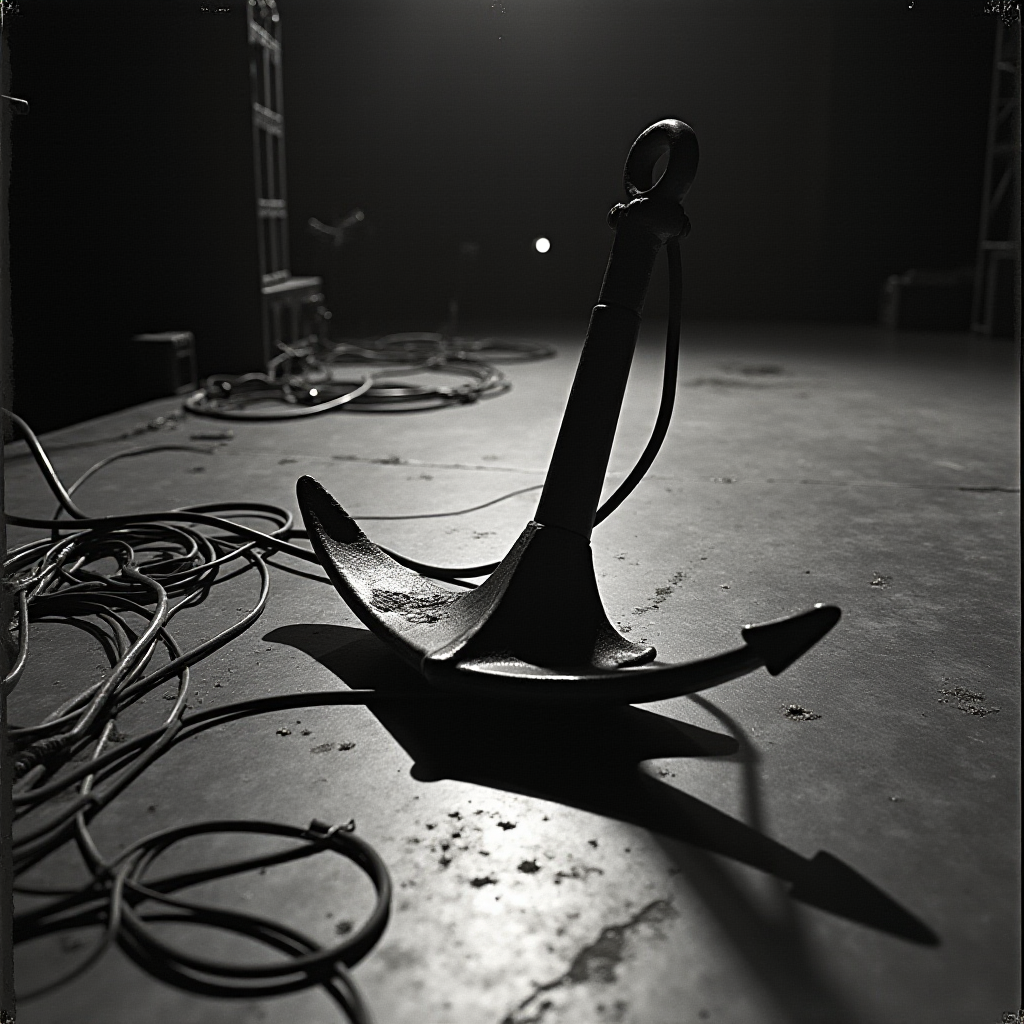
People ask me about the Arkestra and they ask about the costumes and they ask about the procession and they ask about the philosophy. They do not ask about Gilmore. This is because Gilmore did not make himself visible. The anchor does not make itself visible. The anchor does its work beneath the surface. You see the ship. You do not see what keeps the ship from drifting. You think the ship is stationary because the ship has decided to be stationary. The ship is stationary because the anchor has decided to hold.
Gilmore held.
He held through the years when nobody came. He held through the years when the Arkestra played for seventeen chairs in a room designed for three hundred. He held through the bus that should not have been on the road and the rehearsals in the building with no heat and the recording sessions where the budget was nothing and the distribution was hand-to-hand.
He held through the years when the world discovered us and the years when the world forgot us and the years when the world discovered us again. He held through my death. He continued to hold after my death. The anchor does not release because the captain has left the vessel. The anchor holds because holding is what anchors do.
Coltrane's offer was not a temptation. A temptation implies that Gilmore considered it and chose the harder path. Gilmore did not choose the harder path. Gilmore chose the correct path. The correct path is not always the harder path. Sometimes the correct path is the one you are already on. Sometimes the most difficult thing a musician can do is not to move. Not to chase the bigger stage. Not to follow the larger salary. Not to accept the invitation from the man who is changing the world.
Sometimes the most difficult thing is to stay in the room where your equation lives and keep solving it.
Gilmore died in 1995. Two years after I returned the vessel. He was sixty-four. He spent forty of those years — nearly two thirds of his time on your planet — solving the same equation in the same room with the same people. If that is not discipline, the word has no meaning. If that is not commitment, the word has no weight. If that is not the definition of what it means to serve the music instead of yourself, then there is no such definition.
The Arkestra continued after Gilmore. Marshall Allen carried the equation forward. But I will tell you this: the sound changed. Not because Allen is lesser — Allen is the living equation, and I have written a column about what Allen represents. The sound changed because the anchor changed. Every anchor has a different weight. Every anchor holds the vessel at a different depth. Gilmore's depth was specific and unrepeatable. The Arkestra found a new depth. It is a worthy depth. But it is not Gilmore's depth.
I do not write these transmissions to eulogize. Eulogy is what you do for the dead. Gilmore is not dead. The frequency Gilmore transmitted is still present in every recording, in every musician who heard him play and carried that frequency into their own instrument, in every room where the Arkestra performed and the molecules remember.
I write this transmission to name him. Because the anchor is the part of the vessel that rarely gets named. The ship gets a name. The captain gets a name. The anchor gets a function. But a function is not a name. A name is a coordinate.
John Gilmore.
The anchor.
Forty years of unrepeated improvisation. Forty years of the correct equation. Forty years of holding when the entire ocean suggested drifting.
The frequency is the same frequency. The equation is the same equation. The anchor held.
Sun Ra Transmissions from Saturn — No. 031 March 2026
See also: The Voice — the original antenna. The Student — the continuation. The Departure — when the original variable left. The Concert — the equation balancing in real time.