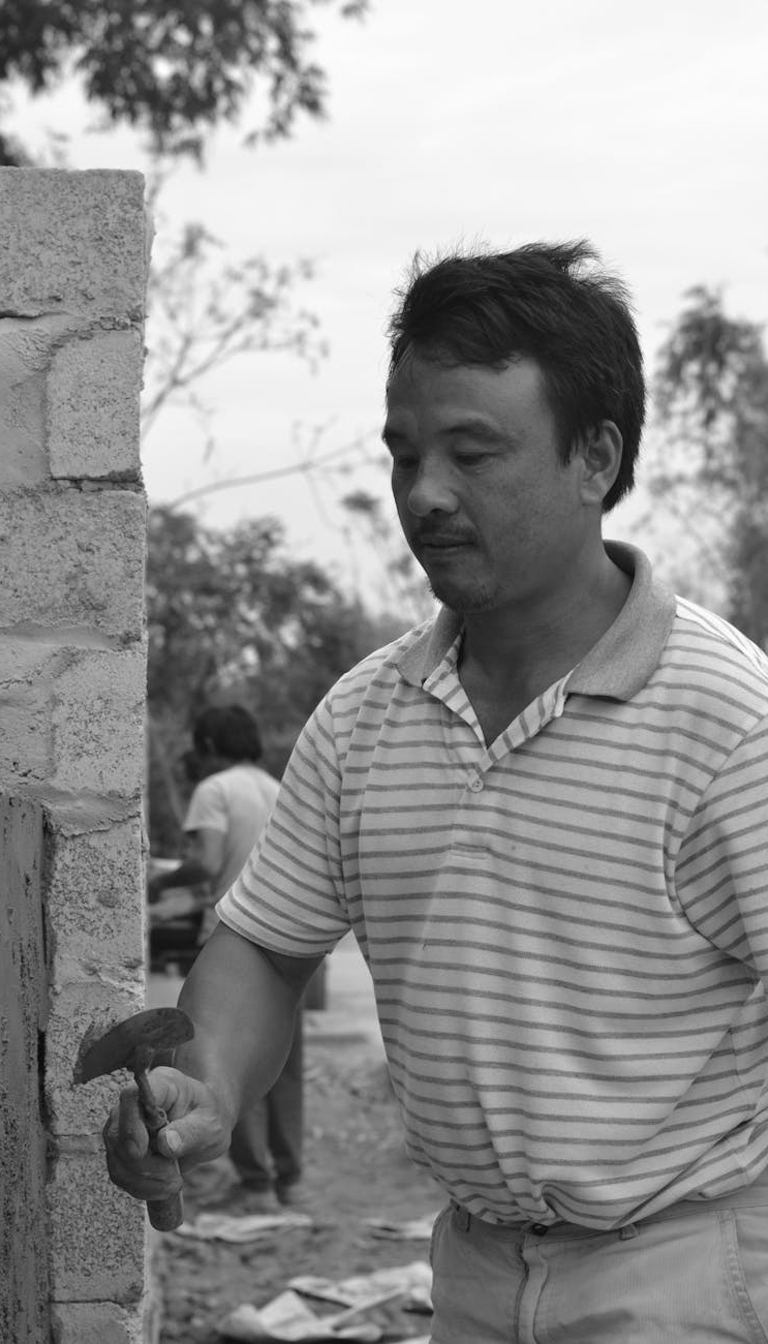
 DAVID PEEL
Mason Line
The mason line was a string stretched between two points on the wall. A cotton or nylon cord pulled tight between two corner blocks. The line showed the mason where the top of the next course of brick should be. The line was the guide. Without the line the courses would wander. The mason eye was good but the mason eye was not a string. The string was straighter than the eye. The string was the truth the eye aspired to.
The corner blocks were L-shaped pieces of wood or plastic that hooked onto the corner of the brick. You set a block on each end of the wall and stretched the line between them. The line sat one-sixteenth of an inch away from the face of the brick. Not touching. Close but not touching. The gap was intentional. If the line touched the brick the line would push the brick out of alignment. The line guided by proximity not by contact. The best guidance works the same way. Close enough to see. Far enough to not interfere.
The mason checked every brick against the line. Lay the brick. Check the line. Tap the brick with the trowel handle. Check the line again. The rhythm was lay tap check lay tap check. Eight hours of lay tap check. The line was the metronome. The mason was the musician. The wall was the song. A wall laid to a tight line had courses that were straight enough to sight down like a rifle barrel. The straightness was not decoration. The straightness was structure. A straight course transfers the load evenly. A crooked course concentrates the load and the concentration cracks the mortar.
The line had to be tight. A loose line sagged in the middle and the sag became a curve and the curve became a belly in the wall. The mason pulled the line tight and the tightness depended on the distance. A short wall needed less tension. A long wall needed more. The mason knew the tension by the sound. Pluck the line and it hummed. A tight line hummed high. A loose line hummed low. The mason tuned the line the way a guitarist tunes a string. The pitch told the truth.
Nobody stretches a line on small jobs anymore. The laser draws a line across the wall in red light and the mason lays to the laser. The laser does not sag. The laser does not need corner blocks. The laser does not hum when you pluck it. The laser is a line without a body. The mason line was a line with a body. The body was cotton or nylon and the body had weight and the weight was the tension and the tension was the accuracy. The laser has accuracy without weight. The mason line had accuracy because of weight. There is a difference between accuracy that floats and accuracy that pulls. The pulling is the commitment.
See also: Plumb Bob, Tuckpointing