 JOHN SINCLAIR
LUNCH COUNTER
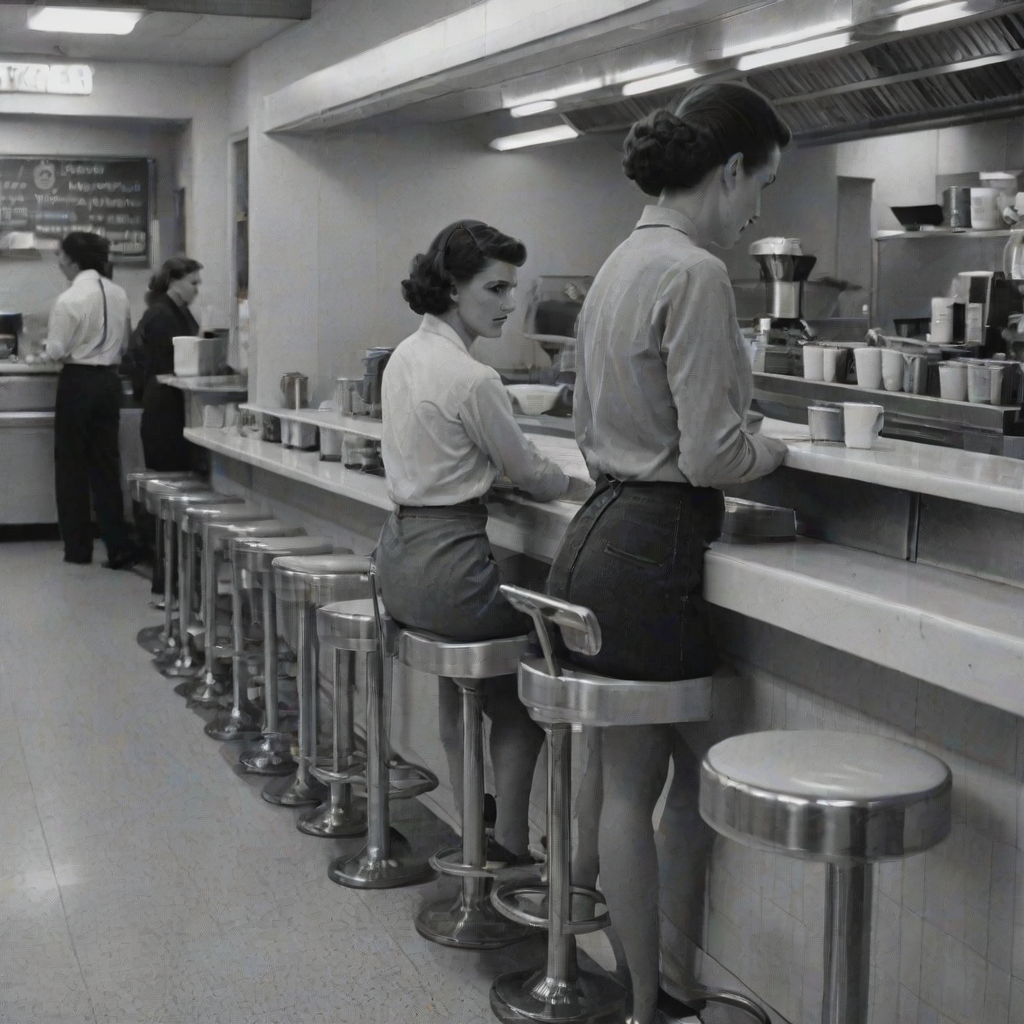
The lunch counter was the most democratic table in America. You did not need a reservation. You did not need a jacket. You needed seventy five cents and a stool and the stool was first come first served and the first come first served was the entire political philosophy of the lunch counter. You sat between strangers. Your elbow touched their elbow. The touching was not intimate. The touching was architectural. The counter was narrow and the stools were close and the closeness was the design. The design said you will eat next to someone you do not know and the eating will make you neighbors for the duration of the meal. The meal lasted eleven minutes. Eleven minutes was the national average for a lunch counter visit in nineteen fifty five. Eleven minutes of coffee and a sandwich and the crossword and then the stool was someone else's. The turnover was the business model. The speed was the product.
Fred Harvey built the first chain of lunch counters along the Atchison Topeka and Santa Fe Railway starting in eighteen seventy six and the Harvey Houses changed the American West. Before Harvey the food at railroad stops was inedible and the stops were too short to eat it anyway. Harvey standardized the meal. The menu was the same in Kansas as it was in New Mexico. The coffee was hot. The pie was fresh. The waitresses were young women recruited from the East and the women were called Harvey Girls and the Harvey Girls were required to be between eighteen and thirty and of good moral character and the moral character requirement was enforced and the enforcement made the Harvey Houses respectable and the respectability made them successful. Judy Garland played a Harvey Girl in the nineteen forty six movie and the movie was a musical and the musical did not mention that the Harvey Girls were the first professional women in many of the towns they served. The Harvey Girl was the waitress and the librarian and the Sunday school teacher and the eligible bride and the town formed around her the way a pearl forms around sand.
The lunch counter became a battlefield on February first nineteen sixty. Four freshmen from North Carolina Agricultural and Technical State University sat down at the Woolworth's lunch counter in Greensboro North Carolina and ordered coffee. The four were Black. The counter was white. The coffee did not come. The four sat. They sat until the store closed and they came back the next day with more students and the next day with more and within two weeks there were lunch counter sit-ins in fifteen cities across five states and within two months the movement had spread to fifty four cities in nine states. The lunch counter did not choose to be a battlefield. The lunch counter was chosen because the lunch counter was public. The lunch counter said anyone can sit here. The segregation said not anyone. The contradiction was visible to everyone in the room and the visibility was the weapon. You could not hide a lunch counter. You could not move it to a back room. The counter was in the middle of the store and the store was on Main Street and Main Street was America and America was watching four men sit quietly on stools and wait for coffee that would not come.
The lunch counter at Woolworth's in Greensboro served its first integrated meal on July twenty fifth nineteen sixty. The four freshmen were Ezell Blair Junior and David Richmond and Franklin McCain and Joseph McNeil and the four names should be as famous as any names in America because the four men changed the country by sitting down. They did not march. They did not shout. They sat on stools at a counter and the sitting was the revolution. The counter is now in the Smithsonian. The actual counter. The actual stools. The formica and chrome that held the weight of four students who were heavier than they looked because they were carrying the future and the future is heavy.
The lunch counter is nearly gone. The diners still have them. The old Woolworth buildings that were not demolished sometimes have the counter intact under a layer of drywall and the drywall is the erasure and the erasure is quiet. The lunch counter was replaced by the booth and the booth was replaced by the table and the table was replaced by the bag and the bag is carried to the car and the car is driven to the desk and the desk is where Americans eat now. Alone. At a desk. Looking at a screen. The lunch counter faced you toward other people. The desk faces you toward yourself. The lunch counter said sit here and be part of the room. The desk says sit here and disappear. The eleven minutes at the counter were eleven minutes of being in public and being in public was the practice and the practice made the democracy. You cannot practice democracy at a desk. You cannot practice democracy in a car. You can only practice democracy in a room full of strangers and the lunch counter was the room and the strangers were the teachers and the lesson was the same every day. You are not alone. You only eat alone.