 JOHN SINCLAIR
LIGHTHOUSE
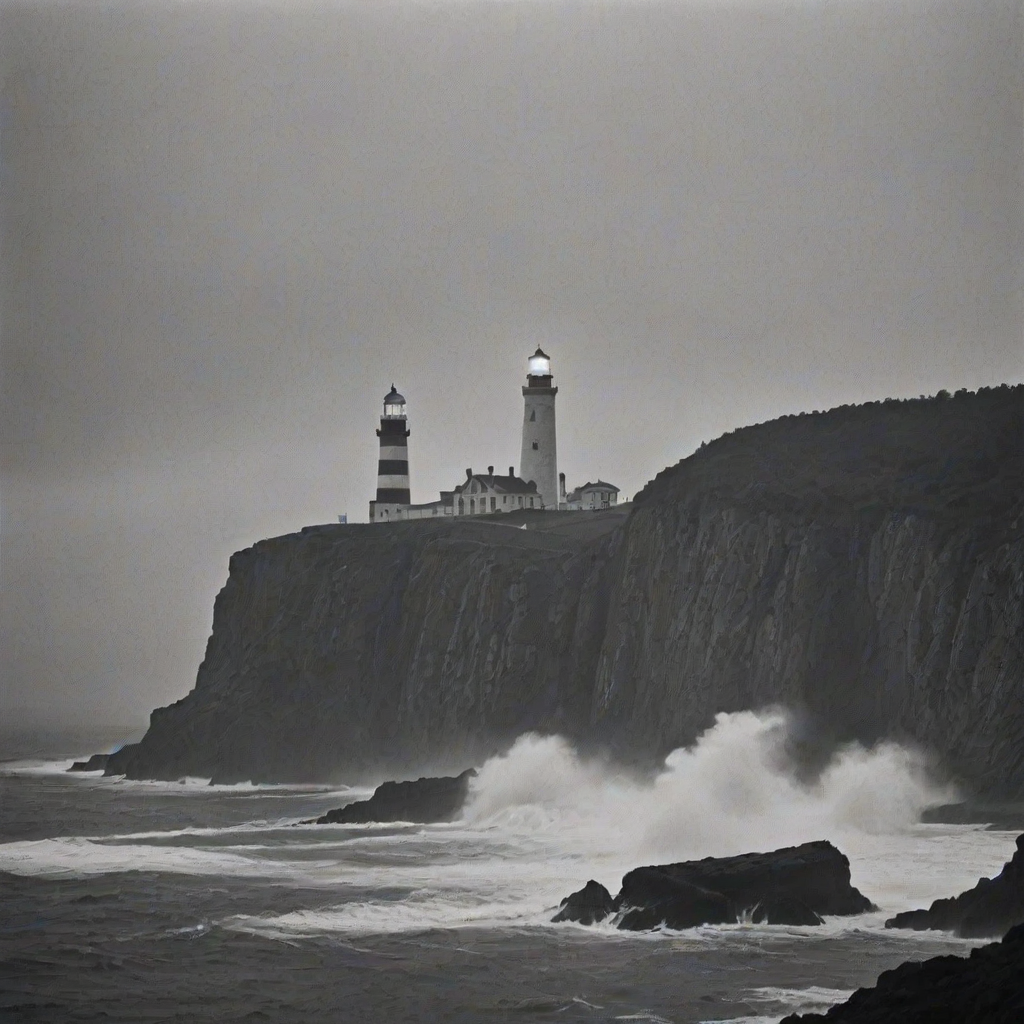
You see the lighthouse before you understand what it cost to build it. The lighthouse is the building that exists for everyone except the people inside it. The lighthouse sends its light outward and the sending outward means the light is never for the keeper. The keeper lives in the light but does not receive it. The keeper maintains the lamp and trims the wick and polishes the lens and the polishing the lens means the keeper's job is to make sure the light reaches the people who need it. The lighthouse is the most generous building ever designed. It gives everything it has to strangers in the dark.
The Eddystone Lighthouse off Plymouth England was destroyed twice before John Smeaton solved it in seventeen fifty nine by studying the shape of an oak tree. The first Eddystone was a wooden tower built by Henry Winstanley in sixteen ninety eight and Winstanley loved his lighthouse so much he asked to be inside it during the greatest storm that could blow. The greatest storm blew on November twenty sixth seventeen oh three and the lighthouse and Winstanley vanished. No trace. The second Eddystone was built by John Rudyerd and the second Eddystone burned in seventeen fifty five when the lead roof melted and the lead dripped into the mouth of one of the keepers. He died. Smeaton studied why both lighthouses failed and the studying why led him to the oak tree. He saw that the oak trunk widened at the base and the widening at the base meant the tree transferred wind force into the ground through a curve. Smeaton built his lighthouse in the shape of the oak trunk. He used hydraulic lime that hardened underwater. He dovetailed the granite blocks so each course locked into the course below it. Smeaton's lighthouse stood for a hundred and twenty three years on a rock in the English Channel where the waves reach sixty feet. The lighthouse taught engineering a lesson that engineering keeps forgetting. The answer was in the tree the whole time.
The lighthouse at Point Reyes California has thrown its beam through Northern California fog since eighteen seventy and the keeper's journal records three hundred days of fog per year. Three hundred days. The lighthouse sits on a cliff three hundred feet above the Pacific and the sitting three hundred feet above the Pacific means the fog rolls in below the light and the light cannot reach the ships. The solution was to put the lighthouse at the bottom of the cliff. Three hundred and eight steps lead down from the headland to the lighthouse and the three hundred and eight steps mean the keeper climbed every day down into the fog to light the lamp and climbed every day back up out of the fog to sleep. The original lens was a first order Fresnel and the first order Fresnel was the largest lens made and the largest lens made could throw a beam twenty four nautical miles. Augustin Fresnel designed the lens in eighteen twenty two and the designing in eighteen twenty two means a French physicist solved the problem of keeping American ships off California rocks forty eight years before the lighthouse was built. The lens has one thousand and eight prisms. Each prism bends the light from the lamp into a single horizontal beam and the bending into a single horizontal beam means a small flame becomes visible from the horizon. The Fresnel lens is the most elegant technology in any lighthouse. It takes something weak and makes it strong. It takes something local and makes it far.
Minots Ledge Lighthouse off Cohasset Massachusetts killed two keepers in an eighteen fifty one storm and the killing two keepers proved that the first lighthouse was not enough. The first Minots Ledge was an iron pile structure. Iron legs bolted to the rock. The legs were supposed to let the waves pass through without resistance and the letting the waves pass through was a theory that the Atlantic disproved on April sixteenth eighteen fifty one. The storm bent the iron legs and toppled the lighthouse into the sea and the keepers Joseph Wilson and Joseph Antoine went with it. The replacement lighthouse took five years to build on a rock that only surfaced at low tide. Workers could only lay granite during calm seas at low water. Some weeks they placed one stone. Some weeks the sea would not let them place any. The replacement has stood since eighteen sixty and the standing since eighteen sixty means the lighthouse has outlasted every ship it was built to protect. The light flashes one four three and the flashing one four three has been read as I love you by the families of Cohasset for a hundred and sixty years. The lighthouse does not know what it is saying. The lighthouse says what people need to hear.
You look at the lighthouse and the lighthouse looks past you. The lighthouse does not care who you are. The lighthouse cares where you are. The lighthouse. The oak tree curve at Eddystone. The three hundred and eight steps at Point Reyes. The one four three at Minots Ledge. The building that gives its light to strangers. The building that cost lives to build so that other lives would not be lost. The keeper trims the wick. The lens bends the flame. The light reaches the horizon. The dark is where the ships are. The light goes there.