 DAVID PEEL
HOPSCOTCH
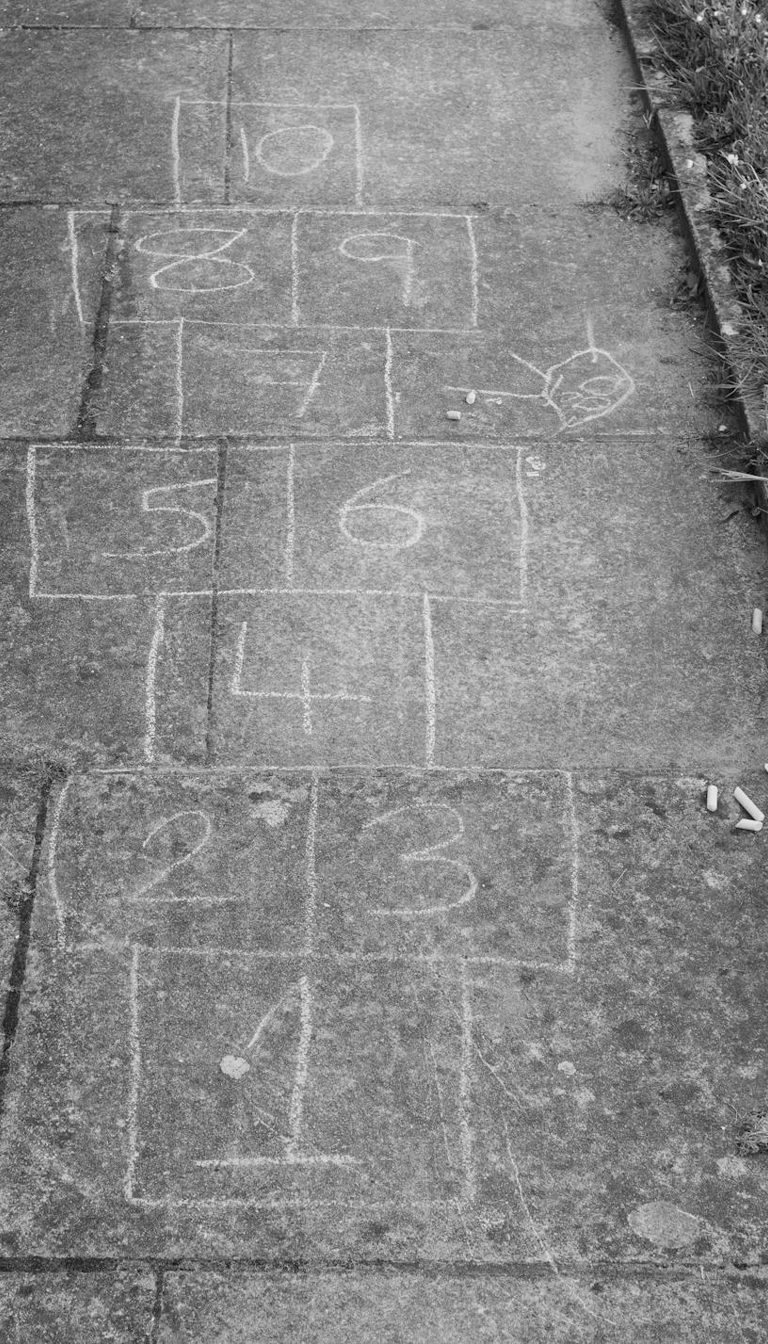
You see the chalk on the sidewalk before you see the kids. Somebody drew a hopscotch board on the concrete and the numbers go from one to ten and there is a stone on number four because that is where the last kid stopped. Hopscotch. The most temporary architecture in the city. Rain erases it. Feet erase it. Tomorrow somebody draws it again in a different color and the game starts over. You do not need anything to play hopscotch. You need a piece of chalk and a stone and a stretch of sidewalk and the ability to stand on one foot.
Every girl on the Lower East Side could draw a hopscotch board with her eyes closed. The proportions had to be right. The squares had to be even. The numbers had to be centered. A crooked hopscotch board was an insult to the sidewalk. The girls who drew the boards were architects and they did not know it. They understood proportion and spacing and balance and they learned it from a piece of chalk and a piece of concrete and the judgment of nine-year-old critics who would tell you your board was wrong before you finished drawing it.
The stone had to be flat. That was the rule. You could not use a round stone because a round stone rolls. You needed a stone that would land and stay. Every kid had a lucky stone. A piece of slate from a broken roof tile. A chunk of marble from a demolished building. The stone was your ticket. You threw it and it landed on a number and you hopped to that number and you picked it up and you hopped back and if your foot touched a line you were out. The lines were the law. The chalk was the law. A nine-year-old with a piece of chalk was the Supreme Court of the sidewalk.
I watched a girl on Avenue B play hopscotch for an hour without missing. She was maybe ten years old and she hopped on one foot from one to ten and back again and the stone landed where she wanted it every time. She was playing alone. No audience. No competition. She was playing hopscotch the way a musician practices scales. Not for anyone. For herself. The sidewalk was her instrument and she played it perfectly and nobody saw it and that was fine because the performance was not for us.
You do not see hopscotch on the sidewalk anymore. The chalk is gone. The stones are gone. The kids are inside looking at screens. A screen does not teach you balance. A screen does not teach you to stand on one foot on a hot sidewalk in July while your friends watch and wait for you to fall. Hopscotch taught you something no app can teach. It taught you that the ground under your feet has rules and the rules are drawn in chalk and the chalk washes away and you draw them again. That is how a neighborhood works. The rules are temporary. The game is permanent.