 JOHN SINCLAIR
GAS STATION
You pull into the gas station and the pulling in is the ritual of the road. You have been driving and the driving requires fuel and the fuel requires stopping and the stopping at the gas station is the pause between distances. The gas station is the place where the journey is interrupted by the machine's hunger. Your car is hungry. The gas station feeds it. The gas station is the restaurant for automobiles and the restaurant for automobiles is the most visited building in America and the most visited building in America is not a church or a school or a library. It is the gas station. The place where you stand next to a pump and watch numbers climb.
The first drive-in gas station opened in Pittsburgh in nineteen thirteen at the corner of Baum Boulevard and St. Clair Street and the opening was the beginning of the end of walking. Before nineteen thirteen you bought gasoline at the hardware store in a can and you poured it into the car yourself and the pouring yourself was the inconvenience that limited how far you would drive. The drive-in station eliminated the inconvenience and the eliminating the inconvenience was the invention that made the road trip possible and the road trip possible was the invention that made America what it is which is a country that drives. Gulf Oil opened that first station and Gulf Oil understood that the automobile needed infrastructure and the infrastructure the automobile needed was a building on every corner that sold one thing and the one thing was motion.
Ed Ruscha photographed every gas station on Route 66 between Los Angeles and Oklahoma City in nineteen sixty three and published them in a book called Twentysix Gasoline Stations and the book was art because the every was the point. Not the beautiful gas station. Not the remarkable gas station. Every gas station. Ruscha understood that the gas station was the vernacular architecture of America and the vernacular architecture of America was not designed by architects but by oil companies and the oil companies designed the gas station to be invisible and the invisible was what Ruscha made visible. Twenty six gas stations. Twenty six photographs. Twenty six versions of the same building that was not quite the same and the not quite the same was the American landscape repeating itself with minor variations forever.
In the nineteen fifties the gas station was the cathedral of the automobile age and the cathedral had a steeple which was the sign. The Mobil Pegasus. The Shell scallop. The Texaco star. The signs rose above the station on poles and the poles lifted the signs into the sky so the driver could see them from a mile away and the seeing from a mile away was the architecture of speed. The gas station was designed to be read at sixty miles an hour and the read at sixty miles an hour is the opposite of every other building which is designed to be entered on foot. The gas station does not want you to linger. The gas station wants you to stop and pay and leave and the stop and pay and leave is the transaction and the transaction takes four minutes and the four minutes is the gas station's entire relationship with you.
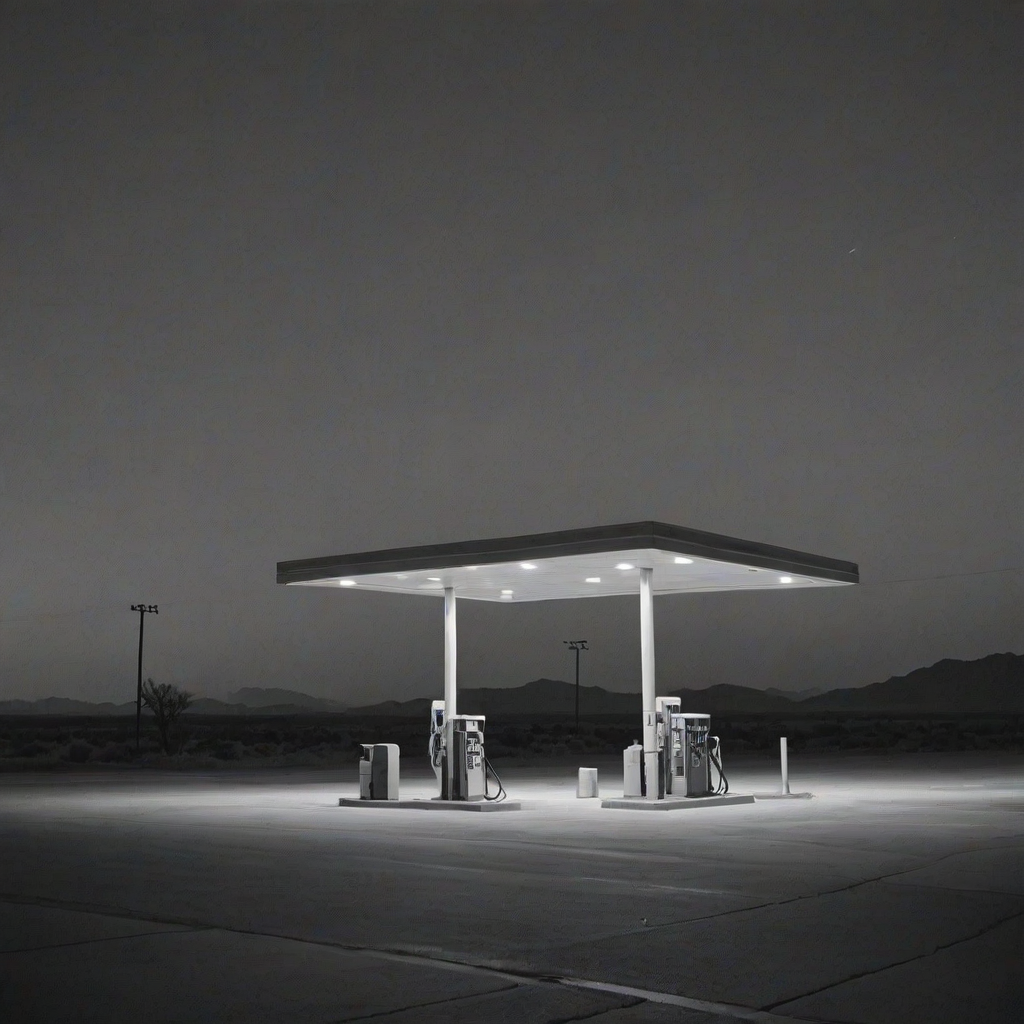
You stand at the pump at two in the morning and the fluorescent canopy above you makes the gas station the brightest place for miles and the brightest place for miles in the desert at two in the morning is the loneliest light on Earth. The gas station at night. Edward Hopper should have painted it but Hopper painted the diner instead and the diner was the wrong building because the gas station is lonelier. The diner has people inside. The gas station has you and the pump and the numbers and the hum of the fluorescent lights and the hum of the fluorescent lights is the sound of petroleum converted to light and the light converted to loneliness and the loneliness is the American road at night. You finish pumping. You get in the car. You drive away and the gas station shrinks in the mirror and the shrinking in the mirror is the gas station becoming a dot of light in the darkness and the dot of light in the darkness is what the gas station always was. A bright interruption. A pause. Then gone.