 DAVID PEEL
Formwork
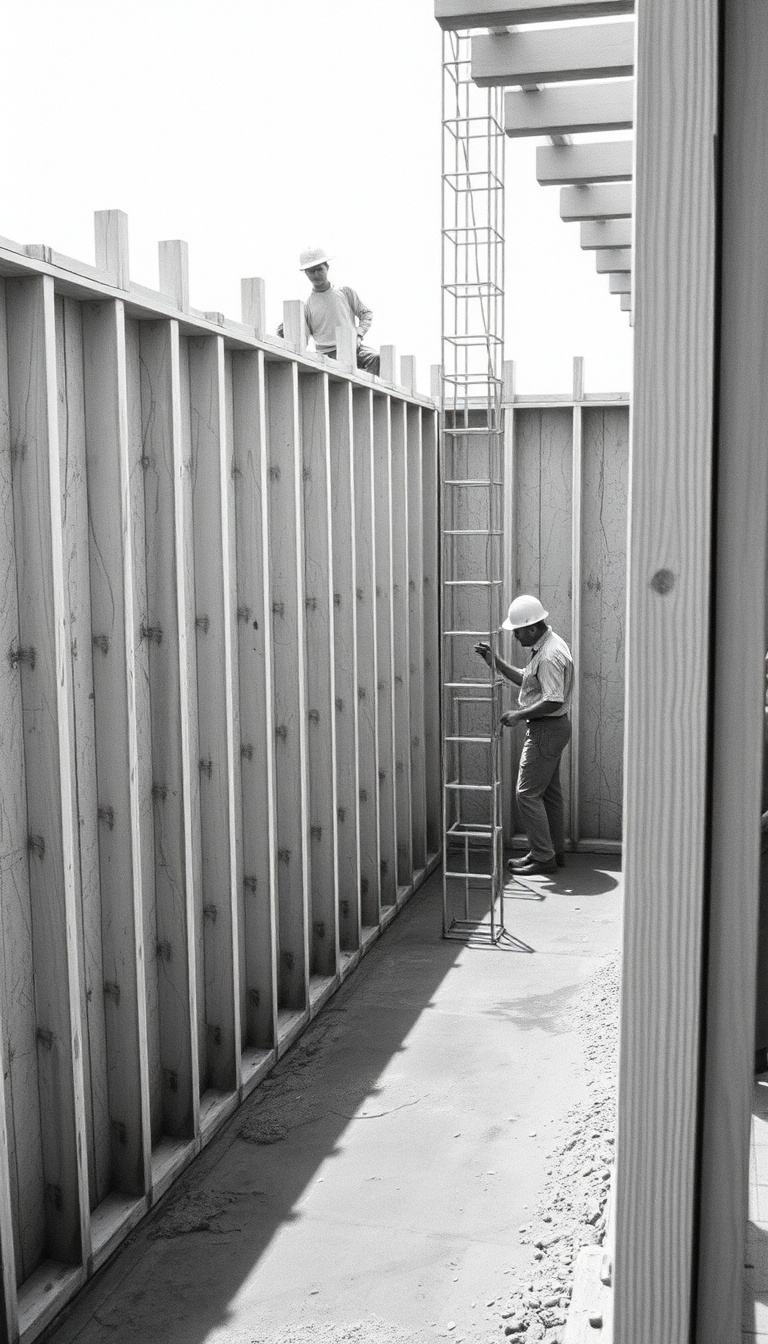
Formwork was the mold. You built the shape you wanted and poured concrete into it and the concrete took the shape. The formwork was the negative. The concrete was the positive. The building started as a wooden box and ended as a concrete wall. The wooden box was temporary. The concrete wall was permanent. You built the temporary thing to make the permanent thing and then you tore the temporary thing apart. The formwork was built to be destroyed.
The carpenter who built formwork was a different carpenter than the carpenter who built cabinets. The formwork carpenter worked fast and rough. The joints did not need to be tight. The surfaces did not need to be smooth. The formwork needed to be strong enough to hold wet concrete and straight enough to make a flat wall. Wet concrete weighed a hundred and fifty pounds per cubic foot. A wall form eight feet tall held twelve hundred pounds per linear foot. The form had to hold that weight without bowing. The carpenter braced the form with two-by-fours called walers and tied the two sides together with snap ties. The snap ties held the form at the right width. The walers held the form at the right shape. The concrete pushed and the form pushed back.
You oiled the forms before the pour. Form oil. A thin coat on the plywood so the concrete would not bond to the wood. Without the oil the plywood stuck to the concrete and the concrete tore the surface when you stripped the forms. The oil was the release agent. The oil said to the concrete you can touch the wood but you cannot hold it. The concrete took the shape of the wood but not the wood itself. The oil was the boundary between temporary and permanent.
The pour was the moment. The truck backed up and the chute swung over the form and the concrete flowed in gray and heavy. The vibrator went into the concrete to settle it. The air bubbles rose. The concrete found the corners. The concrete found the rebar. The concrete filled every gap and void and took the exact shape of the form. The form was the last decision. Once the concrete set the form was gone and the wall was there forever. The wall remembered the form the way a cast remembers the mold. Every mark on the form showed up on the concrete. Every knot in the plywood. Every joint between sheets. Every nail hole. The concrete remembered everything the form did.
They use aluminum forms now. Reusable. The aluminum form strips clean and goes back together for the next pour. The plywood form was used three times and thrown away. The aluminum form is used three hundred times. The aluminum form makes a smoother wall. The plywood form left the grain of the wood in the concrete. The grain was the fingerprint of the tree in the wall of the building. The aluminum form leaves nothing. The wall is smooth and blank and tells you nothing about how it was made.