 JOHN SINCLAIR
FLOODGATE
You see the floodgate and the floodgate is the door between the river and the city. The floodgate is steel or concrete or timber and the floodgate stands in the channel and the standing in the channel means the floodgate controls the water. The floodgate opens and the water flows. The floodgate closes and the water stops. The floodgate is the simplest form of power over water. The floodgate does not redirect the water or pump the water or treat the water. The floodgate simply says yes or no. The floodgate is the binary. Open. Closed. Flood. No flood.
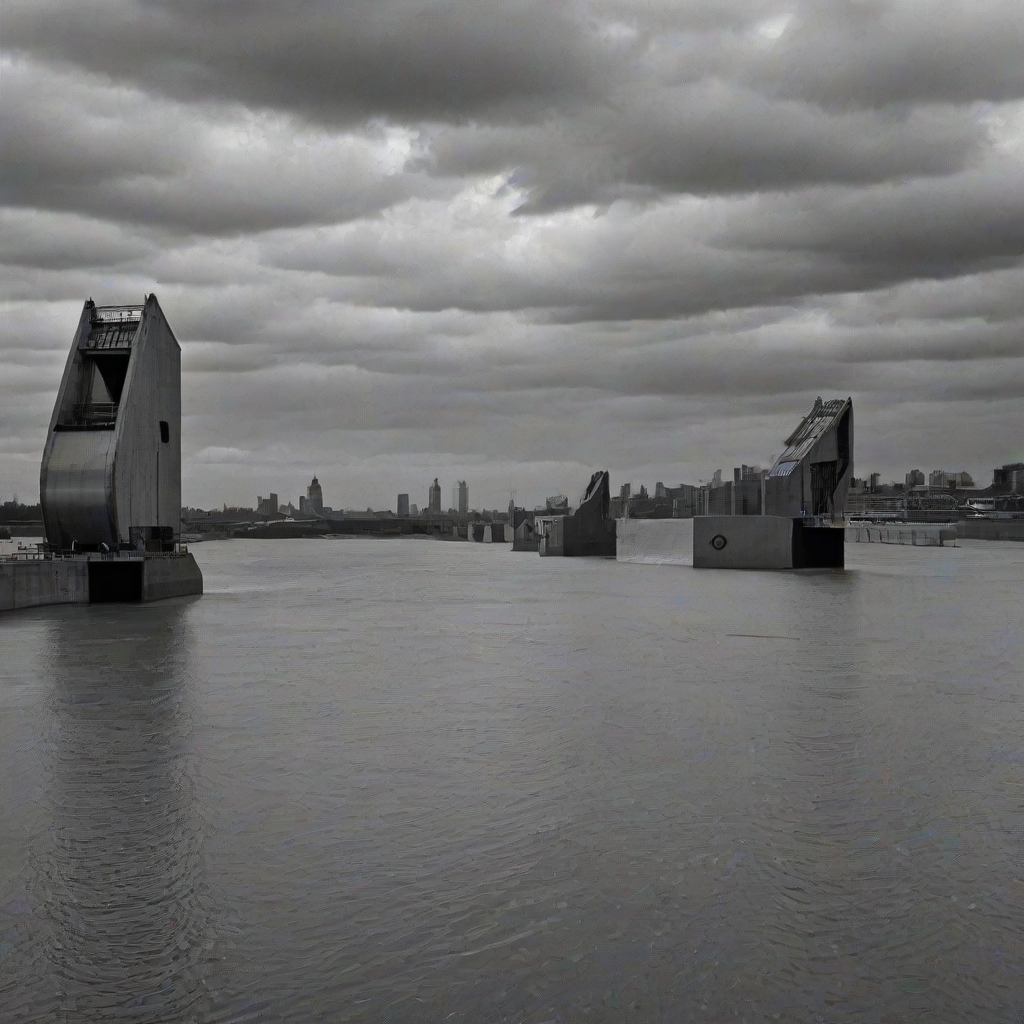
The Thames Barrier has ten steel gates and the ten gates have closed more than two hundred times since nineteen eighty four and each closing saved London from the North Sea. The barrier spans five hundred and twenty meters across the Thames at Woolwich and the spanning five hundred and twenty meters means the barrier is wider than the opening of Sydney Harbour. The gates rest on the river bottom when open and the resting on the bottom means ships can pass over them. When a surge tide approaches from the North Sea the gates rotate upward and the rotating upward takes ninety minutes and the ninety minutes is the time between the decision and the defense. The barrier was built because the North Sea surge tide of nineteen fifty three killed over three hundred people on the east coast of England and flooded three hundred thousand acres and the flooding three hundred thousand acres convinced Parliament that London needed a barrier. The barrier cost over a billion pounds and the over a billion pounds is the price of keeping the North Sea out of the Tube.
The Maeslantkering in Rotterdam weighs twenty two thousand tons per arm and the twenty two thousand tons makes it the largest moving structure on earth. The Netherlands is below sea level. The Netherlands has always been below sea level. The Maeslantkering protects Rotterdam which is Europe's largest port and the protecting Europe's largest port means the floodgate protects not just the city but the continent's commerce. Each arm of the Maeslantkering is as long as the Eiffel Tower is tall and the as long as the Eiffel Tower is tall means the arms swing from their hinges across the waterway like two enormous doors closing. The Maeslantkering closes automatically. A computer monitors the sea level and when the sea level reaches three meters above normal the computer orders the gates to close and the ordering the gates to close means no human makes the decision. The computer decides. The largest moving structure on earth is operated by a machine that reads the tide.
In New Orleans the floodgates failed. The Industrial Canal floodwall was supposed to hold back the surge from Hurricane Katrina in two thousand five but the floodwall failed because the pilings were not driven deep enough and the not driven deep enough meant the soil gave way and the soil giving way meant the wall collapsed and the wall collapsing meant the Lower Ninth Ward flooded to the rooftops. The floodgate at the Seventeenth Street Canal failed for the same reason. The floodgate at the London Avenue Canal failed for the same reason. Three floodgates failed and the three failures killed over a thousand people and the killing over a thousand people was the price of floodgates that were designed to a category three standard in a city that sat below a category five storm. The floodgates of New Orleans proved that the floodgate is only as strong as the decision that designed it.
You stand at the floodgate and the water is on one side and the city is on the other side and the floodgate is between them. The water is patient. The water pushes. The water pushes every second of every day and the pushing every second is the pressure and the pressure is the weight of the water against the gate and the weight against the gate is the load and the load is what the floodgate was built to hold. The floodgate holds. The floodgate has held for years. The floodgate will hold until it doesn't and the until it doesn't is the question that keeps the engineers awake. The floodgate. The steel door. The ten gates at Woolwich. The twenty two thousand tons at Rotterdam. The failures at New Orleans. The door between the river and the city. The binary. Open. Closed. The last line. The water pushes. The gate holds. For now.