 JOHN SINCLAIR
FLEA MARKET
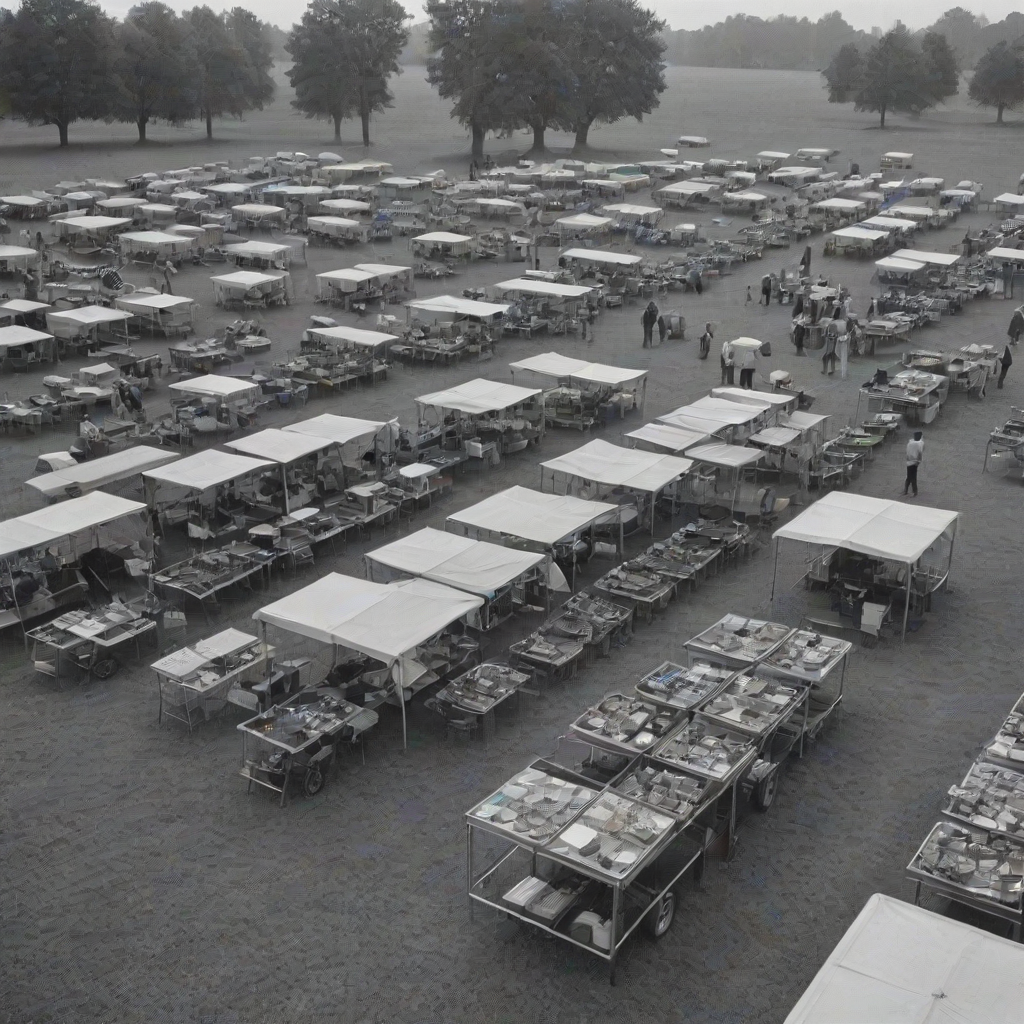
The flea market was a store that assembled itself on Saturday morning and disappeared by Sunday night. The vendors arrived in trucks and vans and station wagons and the vehicles were the inventory system and the inventory system was the vehicle. You opened the back and the store was open. You closed the back and the store was closed. The flea market was the most honest retail space in America because the flea market did not pretend to be permanent. The flea market knew it was temporary and the knowing was the freedom. A permanent store must justify its lease. A flea market table must justify only its morning.
The name comes from the French marché aux puces which translates literally to market of the fleas and the name was first used to describe the outdoor markets of Paris in the eighteen sixties where secondhand goods were sold in the open air and the goods were sometimes infested and the infestation gave the market its name and the name stuck because the name was honest. The Marché aux Puces de Saint-Ouen opened at the northern edge of Paris in eighteen eighty five and the market is still there and the market is still called the flea market and the fleas are gone but the name survived because names survive longer than the things they describe. In America the flea market grew out of the swap meet and the swap meet grew out of the farm auction and the farm auction grew out of necessity. A farmer who lost his farm sold his tools and the selling was public and the public was the community and the community came because the community wanted to help and the helping was buying.
The flea market was the museum of the American household. The objects on the tables were the objects that had outlived their owners or outlived their usefulness or outlived their welcome. The toaster that still worked but had been replaced. The lamp that still lit but no longer matched the couch. The records that no one played anymore. The books that no one read anymore. The flea market was where objects went to find a second life and the second life was always cheaper than the first life and the cheapness was the democracy. The flea market was the only retail space in America where the price was a conversation. You picked up the object. You looked at the vendor. The vendor said a number. You said a lower number. The vendor said a number between the two numbers. You said yes or you put the object down and the putting down was the counteroffer and the counteroffer usually worked because the vendor did not want to take the object home. The vendor wanted to go home with money and an empty table and the empty table was the victory.
The Rose Bowl Flea Market in Pasadena California opens on the second Sunday of every month and twenty five hundred vendors set up on the parking lot of the Rose Bowl stadium and the parking lot becomes the largest regularly scheduled flea market in America and the becoming takes four hours. The vendors arrive at five in the morning and the early buyers arrive at five thirty and the early buyers pay a twenty dollar admission for the privilege of buying before the crowd and the privilege is the profit because the early buyers are the dealers and the dealers know what a thing is worth before the vendor knows what a thing is worth and the difference between the two knowings is the dealer's margin. By nine the admission drops to ten dollars and by noon the admission drops to nothing and the dropping is the economics of foot traffic. The Rose Bowl has operated continuously since nineteen sixty eight and the operation has survived recessions and pandemics and the internet and the survival is the proof that people want to touch things before they buy them. The screen cannot replace the hand. The photograph cannot replace the weight. The listing cannot replace the conversation with the person who owned the thing before you.
The flea market is not dying. The flea market is evolving. The vintage market and the makers market and the artisan market are all flea markets with better lighting and higher prices and the higher prices are the gentrification and the gentrification is the compliment. The flea market proved that people will drive thirty miles on a Saturday morning to walk through a parking lot and look at things they do not need and the driving and the walking and the looking are not shopping. The driving and the walking and the looking are recreation. The flea market understood before any retailer understood that browsing is a leisure activity and the leisure is the product. You did not go to the flea market to buy a thing. You went to the flea market to be in a field full of things and the being was the experience and the experience was worth the drive and the parking and the sun and the dust and the crowd. The flea market was the original scroll. You moved through it with your eyes and your hands and the moving was the pleasure and the pleasure was free.