 JOHN SINCLAIR
DRAFTED
You are eighteen years old and a letter arrives. The letter is from the government and the government knows your name and your address and your birthday and the letter says your country needs you. Your country does not ask. Your country informs. You have been selected. That is the word they use. Selected. As if you won something. You have been selected to go to a place you cannot find on a map and kill people you have never met for reasons nobody will explain to you in language you can understand.
Muhammad Ali was twenty-five years old when he refused. Nineteen sixty-seven. He said I ain't got no quarrel with them Viet Cong. They stripped his heavyweight title. They banned him from boxing for three years. Three years of his prime. They convicted him of draft evasion and sentenced him to five years. The Supreme Court overturned it but the three years were gone. The greatest athlete in the world said no to a war and the country punished him for the no. The no cost him millions of dollars and three years of his career and he said the no was worth more than all of it.
You stand in a line at the draft board. You are eighteen and the man behind the desk does not look at you. The man looks at a piece of paper. The piece of paper is you now. You are not a person you are a classification. One-A means you go. Four-F means you stay. The difference between going to war and staying home is a letter and a number decided by a man who will never go to war. You stand in the line and you wait for a stranger to decide if you live or die and the stranger does not know your name. The stranger knows your number.
Fifty-eight thousand two hundred and twenty names are on the wall in Washington. The Vietnam Veterans Memorial. Maya Lin designed it when she was twenty-one. A twenty-one year old designed the thing that holds fifty-eight thousand names of people who were mostly twenty-one when they died. The wall is black granite and it goes into the ground like a wound and when you stand in front of it you see your own reflection between the names. That is the design. You are supposed to see yourself among the dead. You are supposed to understand that the only difference between you and them is a letter that arrived or did not arrive at your door.
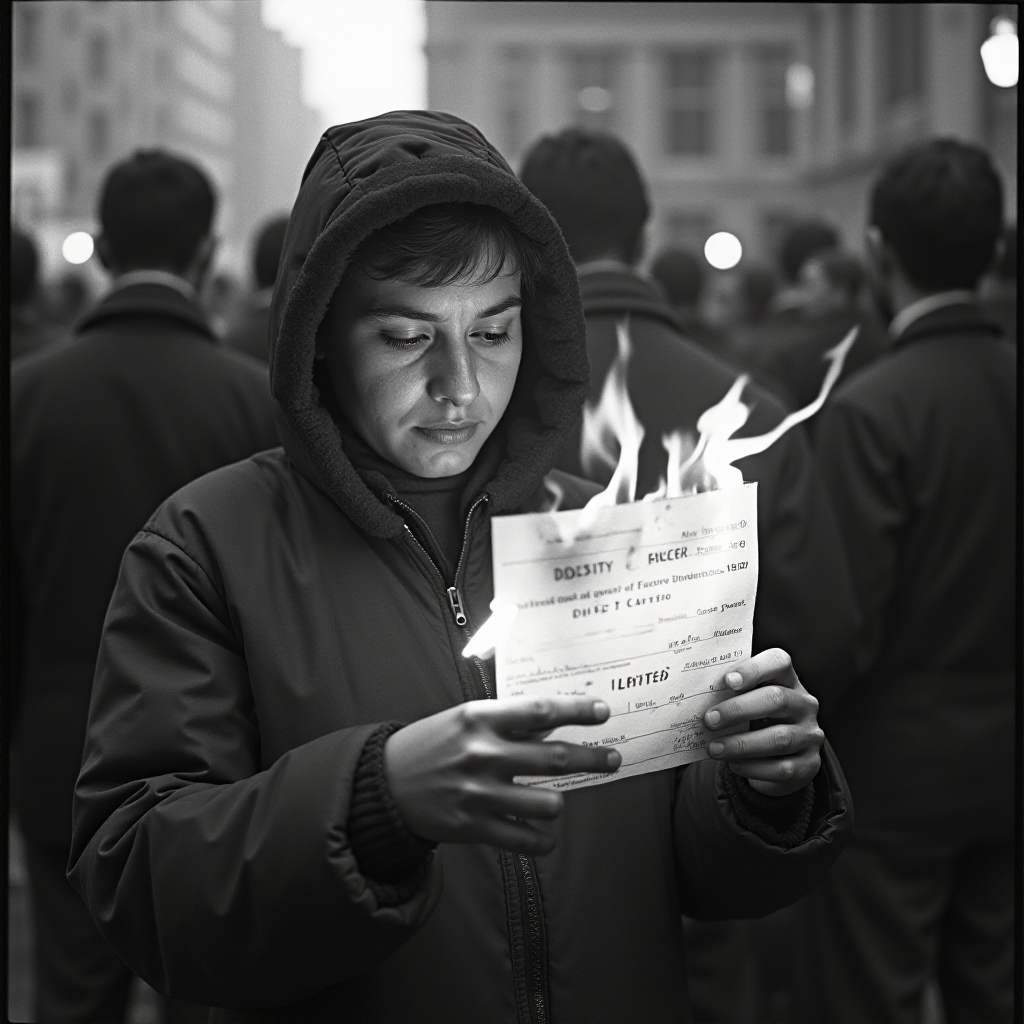
We burned draft cards in Ann Arbor and Detroit and Chicago and on the steps of buildings where men in suits made decisions about which eighteen year olds would go to Asia. The draft card burned at three hundred and eighty-five degrees Fahrenheit. That is the temperature of paper burning. That is the temperature of no. We said no with fire because the government only understands things it can see and fire is the most visible no in the world. The government sent us to war and we sent the war back in the form of a burning piece of paper and the paper said you do not own us and you do not own our bodies and you cannot make us kill people we do not hate.