 JOHN SINCLAIR
DEPARTMENT STORE
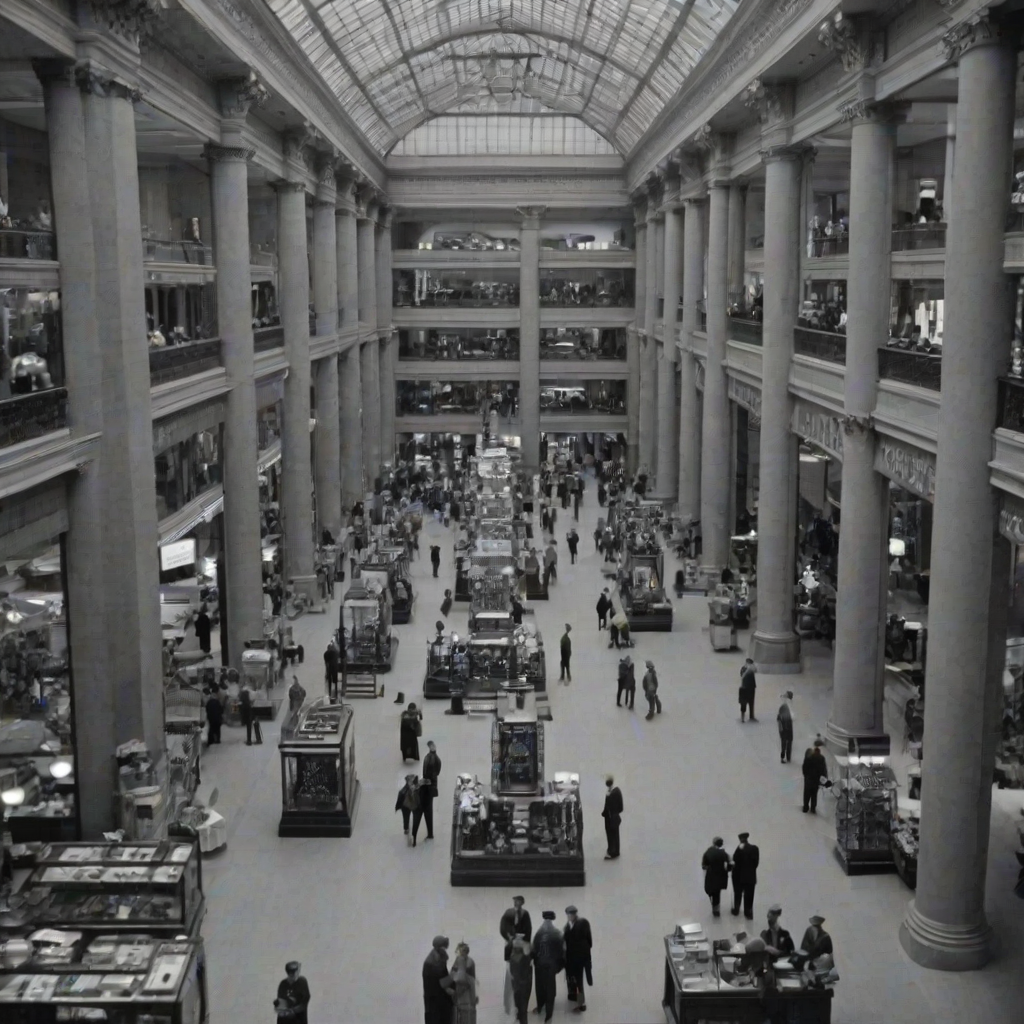
You walked through the revolving door and the revolving door was the invention that said you are entering a world that spins and the spinning was the commerce. The department store was the first building in America where looking was free and the looking being free was the revolution. Before the department store every purchase required a conversation. You walked into a shop and the shopkeeper asked what you wanted and you told the shopkeeper and the shopkeeper retrieved the item from behind the counter and named a price and the naming of a price was the negotiation and the negotiation was the barrier. The department store put the merchandise on the counter with a price tag and the price tag was the democracy because the price tag said the same price for everyone and the same price for everyone was the idea that changed retail forever.
Alexander Turney Stewart opened the Marble Palace on Broadway in New York in eighteen forty eight and the Marble Palace was the first department store in America. Stewart's idea was that a store could be a destination and the destination was the building itself. Marshall Field opened his store on State Street in Chicago in eighteen eighty one and Field's motto was give the lady what she wants and the giving the lady what she wants was the recognition that women controlled the household economy and the controlling of the household economy meant the department store was designed for women in a country where almost nothing else was. John Wanamaker opened his Grand Depot in Philadelphia in eighteen seventy six in an abandoned railroad station and Wanamaker put a money back guarantee on every item and the money back guarantee was the trust and the trust was the invention that made strangers comfortable spending money in a building they had never entered before. Wanamaker installed electric lights in eighteen seventy eight and the electric lights were the spectacle and the spectacle was the point because the department store was the first building that understood that shopping is entertainment.
The department store invented Christmas. Not the holiday but the holiday as an economic event. The department store window at Christmas was the theater and the theater was free. Macy's unveiled its first Christmas window display in eighteen seventy four and the unveiling drew crowds that blocked the sidewalk and the blocking of the sidewalk was the advertising. Marshall Field's windows in Chicago had mechanical figures that moved and the moving was the animation that predated cinema. The department store Santa Claus appeared in the eighteen nineties and the appearing was the commercialization that the churches protested and lost. The Thanksgiving Day parade was invented by department stores. Macy's first parade was in nineteen twenty four and the parade was the procession that led directly to the front door and the leading directly to the front door was the marketing genius that disguised commerce as civic celebration.
The department store was the town square moved indoors. The lunch counter on the mezzanine was where women met for lunch when there were almost no public places where women could eat alone. The restroom was the first public restroom available to women because the city had not thought to build any. The elevator operator called out the floors and the calling out of the floors was the navigation and the navigation said fourth floor housewares fifth floor furniture sixth floor restaurant and the saying of sixth floor restaurant meant the department store fed you and the feeding was the hospitality that kept you in the building for four hours spending money you had budgeted for one hour. The pneumatic tube carried your payment to the cashier and the cashier sent back your change through the tube and the sending of change through a tube was the technology and the technology was the wonder. The department store employed more women than any other business in America and the employing was the independence because the paycheck was the freedom and the freedom was that a woman who worked at Marshall Field's could buy her own hat with her own money and the buying of her own hat with her own money was the revolution that no one called a revolution.
The department store is vanishing because the mall killed the downtown store and then the internet killed the mall. Macy's has closed hundreds of stores. Sears filed for bankruptcy in two thousand and eighteen. J.C. Penney filed in two thousand and twenty. The buildings that remain are too large for any single tenant and the too large is the problem that no landlord can solve. The department store that was designed to make you feel like you were in a palace now makes you feel like you are in a museum of retail that closed ten years ago and forgot to lock the door. But the department store invented the idea that a building could contain everything and the containing of everything was the prototype for the mall which was the prototype for the internet which is the prototype for whatever comes next. The revolving door still turns in the buildings that remain. The price tag is still on the merchandise. The looking is still free. But nobody is looking because everybody is looking at their phone and the looking at the phone is the department store in your pocket and the department store in your pocket has no revolving door and no elevator operator and no window at Christmas and the no window at Christmas is the loss and the loss is that commerce without spectacle is just commerce and commerce without spectacle is not worth the walk downtown.