 JOHN SINCLAIR
COURTHOUSE
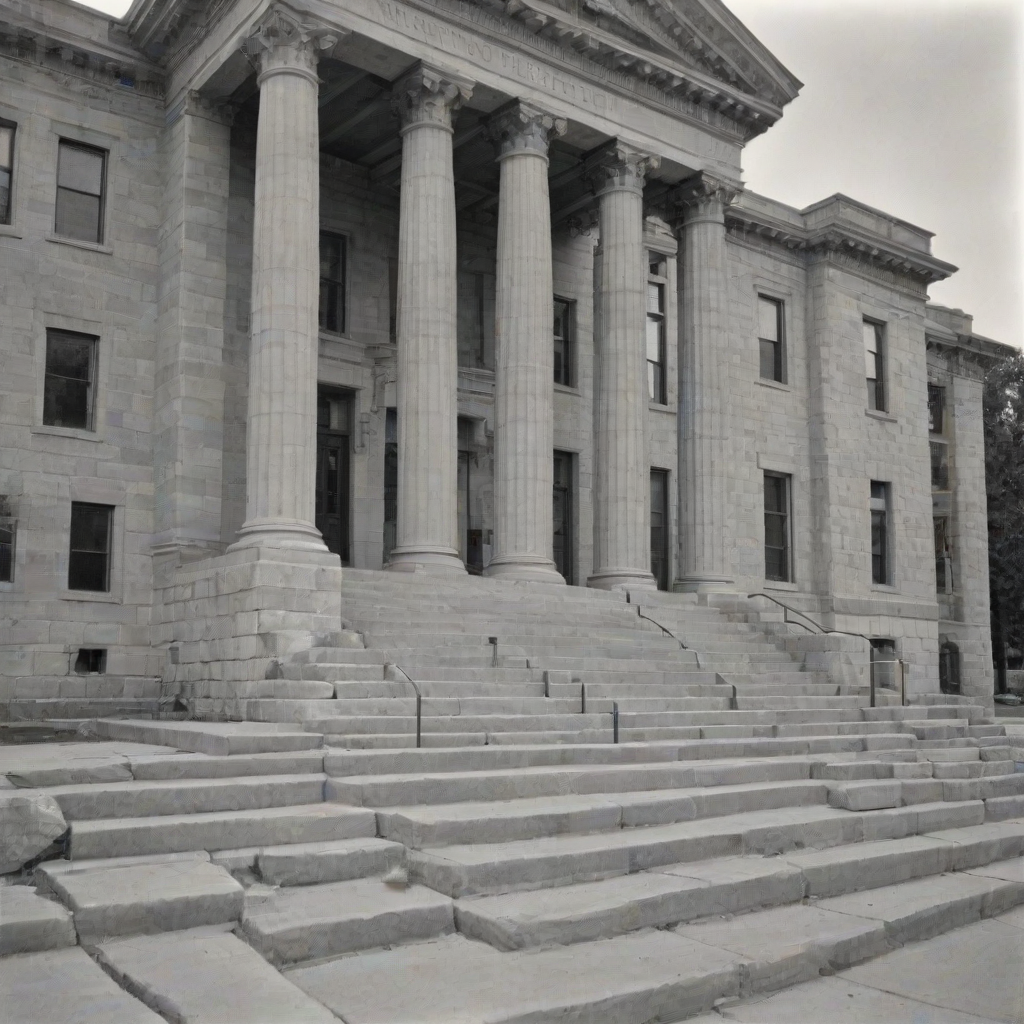
You walked up the steps and the steps were the point. The courthouse was the only building in your county that made you climb to get inside and the climbing was not an accident. The climbing was the architecture telling you that what happens inside is above the ordinary and the above the ordinary was the law. The courthouse had columns and the columns were Greek or Roman and the Greek or Roman was the claim that American justice descended from the ancients and the descending from the ancients was the legitimacy that a country younger than most European churches needed to borrow. The courthouse had a clock tower and the clock tower was visible from every street in town and the visibility from every street was the reminder that time in this county was kept by the law.
Thomas Jefferson designed the Virginia State Capitol in seventeen eighty five and modeled it on the Maison Carrée in Nîmes France and the modeling on a Roman temple was the first time an American public building said we are not building churches. We are building temples to the law. Every county courthouse built after Jefferson's capitol borrowed the columns and the pediment and the steps and the borrowing became the pattern and the pattern became so universal that by nineteen hundred you could not tell an Alabama courthouse from an Ohio courthouse from a Nebraska courthouse and the not being able to tell was the point. The sameness said the law is the same everywhere. The sameness was a lie in eighteen sixty and it was a lie in nineteen sixty but the building kept saying it anyway and the keeping saying it anyway was either the hypocrisy or the aspiration depending on which door you were allowed to enter.
The courtroom was the room where strangers decided your future. Twelve people sat in a box and the twelve people had been plucked from their ordinary lives that morning and told that today they would decide whether a man went to prison or went home and the deciding was the weight and the weight was the democracy. The jury trial is older than the Constitution. The Magna Carta guaranteed trial by jury in twelve fifteen and the guaranteeing meant that eight hundred years of human civilization has agreed on one thing which is that your fate should be decided by people who know nothing about you rather than by a king who knows everything. The judge sat higher than everyone else and the sitting higher was the elevation and the elevation was the authority. The witness sat in a box and swore to tell the truth and the swearing was the ritual and the ritual was that in this room and only in this room your words have consequences that can be measured in years.
The courthouse was the center of the county the way the train station was the center of the city. The courthouse had a square and the square had a lawn and the lawn had a cannon from a war or a statue of a soldier or a monument to the dead and the monument to the dead was the county's relationship with its own history standing in bronze on the grass. The courthouse square was where the farmers came on Saturday and the coming on Saturday was the market and the market was the economy of the county conducted in the shadow of the law. The county clerk's office had the deeds to every piece of land and the deeds were the records and the records were the proof that you owned what you said you owned. The clerk's office had the marriage licenses and the birth certificates and the death certificates and the having of all three meant the courthouse was the building that recorded every American from arrival to departure. You were born and the courthouse wrote it down. You married and the courthouse wrote it down. You died and the courthouse wrote it down and the writing down was the only immortality that the government offered.
The courthouse is not vanishing but the courthouse is emptying. The county seat that once had a courthouse surrounded by lawyers' offices and a hotel for people who came to town for trial now has a courthouse surrounded by vacant storefronts. The lawyers moved to the city. The hotel closed. The cannon is still on the lawn. The clock tower still keeps time. But the courtroom that once heard a case every day now hears a case every week and the every week is the quieting and the quieting is the rural county losing its population to the city and the losing means the courthouse that was built for ten thousand people now serves three thousand. The steps are still there. The columns are still there. The claim that American justice descends from the ancients is still carved in stone above the door. You still climb to get inside. The climbing still means what it meant when Jefferson drew the columns. What happens inside is above the ordinary. The law is still above you and the above you is still the promise and the promise is still carved in Latin that nobody in the county can read but everyone in the county believes.