 DAVID PEEL
Broadaxe
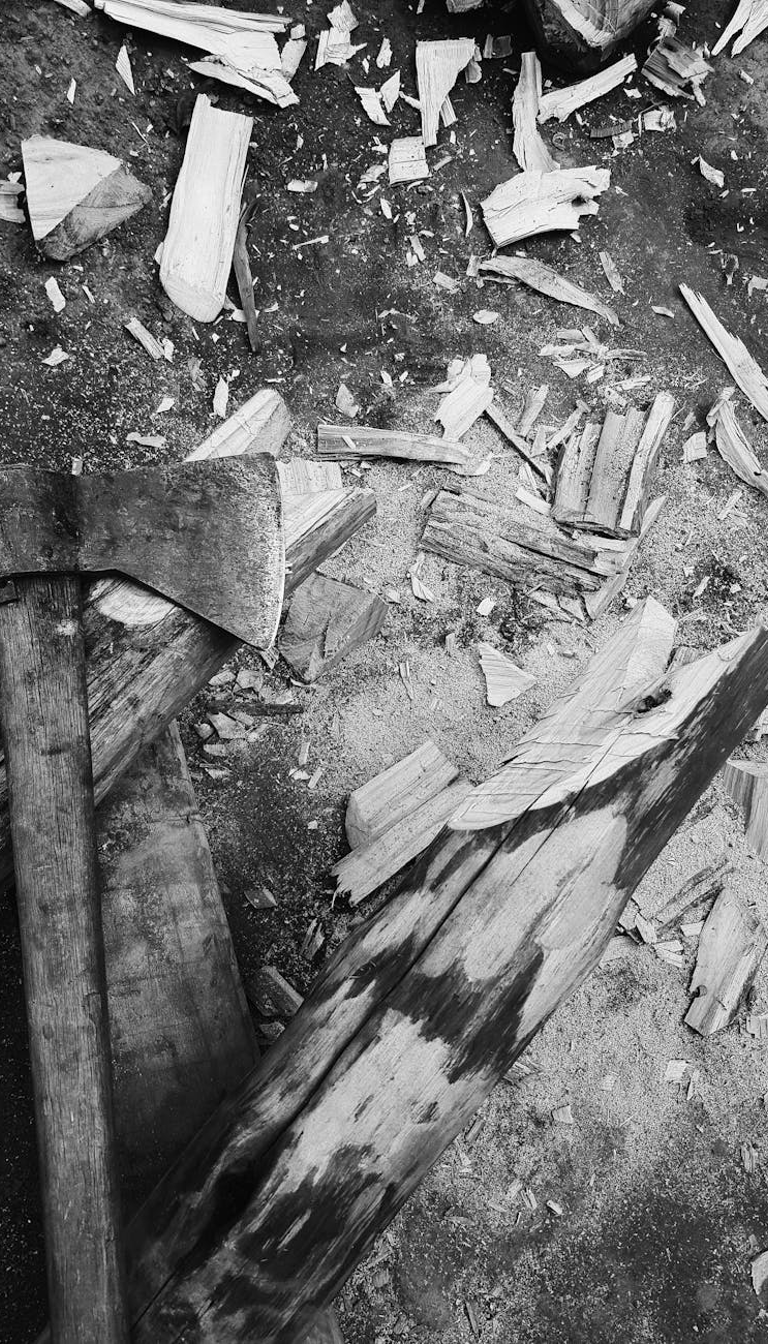
The broadaxe was a hewing axe with one flat face and one beveled face. The flat face rode against the log. The beveled face cut the waste away. You swung the broadaxe sideways into a scored log and the flat face followed the chalk line and the waste fell off in slabs. The broadaxe turned a round log into a square timber in an afternoon. Every barn in New England started with a man and a broadaxe standing over a log in a clearing.
The broadaxe was heavy. Eight to twelve pounds on a short handle. The handle was offset — curved away from the flat face so the knuckles did not drag on the timber. The offset was the difference between a broadaxe and a felling axe. The felling axe had a straight handle because the felling axe swung through the air. The broadaxe swung along a surface. The surface was the guide. The offset kept the hand safe from the guide.
The hewer scored the log first. A series of vertical cuts made with a felling axe every eight inches along the length. The cuts went to the chalk line. Then the hewer knocked the waste off between the cuts with the felling axe. Then the broadaxe came in and flattened the surface between the stumps. Score. Knock. Hew. Three steps. The broadaxe was the third step. The finishing step. The broadaxe did not do the rough work. The broadaxe did the precise work. The broadaxe was the editor not the author.
The hewn timber had a texture that sawn timber does not have. The broadaxe left facets — flat planes at slight angles to each other where the blade hit the wood at different strokes. The facets caught the light differently. The hewn beam in a barn glows because the facets scatter the light. The sawn beam absorbs the light because the saw leaves parallel scratches. The broadaxe was a sculptor. The sawmill was a machine. The sculptor made something the light wanted to touch.
Nobody hews timber. The sawmill cuts a timber in minutes. The broadaxe took hours. The sawmill produces a timber that is dimensionally consistent. The broadaxe produced a timber that was dimensionally close enough. Close enough was the standard for three hundred years. Close enough built every barn and every church and every bridge in colonial America. The sawmill replaced close enough with exact and the exact timber fits better and the exact timber is cheaper and the exact timber has no facets. The light does not want to touch the exact timber. The light passes over it. The broadaxe made timber that light remembered. The sawmill makes timber that light forgets.