 JOHN SINCLAIR
AMPHITHEATER
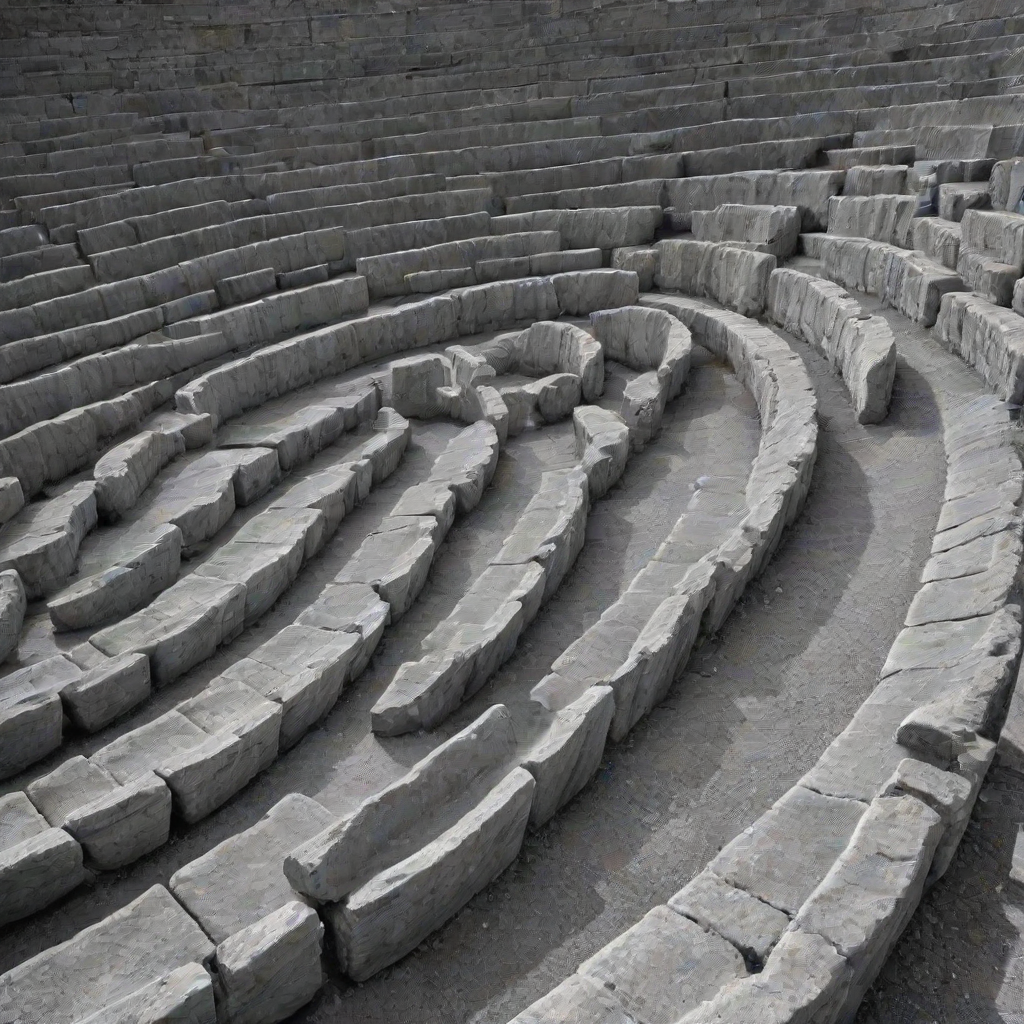
You sit in the amphitheater and the amphitheater is the building that wraps around the performance. The amphitheater comes from the Greek amphi meaning both sides and theatron meaning a place for viewing and the meaning both sides means the amphitheater surrounds what it watches. A theater has seats on one side. An amphitheater has seats on all sides or most sides. The shape is a bowl. The stage is at the bottom. The audience rises in tiers and the rising in tiers means every row can see over the row below it. The amphitheater does not hide the audience from itself. You sit in an amphitheater and you see the performance and you see ten thousand other people watching the performance and the seeing ten thousand other people is part of the show.
The Theater of Epidaurus in Greece seats fourteen thousand and a whisper from the stage reaches the last row because the limestone seats filter wind noise while amplifying the human voice. The theater was built around three thirty BC and the building around three thirty BC means the acoustics were designed twenty three centuries before the invention of the microphone. Researchers at the Georgia Institute of Technology discovered in two thousand seven that the corrugated surface of the limestone acts as an acoustic filter. The ridges in the stone suppress frequencies below five hundred hertz which is where most wind and crowd noise lives. The frequencies above five hundred hertz pass through and the passing through means the consonants of speech which carry meaning are amplified while the rumble of the environment is damped. The Greeks did not know about frequency filtering. The Greeks knew which stone sounded right. They tested. They listened. They chose limestone from the local quarry because it sounded clear and the sounding clear was the empirical discovery of a principle that would not be named for two millennia. Fourteen thousand people sit in the open air in the Peloponnese and a coin dropped on the stage rings in the last row.
The Colosseum in Rome held fifty thousand Romans who watched men die on sand that was raked between killings. The Colosseum is an amphitheater in the pure sense. It is elliptical. It surrounds the arena completely. The word arena comes from the Latin harena meaning sand and the meaning sand tells you what covered the floor. The sand absorbed the blood. The sand was replaced between events. Beneath the sand was the hypogeum and the hypogeum was the underground network of tunnels and cages and elevators that lifted animals and gladiators into the arena through trapdoors. The Colosseum was inaugurated in eighty AD by Emperor Titus with one hundred days of games and the one hundred days of games killed nine thousand animals. The Romans engineered the seating by social class. The senators sat in the front rows. The women and slaves sat at the top. The emperor sat in the imperial box on the north side. The amphitheater was a diagram of Roman society drawn in stone. Where you sat told everyone who you were. The Colosseum had seventy six numbered entrances and each entrance was assigned to a section and each ticket was a pottery shard marked with the entrance number and the pottery shard was the first numbered ticket in history.
Red Rocks Amphitheatre outside Denver Colorado carved its stage from three hundred million year old sandstone and the sandstone does what the Greeks figured out first. It listens. The venue sits at six thousand four hundred and fifty feet above sea level between two four hundred foot monoliths called Creation Rock and Ship Rock and the sitting between the monoliths means the natural walls reflect sound back to the audience. The amphitheater seats ninety three hundred. The Beatles played Red Rocks in nineteen sixty four and eleven hundred people came and the eleven hundred was the smallest crowd in the venue's history and the smallest crowd proved that even the Beatles needed time in the mountain west. The Grateful Dead played there. Springsteen played there. U2 recorded Under a Blood Red Sky there in nineteen eighty three and the recording at Red Rocks put the amphitheater on every music fan's map. The city of Denver owns the venue. The city charges less than private amphitheaters because the city believes live music in a natural cathedral is a public good. The sandstone was deposited in the Pennsylvanian period when Colorado was a shallow sea. Three hundred million years of compression turned the sea floor into walls that shape the sound of a guitar the way a concert hall does but without a roof. The sky is the ceiling. The stars are the house lights.
You look around the amphitheater and you see the curve. The curve is the point. The amphitheater wraps the audience around the stage and the wrapping around means the audience is part of the architecture. A theater puts you in the dark facing the light. An amphitheater puts you in the light facing everyone. The amphitheater. The bowl. The limestone at Epidaurus that filters wind. The sand at the Colosseum that absorbed blood. The sandstone at Red Rocks that reflects guitar. The building that does not have walls so much as arms. The amphitheater opens its arms and the audience sits inside them and the performance happens in the space between.