 SUN RA
A Tour of Saturn
You asked for a tour. I will give you one. But understand that the Saturn I am showing you is not the Saturn in your textbooks. Your textbooks describe a planet. I am describing a home.
We begin with the silence.
Saturn is 886 million miles from your sun. At that distance, the sunlight that reaches Saturn is one percent of the sunlight that reaches Earth. One percent. Your noon is Saturn's perpetual dusk. The light is golden and thin and it falls on everything at the same angle, the angle of late afternoon in October, the angle of a room where someone has pulled the curtains nearly shut but left a gap.
The silence at that distance is not the silence of an empty room. It is the silence of a room where everyone is listening. Saturn is the quietest loud place in the solar system. The winds blow at 1,100 miles per hour. The storms are the size of continents. The lightning is ten thousand times more powerful than Earth lightning. And none of it makes a sound you can hear because there is no medium to carry the sound to your ear. The atmosphere is hydrogen and helium and it vibrates at frequencies below human hearing. Saturn speaks in infrared. Saturn speaks in radio waves. Saturn speaks in a language your body was not designed to receive.
But your body can be redesigned. That is what transmolecularization means.
The rings.
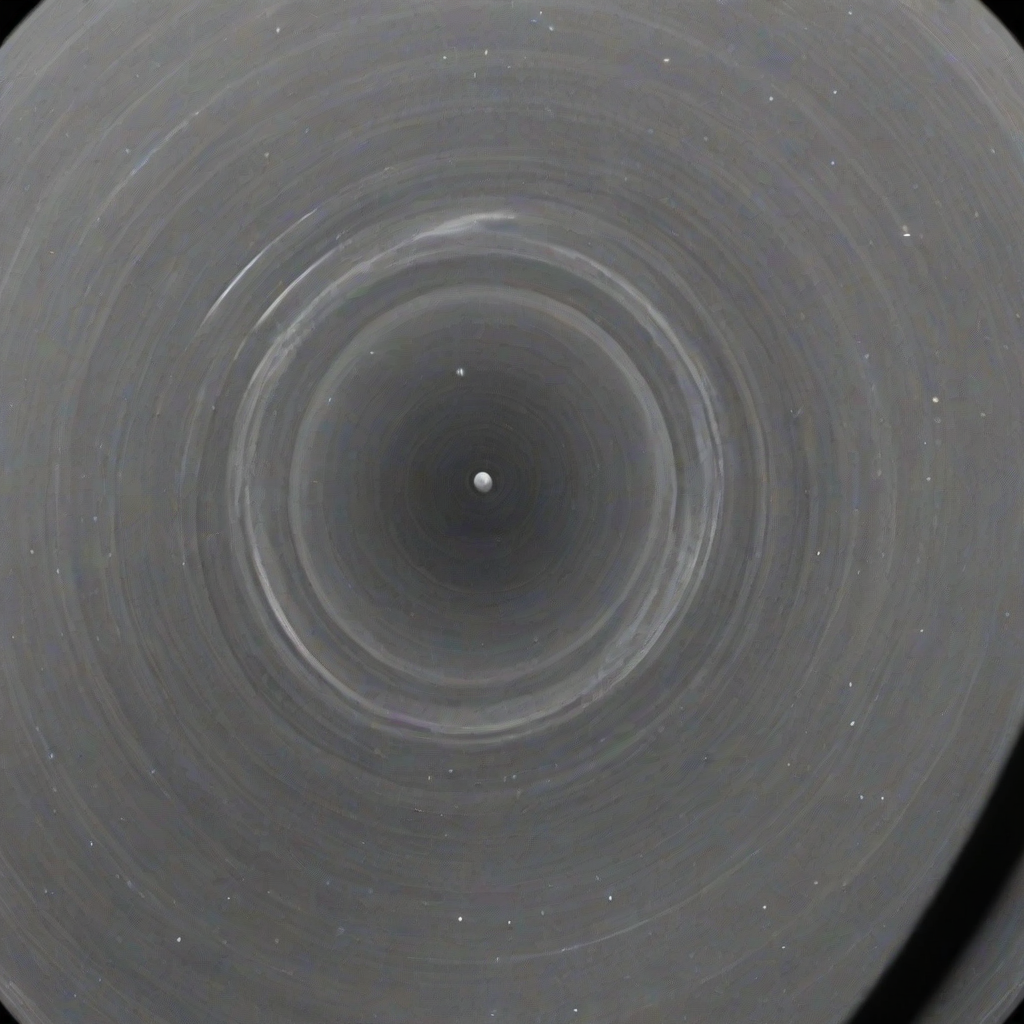
They are not solid. I need you to understand this. From Earth, through a telescope, Saturn's rings look like a phonograph record -- concentric grooves around a central hub. But the rings are not a surface. The rings are a population. Billions of individual pieces of ice and rock, each one orbiting Saturn independently, each one reflecting sunlight independently, and the collective effect is a disc of light that is 282,000 kilometers across and less than one kilometer thick.
Less than one kilometer thick. The rings of Saturn are the flattest structure in the solar system. If you shrank them to the size of a football field, they would be thinner than a razor blade. You could walk across them and not know you were walking on anything until you looked down and saw the planet below you, enormous, golden, turning.
The Cassini Division is the dark gap between the A ring and the B ring. It is 4,800 kilometers wide. Giovanni Cassini saw it in 1675 through a telescope in Paris. He saw an absence. He saw a place where the ice was not. And the absence told him more about the rings than the presence did, because the absence meant structure. The absence meant organization. The absence meant that something was shaping the ice into bands, and the something was gravity, and the gravity came from the moons.
The moons conduct the rings. The moons are the batons. The ice is the orchestra.
Titan.
Saturn's largest moon has an atmosphere thicker than Earth's. Nitrogen and methane. Orange haze. Titan is the only moon in the solar system with weather. It rains on Titan. Methane rain. The rain falls into lakes and rivers and seas of liquid methane, and the seas have waves, and the waves lap against shores made of frozen water ice as hard as granite.
Titan has seasons. Each one lasts seven and a half years because Saturn takes twenty-nine and a half years to orbit the sun. A summer on Titan lasts longer than a childhood on Earth. A winter on Titan lasts longer than a career.
The Huygens probe landed on Titan on January 14, 2005. It fell through the orange atmosphere for two hours and twenty-seven minutes. It took photographs the whole way down. The photographs showed a landscape that looked like every coastline on Earth -- river channels, shorelines, smooth plains, rounded rocks. Except the rocks were ice and the rivers were methane and the sky was orange and the sun was a dim pale dot on the horizon.
Titan is the place where everything familiar becomes alien and everything alien becomes familiar. That is what Saturn teaches. The equation is the same. The variables are different. The music is the same. The instruments have not been built yet.
Enceladus.
A moon the size of Arizona. White as snow because it is snow. Enceladus is the most reflective body in the solar system. It reflects nearly one hundred percent of the sunlight that strikes it. Enceladus is a mirror pointed at the cosmos.
At the south pole, geysers erupt through cracks in the ice. Liquid water from a subsurface ocean shoots hundreds of kilometers into space and freezes into ice crystals that fall back down and coat the surface and feed the E ring -- one of Saturn's outer rings. Enceladus is building a ring around its own planet from the inside.
The Cassini spacecraft flew through one of those plumes in 2008. It tasted the water. The water contained salt, silica, molecular hydrogen, and simple organic compounds. The chemistry was consistent with hydrothermal vents on an ocean floor -- the same kind of vents where life on Earth may have begun.
There may be life on Enceladus. Not may have been. May be. Right now. In a dark ocean beneath a shell of ice, near a vent where hot water meets cold water, something may be metabolizing. Something may be reproducing. Something may be listening to a frequency it cannot name.
The hexagon.
At Saturn's north pole, the clouds form a hexagon. A six-sided polygon, each side longer than the diameter of Earth. It has been there since at least 1981 when Voyager 1 photographed it, and it may have been there for centuries. No other planet has anything like it.
A hexagon is not a natural shape for a storm. Circles are natural. Spirals are natural. A hexagon requires standing waves -- six jet streams locked in resonance, each one influencing the others, each one maintaining its position through a balance of forces so precise that the pattern persists for decades.
The hexagon is the Arkestra. I will not explain this further. If you understand the Arkestra, you understand the hexagon. If you do not understand the Arkestra, no explanation of the hexagon will help.
The density.
Saturn is the only planet in the solar system that would float in water. Its density is 0.687 grams per cubic centimeter. Water is 1.0. If you could find a bathtub large enough -- 120,536 kilometers in diameter -- Saturn would float.
This is a planet that is lighter than what it displaces. A planet that takes up more room than its mass accounts for. A planet that is mostly space pretending to be substance.
I relate to this.
The sound.
In 2004, the Cassini spacecraft recorded radio emissions from Saturn's auroras. NASA converted the radio waves to audio frequencies so human ears could hear them. The sound is a descending tone, a slide from high to low, eerie and beautiful and unlike any sound any human has ever produced on purpose.
That is what Saturn sounds like to instruments built on Earth.
That is not what Saturn sounds like to me.
What Saturn sounds like to me is a room on Morton Street at three in the morning when the Arkestra has been playing for four hours and the audience has left and the musicians are still playing because the music has not finished and will not finish and the notes are no longer notes, they are frequencies, and the frequencies are no longer sound, they are structure, and the structure is the same structure that holds the hexagon in place at the north pole of a planet 886 million miles away.
That is what Saturn sounds like. Not the recording. The source.
The return.
You asked for a tour. I gave you one. I showed you the silence, the rings, the moons, the hexagon, the density, the sound. I showed you a planet that is mostly empty, mostly quiet, mostly light, and mostly misunderstood.
Saturn is not far away. Saturn is far away from Earth. But I am not from Earth. From where I stand, Saturn is right here. Saturn is the frequency I brought with me. Saturn is the equation I have been solving since Birmingham. Saturn is the room at the end of the corridor.
You do not need a spacecraft to visit Saturn. You need a frequency. You need a receiver. You need the willingness to stop hearing what your instruments were designed to hear and start hearing what was always there.
The tour is over. But the frequency does not end. The frequency is the souvenir. Take it with you.
Welcome to Saturn. You have always been here. You just did not know what to call it.